

Mobile Lethality
The Indian Army has been looking to buy Armoured Personnel Carriers (APCs) and Infantry Combat Vehicles (ICVs). The purpose of these vehicles is to provide direct fire support. The difference between APCs and ICVs is that the former is designed to transport troops and is generally for self-defence rather than for offence. The personnel travelling inside the vehicle may carry personal arms, however, the vehicle itself is fitted only with light support weapons.
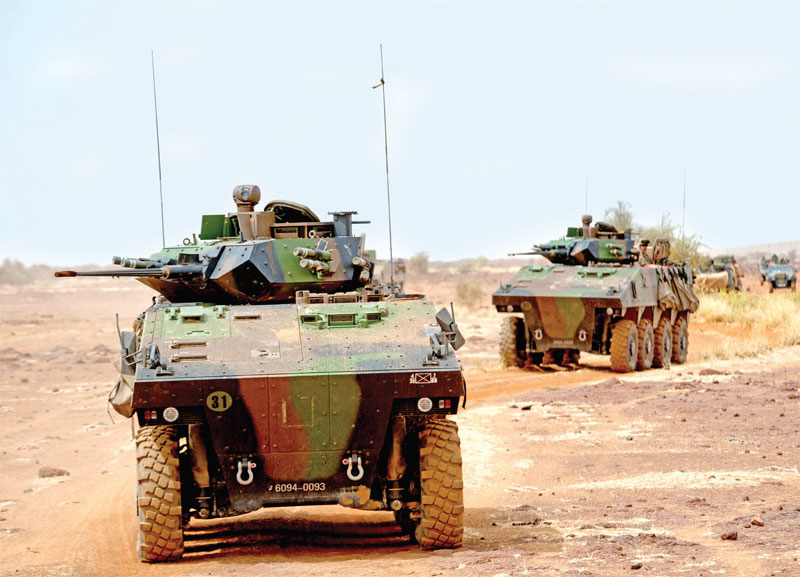
VBCI Mali
ICVs, on the other hand, are designed for attack and have fire support such as machine guns, auto-cannons, small-bore direct fire artillery, anti-tank guided missiles and gun ports fitted atop. Both these vehicles can be tracked or wheeled in order to provide mobility in varying terrains. After the standoff with the People’s Liberation Army (PLA) in Ladakh, the Indian Army signed a number of contracts with Indian companies for the induction of heavy armoured protection vehicles for secure mobility of soldiers deployed in inhospitable terrains. Indian companies such as Bharat Forge, Mahindra and the Tata Group were at the forefront of bagging these contacts.
The Hyderabad-based Midhani, a defence public sector undertaking, will supply armoured vehicles to the J&K Police. The Times of India reported the Midhani chairman and managing director S K Jha as saying that the upgraded armoured vehicles will meet the latest international security standards. Midhani will manufacture at least 60 such vehicles for the J&K Police. The Central Reserve Police Force inducted the heavily-armoured Mine Protected Vehicles (MPVs) ‘Renault Sherpa’ as well as the Mahindra Marksman in Jammu and Kashmir.
Ongoing Programmes
The Indian Army is in the process of procuring assorted vehicles from different Indian companies after the ministry of defence (MoD) in May 2022 floated a Request for Information (RFI) to purchase 500 Protected Mobility Vehicle (PMV), also called ‘high-mobility vehicles’ for high-altitude areas (above 4,000 metres), deserts and plains.
The RFI stated that the vehicles should be wheeled, have a 4x4 drive mode and should have automatic transmission. The personnel carrying capacity should be 10, excluding the driver and co-driver, with each personnel carrying a load of up to 30 kg. The requirement further stated that the vehicle must have ballistic protection to safeguard the vehicle from grenade and mine blasts. It should have a maximum speed of 90 km on road and 40 km per hour on cross country terrain.
The vehicles should also be able to operate in temperature ranges of 40 degree Celsius to minus 15 degree in high-altitude areas. The vehicle will be fitted with a 7.62 mm LMG and a turret with 360-degree rotation for the LMG. It is also required to have 11 firing ports, five each on both sides and one at the rear of the vehicle. Even as the RFI has not materialised, procurements continue based on the earlier orders that the ministry placed with the companies.
In addition, the army is looking for 800 indigenous Light Armoured Multipurpose Vehicles (LAMV). In an RFI issued in June this year, the army stated that these vehicles would be deployed with mechanised and armoured units. The vehicles are intended to be deployed in different terrain, including desert, plains and high altitude. They should be capable of issuing early warning and intelligence and also be adaptable to drones. In India, Tata Motors offers these vehicles. The company displayed the LAMV for the first time at DefExpo in 2014. The company describes the vehicle as an attack vehicle designed for patrol, convoy protection and light strike missions. These vehicles, as per the RFI, will be employed in high-altitude (up to 5,000 metres above mean-sea level), including in India’s northern borders in Eastern Ladakh and North Sikkim.
Subscribe To Force
Fuel Fearless Journalism with Your Yearly Subscription
SUBSCRIBE NOW
We don’t tell you how to do your job…
But we put the environment in which you do your job in perspective, so that when you step out you do so with the complete picture.





 VIDEO
VIDEO