India’s defence spending is dependent on the threat perceptions and imperatives of maintaining battle ready armed forces to meet all possible contingencies. The restraining factor is the state of the economy, its resilience and its long-term sustainability. Political decisions have to be made to divert scarce financial resources from areas which impact the common citizen. This is an onerous task. A realistic balance has to be maintained. Enhancing budgetary allocations is an imperative to cater to modernisation and for defence R&D to keep abreast with rapid advancement of technology, especially in the fields of aerospace, submarine, UAV, cyber and artificial intelligence. The high rate of obsolesce of weapon systems and their replacement makes this an imperative.
For the uninitiated in defence finances, the outlay of defence budget is under two major heads—revenue and capital. The capital expenditure is utilized for modernisation and procurement of arms, ammunition, weapons as well as for creation of defence infrastructure. Expenditure under the revenue head comprises military pay and allowances, including those of civil defence employees. High revenue expenditure leaves little for capital acquisitions.
Due to financial constraints, the yearly budget increments cater only for inflation. This suffices for revenue expenditure but is totally inadequate for capital expenditure where incremental change cannot be applied. There has been a quantum jump in technological advancement and the rate of obsolesce is high. Replacements are costly. Financial constraints preclude the defence forces from holding 100 per cent modern weapons and equipment at any given point of time. Even modern armies cannot achieve this. A realistic situation is having a mix of 50 per cent state of the art, 30 per cent obsolescent and 20 per cent obsolete (but under upgradation/replacement) systems.
A comparison of defence expenditure of India with its adversarial neighbours should indicate the pressing requirement for increase in defence spending. India’s defence expenditure of USD 70.2 billion is one third that of China’s USD 237 billion in the current financial year. It should not provide any consolation that Pakistan, on the verge of financial collapse, could allocate only USD 11.3 billion and is under increasing pressure to further cut down its defence budget by International Monetary Fund.
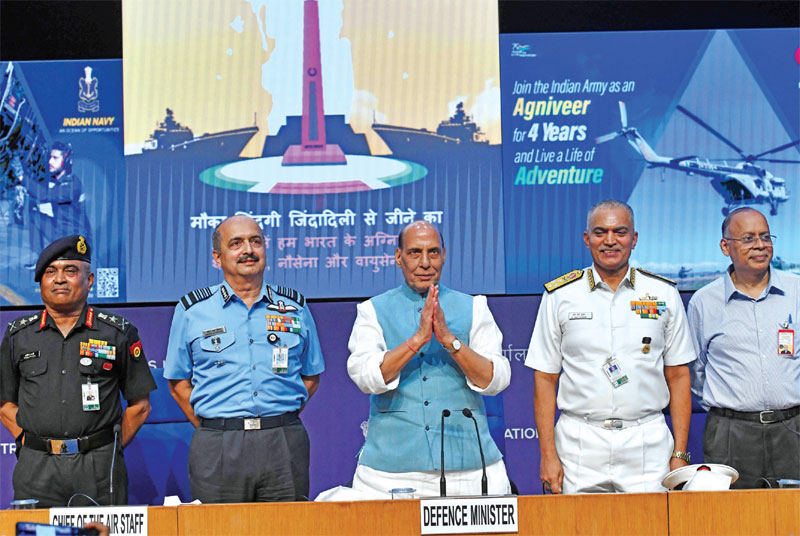
The Agnipath scheme may save money but compromises both national and personnel security
Resource Constraints
The ministry of defence (MoD) has been battling resource constraints for several years. In the last six years, the MoD’s annual shortfalls have consistently remained over Rs 100 billion, or approximately 17-23 per cent. The additional amount, provided in the new budget, is inadequate to meet the short falls of the preceding budgets.
This amount is around 13.33 per cent of total government expenditure and just 2.04 per cent of the estimated GDP. Capital expenditure, for modernisation, is not keeping pace with that of our adversaries. The gap with China is large and the chasm is growing wider. There is thus a requirement for a bigger hike in defence budget allocation, coupled with reduction in revenue expenditure.







 VIDEO
VIDEO