On 21 March 2020, as Indian government and other agencies including the security forces, were grappling with the rising numbers of Covid-19 infected people, the jungles of Dandakaranya sent the message that in the forests of central India, it was business as usual.
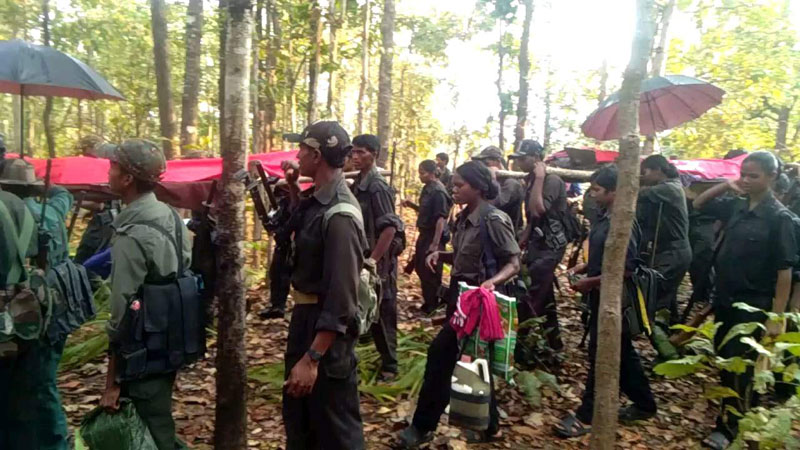
Courtesy Daily Chhattisgarh
The modus operandi was tried and tested. The Chhattisgarh police got the information that Communist Party of India-Maoist (CPI-M), often referred to as Left-Wing Extremists (LWE), were holding a large-scale meeting as part of their summer Tactical Counter Offensive Campaign (TCOC). TCOC is carried out every summer in the tribal villages abutting the forest. Something akin to area domination, TCOC is also used to recruit cadre and push the boundaries of their influence.
Hence, based on the intelligence input about a Maoist gathering in the general Chintagufa-Burkapal area of the Sukma district, the police party, comprising Chhattisgarh police’s Special Task Force, District Reserve Guards (a cross between better armed and trained Salwa Judum and the Ikhwanis of Kashmir) and Central Reserve Police Force’s (CRPF’s) commandos from Combat Battalion for Resolute Action (CoBRA) launched the operation.
The intelligence input was not accurate. The number of the Maoists was higher than anticipated, even though the police party had nearly 600 personnel among them. But in the forests, the initiative is always with the dweller, and in this case, it was with the Maoists. First, they created confusion among the security forces by triggering IED blasts. And before the forces could recoup from that, the gun battle commenced. At the end of which 17 of the police party were dead – five of the Special Task Force (STF) and 12 of the District Reserve Guards (DRGs). Once again, instead of surprising the Maoists, the security forces were surprised.
Though the state government insisted that a sizeable number of Maoists were killed in the operation, no dead bodies were retrieved. Subsequently, the Maoists issued a press statement, in which the group claimed that three of its fighters from battalion-1 of People’s Liberation Guerrilla Army (PLGA) were killed. It also issued photographs, one of which showed the equipment the extremists successfully snatched from the security forces. These included 11 AK-47 rifles, two INSAS rifles, one SLR LMG, two UBGLs, 1,550 bullets and six UBGL shells.
As is the drill, the state government ordered an enquiry into the incident. It is likely that the cause assigned for heavy casualties would be the failure in following the laid down standard operating procedures (SOP).
However, whatever else the enquiry finds, two factors are glaringly obvious. First, is intelligence. There is enormous dependence on human intelligence in these areas. And as has been evident in the past also, this source of intelligence remains dubious and sometimes misleading. Worse, intelligence leaks, whether deliberate or inadvertent, from among the security personnel compound the problem. In the past also, information about troop movement, including their weapons’ load, route etc has been shared casually among the personnel and through them inadvertently with the locals. The 2010 massacre of 76 CRPF personnel in Chintalnar area of Chhattisgarh was the horrible consequence of this – part of the patrol party had stopped at a roadside eatery, which is where the details of the patrol were compromised. It is well established that the Maoists’ enjoy local support, hence the information traffic is largely unidirectional.








 VIDEO
VIDEO