In an attempt to reverse the growing power differential with its arch-rival India, Pakistan has begun procuring up to 60 Chengdu J-10CE medium multi-role combat aircraft (M-MRCA) from China. The first tranche of these aircraft comprising 25 single-seat J-10CEs were ordered on June 25 last year, and deliveries commenced on March 4 this year. The first six aircraft arrived at Pakistan Air Force’s (PAF) Minhas air base at Kamra in Punjab’s Attock district, and were inducted by the PAF’s No. 15 ‘Cobras’ squadron on March 11.
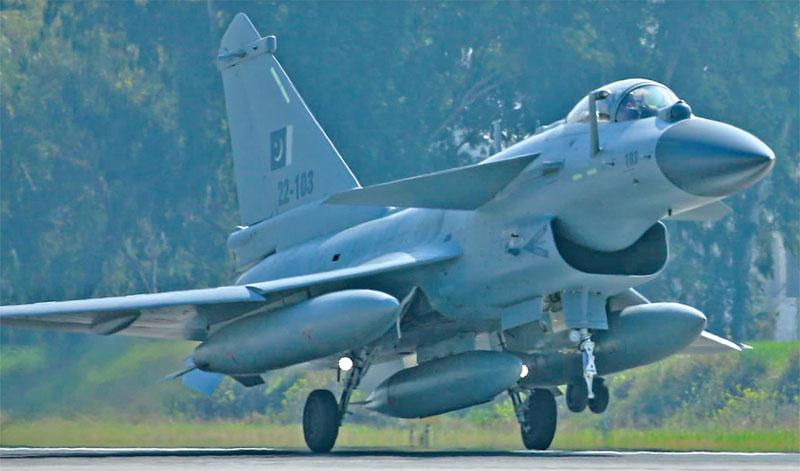
PAF J-10CE M-MRCA
No. 15 is a tactical attack squadron under 33 Wing of the PAF’s Northern Air Command. The J-10CEs will eventually replace the PAF’s existing Dassault Mirage-III/-V fleet. Interestingly, the J-10CE’s service-induction event occurred 54 years to the day since the first of the French delta-wing Mirage-IIIPs arrived In Pakistan. No. 15 squadron previously flew Mirage-IIIPs and Mirage-VPs from the Rafiqui air base (under 34 Wing of the Central Air Command) at Shorkot in Punjab’s Jhang district. This squadron began flight-testing for a 30-day period the J-10CE in November 2020 at the PLA Air Force’s (PLAAF) flight-test/evaluation and operational conversion air base at Dingxin. Essential design and performance parameters of the J-10CE include a length of 16.9 metres, wingspan of 9.8 metres, height of 5.7 metres, maximum indicated airspeed of 1,350kph or Mach 1.8, G-sustainment load of -3 G/+9 G, 300 metres/ second rate of climb, service ceiling of 56,000 feet, un-refuelled air combat radius of 1,240km, aerially refuelled combat radius of 2,600km, maximum ferry range of 2,950km, internal fuel capacity of 3,860kg, and weapons load of 5.5 tonnes on 11 external hard-points. For air superiority, the principal weapons carried are an internally-mounted clone of the Gryazev-Shipunov GSh-23 cannon, along with PL-15E beyond-visual-range air-to-air missile (BVRAAM) and PL-10E short-range air-to-air missile, or SRAAM (FORCE November 2021).
Unlike the PLAAF’s J-10C M-MRCAs that are powered by Russia’s NPO Saturn-built AL-31FN turbofans rated at 134kN thrust with after-burning, the PAF’s J-10CEs are powered by China-developed Shenyang-Liming WS-10B Taihang turbofan, rated at 89.17kN dry thrust and 132kN with afterburner and with a total technical service-life of only 700 hours of operation, due to Russia’s refusal to authorise China to re-export the AL-31FN. In addition, the PAF, unable to source a functional active electronically scanning multi-mode radar (AESA-MMR) from China, has selected the Grifo-E AESA-MMR from Italian company Leonardo’s SELEX-ES subsidiary for its J-10CEs—this also being the same AESA-MMR that is going on board the 50 Chengdu JF-17 Block-3 light-MRCAs that are now being delivered to the PAF after being licence-built by the Kamra-based Pakistan Aeronautical Complex (PAC). The Grifo-E is derived from SELEX-ES’ mechanically-scanned Grifo-7 MMR (already installed on the PAF’s upgraded Mirage-IIIPs and the JF-17 Block-1s and Block-2s) developed at the company’s Nerviano-based facility in Italy and is a gallium nitride (GaN), liquid-cooled, eight-channel receiver AESA-MMR. AESA technology involves a matrix of hundreds of tiny transmit-receive modules being used to ‘steer’ electronic beams, rather than the radar’s antenna physically moving to point a beam at a target. This means that the beam can be moved around extremely quickly, allowing the radar to perform multiple tasks simultaneously.








 VIDEO
VIDEO