

Making in India | September 2026
India does not need another Rafale deal, it needs a Rafale strategy
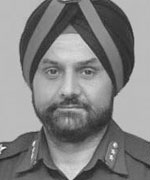 By Maj. Gen. Rambir Singh Mann, PhD
On 12 February 2026, India’s Defence Acquisition Council (DAC) accorded Acceptance of Necessity (AoN) for the procurement of additional Dassault Rafale fighters under the Multi-Role Fighter Aircraft (MRFA) programme, with the ministry of defence (MoD) stating explicitly that the majority of the aircraft would be manufactured in India. New Delhi subsequently issued a letter of request to France. In early August 2026, Indian media reported that Dassault Aviation had submitted its detailed technical and commercial proposal for 114 aircraft, with the programme widely estimated at roughly Rs 3.25 lakh crore. The figure and the contractual architecture remain provisional until negotiations are completed and the agreement is signed.
Told simply as a procurement story, this is India’s biggest-ever weapons purchase. It is the third and possibly decisive act in a 25-year conversation India has been having with itself about what kind of aerospace power it wants to be. The first has already produced one failure (the original 126-aircraft medium multi-role combat aircraft [MMRCA] competition) and the second, an operationally sound but industrially thin compromise (the 36-jet emergency buy of 2016). The current negotiation is being conducted in the shadow of Operation Sindoor, the four-day conflict with Pakistan in May 2025 in which the Indian Air Force (IAF) is alleged to have lost aircraft in combat. The 114-jet deal now must be about acquiring not just aircraft, or even factories, but the industrial, technological and systems-integration capability to build, upgrade and independently fight the aircraft that comes after Rafale. Operation Sindoor supplies the operational proof of why that matters.
MMRCA
India’s requirement for a modern medium multirole fighter dates to the turn of the century, as the IAF sought to arrest falling squadron strength. The 2007 MMRCA tender sought 126 aircraft: 18 fighters to be delivered in fly-away condition by the original equipment manufacturer (OEM) and 108 to be produced in India by Hindustan Aeronautics Limited (HAL) under licence. Six contenders including the Rafale, Eurofighter Typhoon, F-16IN, F/A-18E/F Super Hornet, MiG-35 and JAS-39 Gripen went through extensive technical and field evaluation. Commercial bids were opened in November 2011, and Dassault’s Rafale emerged as the lowest bidder in January 2012.
One point of popular memory needs correcting: MMRCA’s licence-manufacture structure, however ambitious, was never a transfer of design sovereignty. Government’s own subsequent characterisation was that the proposal provided for licence production, not the wholesale transfer of design authority over the aircraft. That distinction matters, because the deal that collapsed was already a compromise between buy and build, and not the maximal indigenisation model it is sometimes remembered as.
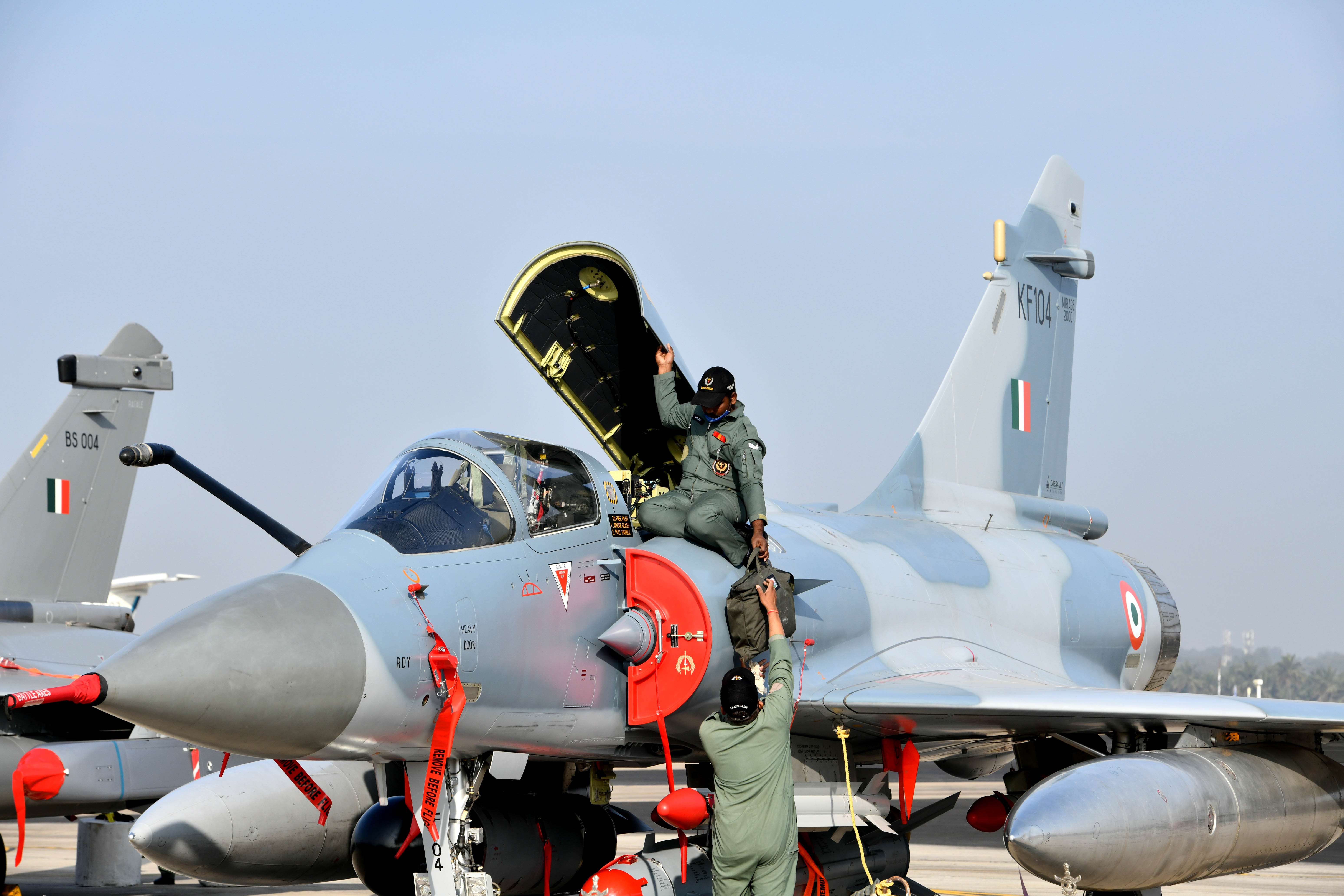
Rafale Aero India 2021President Emmanuel Macron looks on.
The negotiations collapsed, and the reasons exposed a structural weakness that still shapes Indian procurement. Dassault was expected to assume contractual responsibility for all 126 aircraft, including those produced by HAL, while retaining limited control over the Indian production line. HAL, for its part, reportedly assessed that Indian manufacture would require substantially more man-hours than French production, contributing to disagreements over cost, schedule, responsibility and guarantees. Disputes also persisted over the depth of technology transfer and the division of industrial responsibility. Negotiations dragged on from 2012 without resolution.
The deeper lesson is not simply that MMRCA fell victim to political delay. India tried to acquire production capability before it had resolved the prior questions of production responsibility, manufacturing productivity and where technological ownership would actually sit. The industrial model itself was not mature enough to bear the weight of the ambition.
The 36 Rafales
The government that took office in 2014 inherited both the stalled MMRCA talks and a worsening fighter shortage. On 10 April 2015, Prime Minister Narendra Modi announced in Paris that India would acquire 36 Rafales in fly-away condition through a government-to-government arrangement. The original 126-aircraft tender was subsequently withdrawn, and the Inter-Governmental Agreement was signed on 23 September 2016.
The package at roughly Rs 59,000 crore (Euros 7.8-7.9 billion) bundled in weapons, including Meteor beyond-visual-range missiles and SCALP stand-off strike weapons, simulators, training, India-specific enhancements, and performance-based logistics support promising high aircraft availability. Operationally, this was consequential: it gave the IAF a genuinely modern, combat-proven, AESA radar-equipped platform quickly, without the years a fresh competition would have consumed.
Industrially, the government was candid: there was no transfer of technology involved in the 36-aircraft procurement. A 50 per cent offset obligation was retained instead, on the premise that Dassault and its principal missile partner, MBDA, would channel value equivalent to half the contract back into Indian industry. Offsets generate economic activity such as contracts, jobs, revenue for Indian suppliers. Technology ownership generates strategic capability such as the ability to design, certify and independently evolve a weapons system. The two are not interchangeable, and India’s subsequent audit experience proved it.
Subscribe To Force
Fuel Fearless Journalism with Your Yearly Subscription
SUBSCRIBE NOW
We don’t tell you how to do your job…
But we put the environment in which you do your job in perspective, so that when you step out you do so with the complete picture.



 VIDEO
VIDEO