

Making in India
India does not need another Rafale deal, it needs a Rafale strategy
 By Maj. Gen. Rambir Singh Mann, PhD
On 12 February 2026, India’s Defence Acquisition Council (DAC) accorded Acceptance of Necessity for the procurement of additional Dassault Rafale fighters under the Multi-Role Fighter Aircraft (MRFA) programme, with the ministry of defence stating explicitly that the majority of the aircraft would be manufactured in India. New Delhi subsequently issued a letter of request to France. In early August 2026, Indian media reported that Dassault Aviation had submitted its detailed technical and commercial proposal for 114 aircraft, with the programme widely estimated at roughly Rs 3.25 lakh crore. The figure and the contractual architecture remain provisional until negotiations are completed and the agreement is signed.
Told simply as a procurement story, this is India’s biggest-ever weapons purchase. It is the third and possibly decisive act in a 25-year conversation India has been having with itself about what kind of aerospace power it wants to be. The first has already produced one failure (the original 126-aircraft MMRCA competition) and the second, an operationally sound but industrially thin compromise (the 36-jet emergency buy of 2016). The current negotiation is being conducted in the shadow of Operation Sindoor, the four-day conflict with Pakistan in May 2025 in which the Indian Air Force (IAF) is alleged to have lost aircraft in combat. The 114-jet deal now must be about acquiring not just aircraft, or even factories, but the industrial, technological and systems-integration capability to build, upgrade and independently fight the aircraft that comes after Rafale. Operation Sindoor supplies the operational proof of why that matters.
MMRCA
India’s requirement for a modern medium multirole fighter dates to the turn of the century, as the IAF sought to arrest falling squadron strength. The 2007 MMRCA tender sought 126 aircraft: 18 fighters to be delivered in fly-away condition by the original equipment manufacturer and 108 to be produced in India by Hindustan Aeronautics Limited (HAL) under licence. Six contenders including the Rafale, Eurofighter Typhoon, F-16IN, F/A-18E/F Super Hornet, MiG-35 and JAS-39 Gripen went through extensive technical and field evaluation. Commercial bids were opened in November 2011, and Dassault’s Rafale emerged as the lowest bidder in January 2012.
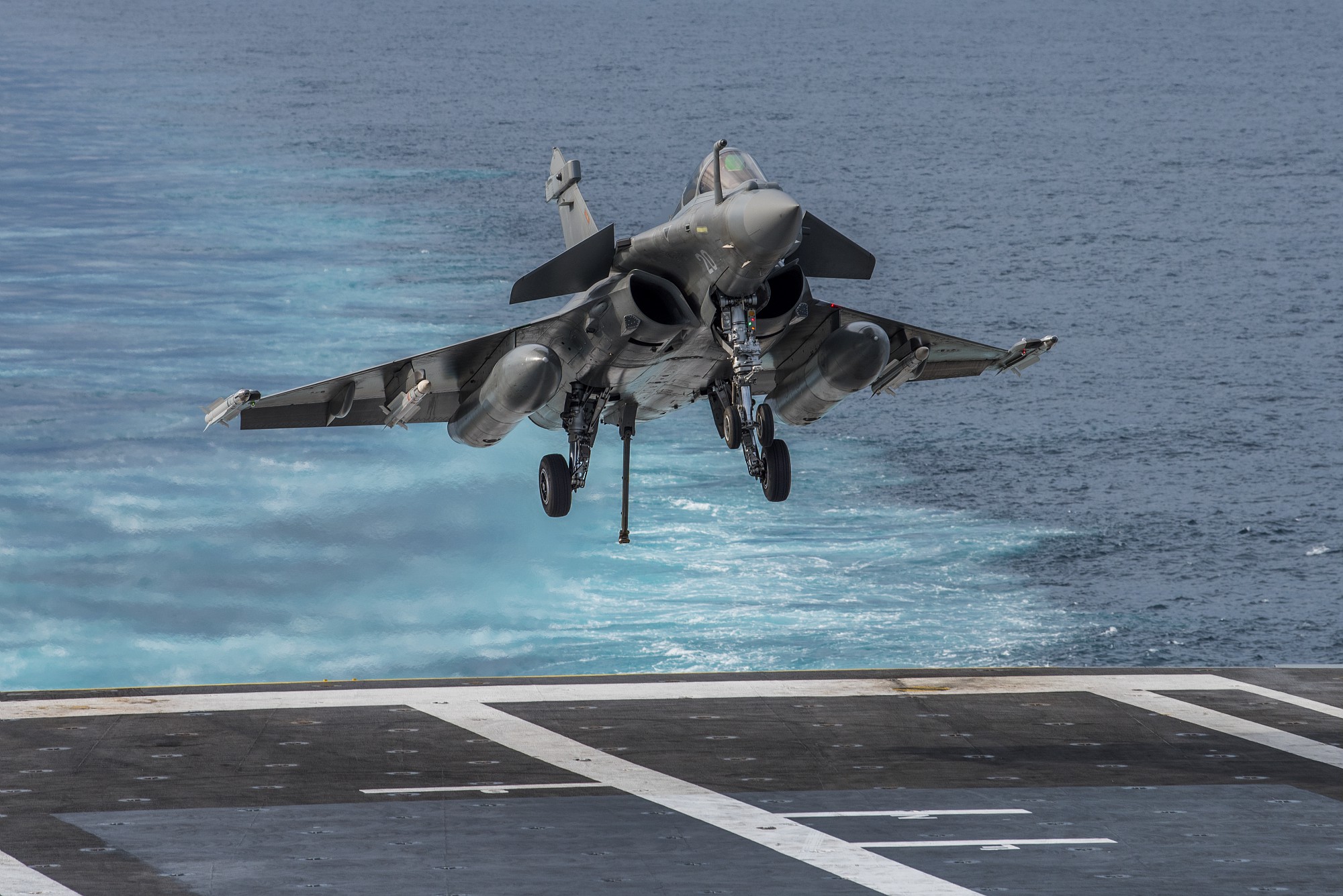
One point of popular memory needs correcting: MMRCA’s licence-manufacture structure, however ambitious, was never a transfer of design sovereignty. Government’s own subsequent characterisation was that the proposal provided for licence production, not the wholesale transfer of design authority over the aircraft. That distinction matters, because the deal that collapsed was already a compromise between buy and build, and not the maximal indigenisation model it is sometimes remembered as.
The negotiations collapsed, and the reasons exposed a structural weakness that still shapes Indian procurement. Dassault was expected to assume contractual responsibility for all 126 aircraft, including those produced by HAL, while retaining limited control over the Indian production line. HAL, for its part, reportedly assessed that Indian manufacture would require substantially more man-hours than French production, contributing to disagreements over cost, schedule, responsibility and guarantees. Disputes also persisted over the depth of technology transfer and the division of industrial responsibility. Negotiations dragged on from 2012 without resolution.
The deeper lesson is not simply that MMRCA fell victim to political delay. India tried to acquire production capability before it had resolved the prior questions of production responsibility, manufacturing productivity, and where technological ownership would actually sit. The industrial model itself was not mature enough to bear the weight of the ambition.
The 36 Rafales
The government that took office in 2014 inherited both the stalled MMRCA talks and a worsening fighter shortage. On 10 April 2015, Prime Minister Narendra Modi announced in Paris that India would acquire 36 Rafales in fly-away condition through a government-to-government arrangement. The original 126-aircraft tender was subsequently withdrawn, and the Inter-Governmental Agreement was signed on 23 September 2016.
The package at roughly Rs 59,000 crore (Euros 7.8-7.9 billion) bundled in weapons, including Meteor beyond-visual-range missiles and SCALP stand-off strike weapons, simulators, training, India-specific enhancements, and performance-based logistics support promising high aircraft availability. Operationally, this was consequential: it gave the IAF a genuinely modern, combat-proven, AESA radar-equipped platform quickly, without the years a fresh competition would have consumed.
Industrially, the government was candid: there was no transfer of technology involved in the 36-aircraft procurement. A 50 per cent offset obligation was retained instead, on the premise that Dassault and its principal missile partner, MBDA, would channel value equivalent to half the contract back into Indian industry. Offsets generate economic activity such as contracts, jobs, revenue for Indian suppliers. Technology ownership generates strategic capability such as the ability to design, certify and independently evolve a weapons system. The two are not interchangeable, and India’s subsequent audit experience proved it.
The Comptroller and Auditor General (CAG) later reported that Dassault Aviation and MBDA had initially proposed to discharge 30 per cent of their offset obligation by offering high technology to DRDO. DRDO had sought technical assistance connected with the Kaveri aero-engine programme, but that technology transfer had not materialised by the time of the 2020 audit. The CAG’s broader finding was more damaging: India’s offset policy had not proved reliable as a route to high-end technology acquisition. Defence Acquisition Procedure 2020 subsequently removed offset requirements from certain categories, including inter-governmental and government-to-government agreements and ab-initio single-vendor cases. The 2025 Rafale-Marine agreement was correspondingly structured around specific industrial and technology-transfer provisions rather than a generic offset obligation.
Rafale 3.0
The present proposal is arriving in an environment structurally different from the earlier procurements. An embryonic Rafale-linked industrial ecosystem in India already exists, reinforced by the 2025 naval deal and by separate Dassault-Tata and Safran investments. The precise contractual terms are not in the public domain. Media reporting has commonly described a model of roughly 18 fly-away aircraft and 96 produced in India, with indigenous content intended to rise progressively from an initial level of around 30 per cent toward 55-60 per cent as the production run matures. These figures should be treated as negotiating parameters rather than settled contract terms. The broad contours reported publicly are as follows:
Scale and Cost: 114 additional aircraft, on top of the existing 36 IAF Rafales and 26 naval Rafale-Ms, at a reported programme value of roughly Rs 3.25 lakh crore. If concluded on that scale, India would become one of the world’s largest Rafale operators.
Local Manufacture, Rising Over Time: A minority of aircraft would be delivered fly-away, with the substantial majority produced in India and indigenous content intended to rise progressively through the production run rather than remain fixed at a single figure.
F4-Standard Aircraft, With Scope for Later Evolution: India is widely reported to be seeking the Rafale F4 configuration, which is materially more network-centric than the F3R-standard baseline from which India’s current fleet was derived, with improved connectivity, sensors, electronic warfare and collaborative-combat functionality. Reports have also discussed upgrading the existing IAF fleet toward F4 and preserving an eventual path to the future F5 standard. Until the contract is signed, however, these should be described as reported negotiating objectives rather than guaranteed provisions.
Engine Localisation: Safran has publicly said it is prepared to establish M88 engine assembly in India as part of a larger Rafale programme and to source more parts from Indian suppliers. Separately, it has announced an M88 MRO facility in Hyderabad designed to handle more than 600 engine modules annually. Reports of 40-60 per cent M88 localisation remain industry/ media estimates and should not yet be treated as a contractual commitment.
A Potential Second Rafale Production Base: Public reporting points to a much deeper Indian manufacturing role than in the 2016 purchase. The strategic objective should be a genuine final-assembly and supplier ecosystem in India, capable, if commercially and contractually structured that way, of serving Dassault’s wider Rafale supply chain rather than becoming an India-only line that winds down after the domestic order is complete.
This is arguably the single most consequential industrial variable in the entire deal. A plant permanently wired into Dassault’s global supply chain creates an aerospace industry, with the order books, quality certifications and sustained engineering demand that implies.
Indian Ecosystem
What makes the current negotiation different from MMRCA is that India is not starting from an industrial blank sheet. In June 2025, Dassault and Tata Advanced Systems Limited (TASL) signed four Production Transfer Agreements to manufacture complete Rafale fuselage including the front section, centre fuselage, rear section and rear lateral shells at a new facility in Hyderabad. The production is intended from FY2028 at a targeted rate of up to two complete fuselages a month. Dassault has described this as the first time Rafale fuselages will be built outside France, and the output is explicitly meant to feed Dassault’s global Rafale supply chain.
This industrial foundation was reinforced by the April 2025 Rafale-Marine agreement for the navy’s 26 carrier-capable aircraft. The government explicitly stated that the agreement includes transfer of technology for integration of indigenous weapons in India, a Rafale fuselage production facility, and MRO facilities for aircraft engines, sensors and weapons. That is the beginning of exactly the kind of ecosystem the initial MMRCA proposal had promised but never delivered. Safran has since announced an M88 engine MRO operation in Hyderabad.
The opportunity before New Delhi now is to stop thinking of this as a Rafale ecosystem and start deliberately building it into an Indian combat-aerospace ecosystem. One whose engineers, suppliers, tooling and quality systems are not permanently tied to a single French airframe, but migrate into indigenous programmes as they mature. That reframing should be the organising idea behind whatever India negotiates next.
What 60% Indigenous Content Means
This is where most commentary on the deal stops short, and where a sharper analysis has to begin.
The wrong question to be asked is how much of the aircraft, by value, is manufactured in India. The better question is about which capabilities would India retain if Dassault vanished from the equation tomorrow. It is entirely possible to build 60 per cent of an aircraft’s value domestically through airframe panels, sub-assemblies, wiring, structural components, while remaining fully dependent for the decisive issues. These include software, the sensor architecture, the flight-control laws, the mission-system design authority. An aerospace nation needs to control several distinct technological layers, not one manufacturing-value percentage.
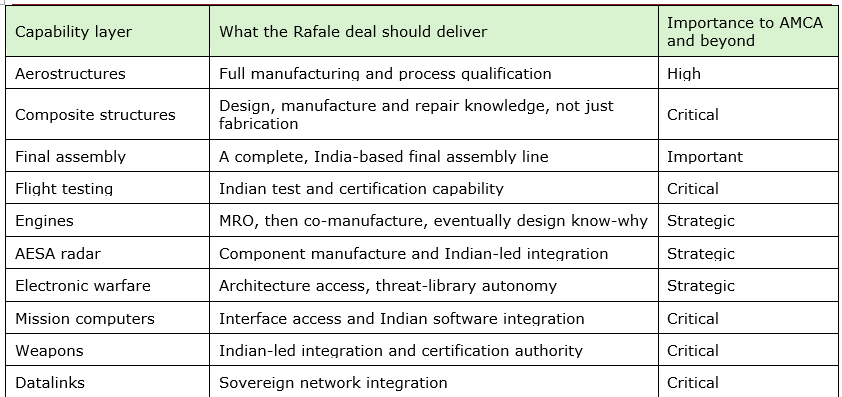

Of these, systems integration along with design authority—the ability to decide how a radar, jammer, missile and mission computer work together, is the most consequential.
On Source Code
India should not make transfer of the complete Rafale mission-system source code the sole test of sovereignty; that may be neither realistic nor necessary. It should instead negotiate the practical authorities that matter in wartime: Interface Control Documents; sufficient software and hardware interface access to integrate Indian systems without repeated recourse to Paris; Indian-led weapon-integration authority; sovereign mission-data and electronic-warfare threat-library generation; datalink integration authority; a defined software-upgrade pathway; and Indian test and certification facilities capable of validating these changes. A sovereign fleet does not require the ability to redesign the airframe from scratch. It does require freedom from overseas permission every time India wants to integrate an Astra, a Rudram, an indigenous jammer, a new sensor or, eventually, a home-grown collaborative combat aircraft.
Weapons Integration as a Testbed
India should seek integration rights for indigenous weapons as part of the broader deal. This is a provision that is already featured, in narrower form, in the 2025 Rafale-Marine agreement’s technology-transfer clause. Pursued seriously, this should extend progressively to the Astra Mk-1/Mk-2 family and its longer-range successors, the Rudram anti-radiation missile family, indigenous stand-off precision weapons and glide bombs, and eventually India’s emerging networked-weapons concepts.
The value here goes beyond import substitution. Every certification cycle India runs integrating an indigenous weapon onto a Rafale is testing methodology, telemetry and systems-engineering discipline that transfers almost directly into the Tejas Mk2 and AMCA weapons-integration programmes.
The Real Prize is Propulsion
If there is one capability India must extract from this procurement above all others, it is progress toward fighter-engine sovereignty. India can now design an increasingly credible fighter airframe; what it has never been able to do, across four decades of the Kaveri programme, is design and mature a modern high-thrust military turbofan on its own.
This should form part of the wider strategic conversation because Safran, which supplies the Rafale’s M88 engine, is also competing alongside Rolls-Royce for India’s separate next-generation fighter-engine programme associated with later AMCA variants and GTRE. Public reporting through 2026 has described unusually expansive offers on technology transfer, design participation and intellectual-property arrangements. Those claims need to be tested contractually, but the conjunction of the Rafale and AMCA-engine negotiations gives India leverage it did not possess a decade ago.
India should not let the M88 relationship and the AMCA-engine competition be treated as unconnected transactions. The Rafale ecosystem which presently includes engine MRO now should aim at deeper local M88 content later. It is a live opportunity to build Indian engineering experience. This should include high-pressure compressors, turbine aerodynamics, single-crystal blades, thermal-barrier coatings, combustor design, FADEC control systems, engine-health monitoring, hot-section metallurgy and the manufacturing tolerances that make a jet engine survive thousands of flight hours. It must be noted that manufacturing or even locally assembling the M88 is not the same as learning to design the engine that follows it. India needs to acquire know-why, not merely know-how.
Rafale-To-AMCA Bridge
The Rafale procurement and AMCA should be designed as complementary industrial programmes and not competing claims on the same finite pool of engineers and budget. Here the government has already taken one useful structural step: in May 2025, it approved a new AMCA execution model allowing Indian private and public-sector companies to compete or form consortia for development, opening the programme beyond HAL alone.
That creates the possibility of three parallel but interlinked aerospace streams over the next decade: the HAL-anchored Tejas Mk1A/Mk2 line; a Rafale industrial ecosystem built around Tata, Dassault, Safran, Thales and MBDA together with a deepening base of Indian Tier-1/2/3 suppliers; and an AMCA ecosystem organised around the Aeronautical Development Agency (ADA) and a newly-opened industrial consortium. The task for policy is to ensure engineers, suppliers, manufacturing technologies and quality systems migrate between all three, otherwise India risks building two aerospace islands, one under French industrial control and one indigenous, that never actually talk to each other.
It is also worth being clear about the limits of the Rafale ecosystem. Rafale is an outstanding 4.5-generation aircraft but manufacturing it will not by itself teach India very-low-observable shaping, internal weapons-bay design, deeply embedded aperture integration, low-observable inlet and exhaust architecture, radar-absorbent structural design or full-spectrum signature management. These stealth-specific disciplines must remain indigenous AMCA competencies, developed through AMCA’s own design and test programme. What Rafale can help strengthen is the other half of fifth-generation capability: sensor fusion, network-centric warfare, high-end electronic warfare, complex mission computing, AESA-related industrial capability, weapons-integration methodology, digital engineering, flight-test discipline, high-reliability aerospace manufacturing, propulsion support and the management of a complex multi-tier supply chain. None of that is trivial.
Rafale After Sindoor
Operation Sindoor and the varying accounts of the air battle aside, what has emerged as critical is systems integration, battle-management performance, situational awareness, targeting data, electronic support and decision advantage. This has direct implications for what India should be negotiating into the 114-jet deal.
Modern air combat is increasingly kill-chain versus kill-chain, not aircraft versus aircraft.
Sindoor changes what India should demand.
Before Op Sindoor, India could have negotiated the Rafale deal around aircraft numbers, price, delivery schedule, weapons fit and manufacturing share. Now survivability within a contested, networked battlespace has to be an explicit negotiating objective in its own right reinforcing, with combat evidence, the case for genuine sovereignty over interfaces and mission data rather than simply more capable hardware. That should translate into specific asks: further SPECTRA and broader electronic-warfare upgrades; the ability to generate and rapidly update India’s own threat libraries without OEM sign-off; improved passive detection and missile-approach warning; longer-range and more resistant Indian air-to-air weapons; secure, low-probability-of-intercept communications; deeper sensor fusion and off-board targeting; connectivity with India’s own AEW&C aircraft and, eventually, space-based sensors; and integration pathways for decoys and unmanned teammates.
This is also the strongest argument for insisting on the F4/F4+ configuration rather than settling for the earlier F3R-derived standard: F4’s network-centric architecture is precisely what a kill-chain-centric threat environment demands. This understanding is a far more actionable military lesson than a platform comparison. It is a lesson that no amount of additional hardware purchase can fix on its own. It requires better intelligence, better sensor fusion, and faster, more sovereign software and doctrine cycles. Precisely the software-defined, rapidly updatable combat ecosystem that a genuinely capability-focused Rafale deal, and its AMCA successor, should be built to deliver.
There is a wider strategic concern attached to this. Pakistan’s use of Chinese-origin aircraft, missiles and sensors in a real engagement against Western and Indian-operated platforms effectively hands Beijing a live combat laboratory against Rafale and comparable systems. Whatever tactics, seeker parameters, electronic-countermeasure techniques or datalink methods China refines as a result will not necessarily repeat identically in any future encounter. Beijing can update software, seekers, jamming techniques and doctrine faster than India can procure new airframes. The answer is therefore not to buy more hardware, but to have the ability to modify, update and independently evolve India’s combat systems at the same tempo an adversary can update its own. This is a software-and-systems-sovereignty problem before it is an airframe problem.
Rafale and the Coming 6th Generation
Sixth-generation air power is no longer simply a better aircraft. It is a combat cloud: a manned fighter operating alongside collaborative combat aircraft (loyal wingmen), satellites, airborne early warning, ground-based sensors, autonomous weapons and AI-assisted battle management, deciding and acting faster as a networked system than any single platform could alone. Rafale F4 is already moving in that direction through enhanced connectivity and collaborative-engagement features. The F5, still in development in France, is expected to push further toward integration with unmanned combat systems and France’s own future combat-air architecture. The most valuable thing India ultimately extracts from the Rafale relationship may turn out to be less about how to build a Rafale, and more about how to connect a Rafale and everything India builds after it, to everything else in the battlespace.
That has direct implications for AMCA, for India’s emerging collaborative-combat-aircraft and loyal-wingman concepts, for the Ghatak unmanned combat programme, for AEW&C and space-based ISR, for ground-based air defence, and for AI-enabled command networks. All of these depend on exactly the network-centric, software-defined disciplines a well-negotiated Rafale deal can help build.
This is where an almost simultaneous development becomes strategically important. Reporting on an August 2026 Parliamentary Standing Committee on Defence report indicates that the ministry of defence has initiated efforts to explore participation in a French-led future combat-air programme. The committee has sought a clearer roadmap and timeline for India’s sixth-generation fighter ambitions, alongside progress on AMCA. At this stage, however, Indian participation remains an exploratory policy effort, not an agreed international programme.
India should not be thinking in terms of a single contract, but a continuum: Rafale F4/F5 acquisition and localisation now, feeding into AMCA wherever the technology genuinely transfers, alongside next-generation propulsion development, moving toward collaborative combat aircraft, and potentially toward sixth-generation technologies through a French partnership now being actively explored at government level. This does not need a single mega-contract. But it should be one coherent national aerospace strategy, with the Rafale MRFA deal treated as its opening chapter rather than a standalone transaction.
The Danger That Must Not Be Waved Away
There is a key consideration that must remain central to the debate. A programme estimated at Rs 3.25 lakh crore would impose an extraordinary capital commitment. Defence budgets are not perfectly fungible, but opportunity costs are real: expenditure and institutional attention devoted to Rafale cannot be considered in isolation from Tejas Mk2, AMCA, an indigenous engine, AEW&C, unmanned combat aircraft, long-range weapons and sensor networks. The acquisition therefore makes strategic sense only if it functions as a bridge to Indian aerospace autonomy rather than as a substitute for indigenous programmes. That is a test of political discipline, industrial design and contract enforcement over the next decade, not a benefit that follows automatically from signing the deal.
Last Major Imported Fighter
India should not judge this agreement by how many aircraft arrive, how quickly squadron numbers recover, or even by what percentage of the airframe’s value is generated domestically. Its real measure will arrive roughly 20 years from now: whether Indian engineers can design the engine, integrate the sensors, write the mission software, manufacture the airframe, orchestrate unmanned teammates, and independently upgrade the combat aircraft that eventually succeeds the Rafale in Indian service.
Operation Sindoor has already supplied the operational argument for why this cannot simply be a hardware question. A kill-chain that out-thinks India’s own is not defeated by 114 more excellent airframes; it is defeated by sovereign sensors, sovereign software, sovereign weapons integration and a genuinely networked Indian air power system that can be updated on India’s own timeline. If Rs 3.25 lakh crore buys that—a bridge deliberately used to de-risk and accelerate AMCA, an indigenous engine, and the networked systems around them—the Rafale programme could mark a genuine turning point in Indian aerospace history. If it merely buys 114 excellent fighters, substantially assembled in India, it will remain, however formidable the aircraft and however impressive the assembly line, another import.
(The writer tracks India's defence-industrial policy and combat-air modernisation)






 VIDEO
VIDEO