

Make in India
The Kargil conflict of 1999 catalysed the need to modernise India’s defence procurement process, prompting a renewed emphasis on adopting advanced technologies and streamlining procurement procedures. The conflict exposed shortcomings in the country’s defence preparedness and has forced successive Indian governments under different political dispensations to attempt reforms towards a structured and transparent mechanism.
In 2002, the Indian government introduced the first formal document outlining defence procurement procedures: the Defence Procurement Procedure 2002 (DPP-2002). The DPP has subsequently seen multiple revisions leading to DPP-2005, DPP-2006, DPP-2008, DPP-2011, DPP-2013, DPP-2016, and DAP-2022.
Over the past 25 years, the requirements of the defence sector have become increasingly demanding, particularly in light of China’s military growth and assertiveness. The evolving geopolitical landscape, technological advancements and regional dynamics have driven the need for a more robust defence posture. India has little choice but to invest in modernising its armed forces, improving infrastructure and acquiring advanced defence technologies to address emerging security concerns.
The provision of defence and national security has to contend with two characteristics: the advanced technological and scientific content of the materials, services, products and components negotiated in contracts; and the increasingly non-market context within such contracts. Both characteristics compound and complicate many of the problems facing governments concerning policy alternatives, allocation of resources and the relationship with the private sector.
The unique complexities of the military industrial complex (MIC) in contrast to the larger manufacturing and service industries require an evaluation of the effectiveness of recent policy adjustments, such as the Strategic Partnership (SP) model using Project P-75I as a case study. Reforming the ministry of defence (MoD) and its related organisations is imperative for effectively managing complex defence industrial programmes and processes.
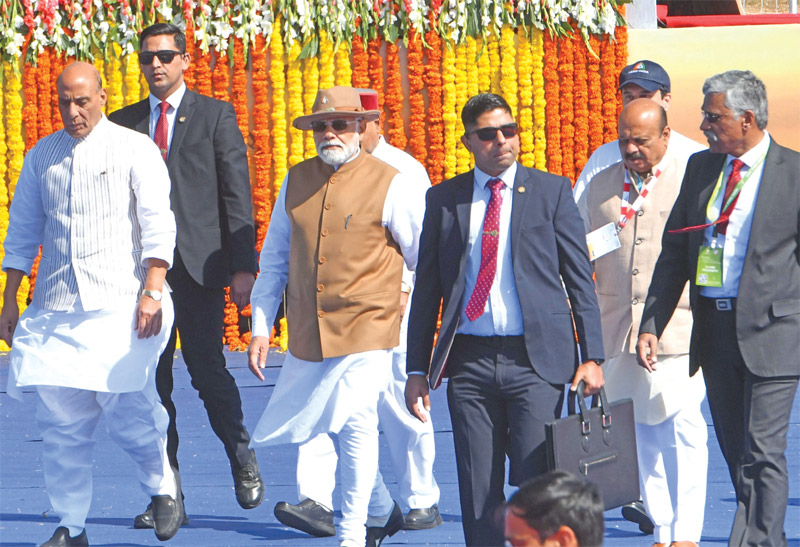
Defence procurements need more than Prime Minister Narendra Modi and defence minister Rajnath Singh’s oversight
Defence Acquisition System
In 2015, the Dhirendra Committee Report was submitted to the government that came into office in 2014 with its election manifesto identifying Make in India as a critical policy initiative. The report is subtitled ‘Facilitating Make in India in defence sector through defence procurement procedure’ (July 2015).
The committee suggested procedural additions and amendments to DPP 2013 when examining the issues with the DPP without delving into bureaucratic processes that have hamstrung defence procurement. It stays within rigid vertical hierarchical frameworks where the armed forces staff system (central to professional staff inputs in current arrangements) is placed under the political executive for oversight and approvals. The defence procurement system has an opacity regarding responsibility and accountability within these structures.
The report in Chapter I on ‘Defence Materiel’ states: ‘The political executive of various shades has also not built-up cadres of strategic thinkers to provide continuity. Internal social divisions and the structure of the Indian polity is such that there are continuous internal confrontations and only in time of crisis and war that everyone comes together, unfortunately, to relapse into business as usual once the crisis abates. Unless a consensus develops and an institutional framework is put in place, adequate military power will not be generated.’
In identifying certain lacunae within the Indian armed forces staff system from which defence materiel demands emanate, the report states: ‘There is a widespread belief that the Qualitative Requirements are gleaned from glossy brochures and that unrealistic parameters for defence equipment are formulated. We would like to dispel this notion and state that whereas primacy has to be accorded to policy makers in strategic planning taking into account domestic compulsions (including resource allocations) and international relations, sometimes translating into greater reliance on diplomatic efforts and defensive postures, the balance of advantage, however, needs to shift to the armed forces in the matter of the choice of the characteristics of defence systems and equipment based on user preference and tactical and operational doctrines. Modernisation is not merely induction of new types of equipment, but a mix of strategy and security perceptions and optimum use of hardware to achieve stated national objectives. The services should lead the initiative for modernisation.’
Subscribe To Force
Fuel Fearless Journalism with Your Yearly Subscription
SUBSCRIBE NOW
We don’t tell you how to do your job…
But we put the environment in which you do your job in perspective, so that when you step out you do so with the complete picture.



 VIDEO
VIDEO