

Look East, Act Fast
Volatility of the Northeast and the Challenges in 2026
 S.K. Sood
Since independence India has faced several challenges in Northeast India, especially several separatist insurgencies immediately after Independence. The region now stands divided into seven states.
Geographically, the entire Northeast is connected to mainland India through a narrow 22km ‘chicken’s neck’ near Siliguri. The region shares border with Myanmar and Bangladesh and that makes it extremely sensitive from security point of view. Both these countries have new governments after recent elections.
The unstable government in Myanmar over last few years has led to large-scale violence causing many affected innocent victims to seek refuge in India by crossing over from the 1,600km long border it shares with four of the seven Indian states: Arunachal Pradesh, Nagaland, Manipur and Mizoram. The presence of a large number of refugees is a drain on the limited resources of these states and may be a cause of conflict with the locals.
India also shares 4,096.6km long border with Bangladesh passing through four states of the Northeast—Assam, Meghalaya, Tripura and Mizoram—besides almost 2200 km border along West Bengal. Illegal migration from Bangladesh is a longstanding problem and the strategic community feels that many from the minority community may attempt to cross over to India because of widely reported violence against Hindus in Bangladesh.
The region faces several security challenges, both internal and external. The major challenges pertain to tackling conflicts due to ethnic diversity and demands of several insurgent and separatist groups ranging from demand for autonomy to separation. Internal challenges also include meeting the aspiration of citizens such as employment, education and quality of life. I discuss all these issues below.
Of the seven Northeastern states, the situation in Arunachal Pradesh, Meghalaya, Mizoram and Tripura can be said to be peaceful. The peace in Nagaland is tenuous while Manipur has been witnessing large-scale ethnic violence since 3 May 2023. While in case of Assam, though things appear peaceful, the fire of communalism is simmering.
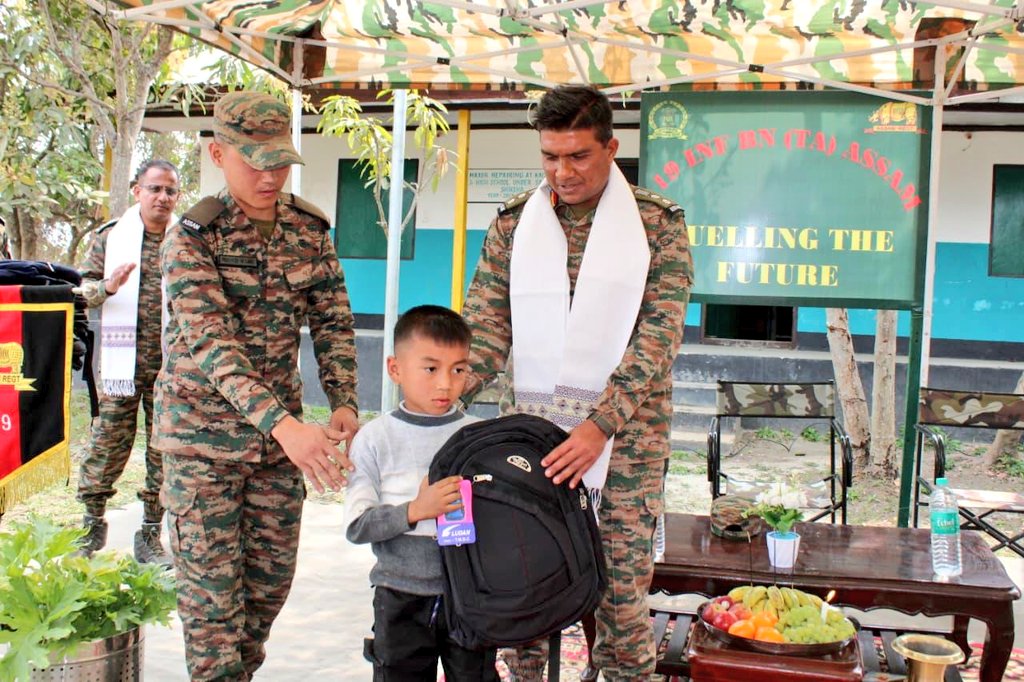
PEOPLE’S POLICY Territorial Battalion of Indian Army carried out a distribution drive at
Government Junior High School in Kachikul village of Manipur in February 2026.
Tripura: The state has been peaceful for over a decade after prolonged strife. The origin of the strife was due to a feeling among ethnic tribal inhabitants that they were being deprived of their land and other resources by the Bengali settlers. However, in October 2021, riots broke out following an attack on a mosque, besides clashes in Kadamtala market and Ranirbazar. These incidents have led to ongoing communal tensions and a source of concern for all. The challenge for the state government is to proactively prevent religious desecrations which lead to clashes, property damage, and arson.
Mizoram: The peace in Mizoram has come at a huge cost in terms of lives lost during the separatist insurgency in early years after Independence. Recent pronouncement by the central government to fence the entire border with Myanmar, suspending free movement regime (FMR) and directions to the state government to not treat people trying to take refuge as refugees has caused resentment among locals and in the government circles.
The Mizoram government and civil society groups, such as Mizo Zirlai Pawl (MZP) and Zo Reunification Organisation (ZORO) have strongly opposed these plans of the central government on the grounds of disruption of centuries old ethnic, cultural, and familial ties between Mizo communities on both sides of the border. The Mizoram government has vehemently opposed these directions to deprive shelter and amenities to over 30,000 people who have come in from Myanmar’s Chin state, displaced by the military coup in 2021. As recently as February 2026, the Mizoram cabinet has reiterated its opposition to the border fencing and FMR about which the Mizoram Assembly had passed a unanimous resolution in February 2024. The government of India needs to take a considered view in these matters lest trouble starts brewing again.
Subscribe To Force
Fuel Fearless Journalism with Your Yearly Subscription
SUBSCRIBE NOW
We don’t tell you how to do your job…
But we put the environment in which you do your job in perspective, so that when you step out you do so with the complete picture.
 VIDEO
VIDEO