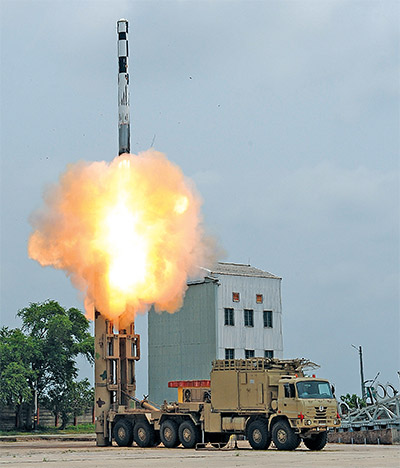
BRAHMOS land-attack cruise missile being launched
The otherwise robust Russian-Indian arms trade is currently facing testing times. While finalisation of large defence contracts by India (such as the deals for 48 Mi-17V-5 helicopters, five S-400 SAM system regiments, and four Project 11356 frigates agreed by the two governments in October 2015) has taken longer than usual, the difficulties have now been further compounded by the Countering America’s Adversaries Through Sanctions Act (CAATSA) bill, which came into effect in 2018. The bill, it is believed, has already slowed down Russian-Indian talks on S-400; even though CAATSA threat has now become somewhat less urgent because the US has put India on the list of strategic allies who can sign arms deals with Russia without risking American retaliation.
Against that backdrop, the Russian-Indian BRAHMOS supersonic cruise missile programme, launched 20 years ago, stands out as an exemplary partnership with mutual benefit and interest.
The Joint Venture (JV) programme has achieved major progress over the past few years. When it began in 1998, locally sourced Indian components accounted for only 10-12 per cent of the total cost of each BRAHMOS missile. By May 2018, the localisation level is as high as 65 per cent, and the figure is likely to rise to 75 per cent by the year’s end. Indian specialists have recently succeeded at substituting the Russian imports of aluminium alloys used in the F3 section of the missile’s body, which bears the greatest stress during flight. In 2017, India also conducted successful tests of the solid-fuel booster, which is one of the costliest parts of the missile still imported from Russia.








 VIDEO
VIDEO