The long-delayed modernisation of the Indian Army has been particular severe on the artillery, which is largely outdated and lacks precision fire capability, now in widespread use with other modern militaries. The use of precision artillery munitions are now de rigueur in modern warfare, offering improved fire support, greater lethality and reduced collateral damage.
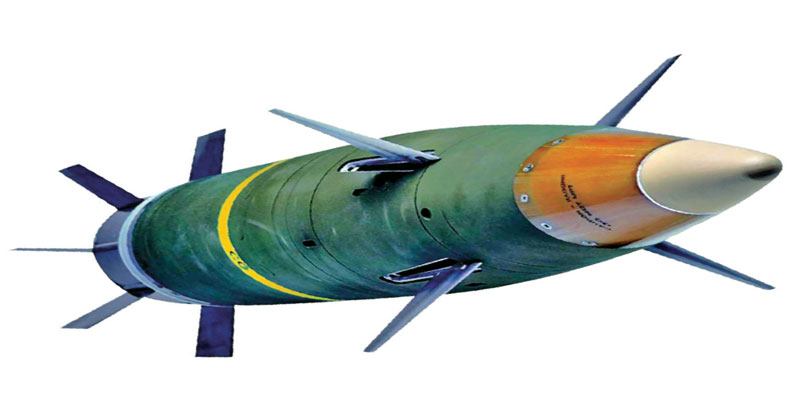
The Indian Army inducted US supplied Excalibur 155 mm, Global Positioning System (GPS) guided, extended range artillery projectiles in late 2019 for its M777 howitzers, providing a quantum leap in its artillery strike capability. Excalibur projectiles have provided the Indian artillery with true precision strike capability and the ability to strike targets at a radial miss distance of less than two meters. These munitions can also deliver accurate first-round effects at all ranges in all weather conditions. Efforts are also under-way to indigenously develop Terminally Guided Munitions (TGM) for the army.
Excalibur
The Excalibur is available in XM982, M982 and M982A1 variants and is the US Army’s next-generation cannon artillery precision munition. According to its manufacturer, Raytheon Missiles & Defence, it takes at least 10 conventional munitions to accomplish what one Excalibur weapon can. Due to the precision strike capability of such munitions, there is a drastic reduction in the time, cost and logistical burden as compared to conventional artillery munitions. Excalibur projectiles can be used to engage targets out to a maximum range of 39.3km, 39 calibre howitzers with Zone 5 Modular Artillery Charge System (MACS) and a minimum range of 8.7km with Zone 3 MACS. These shells can travel distances of more than 50 km when used with .52-caliber artillery.
Excalibur projectiles use a jam-resistant internal GPS receiver to update the inertial navigation system, providing precision in-flight guidance. This affords them with dramatically improved accuracy of less than two meters miss distance (regardless of range). The projectile is available with three fuse options (point-detonation, point-detonation delay and height-of-burst). The GPS guided projectile is fully qualified on artillery systems such as the M777, M109 series, M198, Archer and PzH2000 and is also compatible with the AS90, K9 and G6 howitzers.








 VIDEO
VIDEO