It is not an easy task to fight in the dark. Due to extremely low visibility on dark nights, night fighting capabilities require Night Vision Devices (NVDs) – both for personnel and vehicles.
The ability to see in low light conditions is termed as ‘night vision’. This is achieved by combining sufficient spectral and intensity range. Image intensification, active illumination, and thermal imaging are the main categories that ‘night vision’ can be classified into.
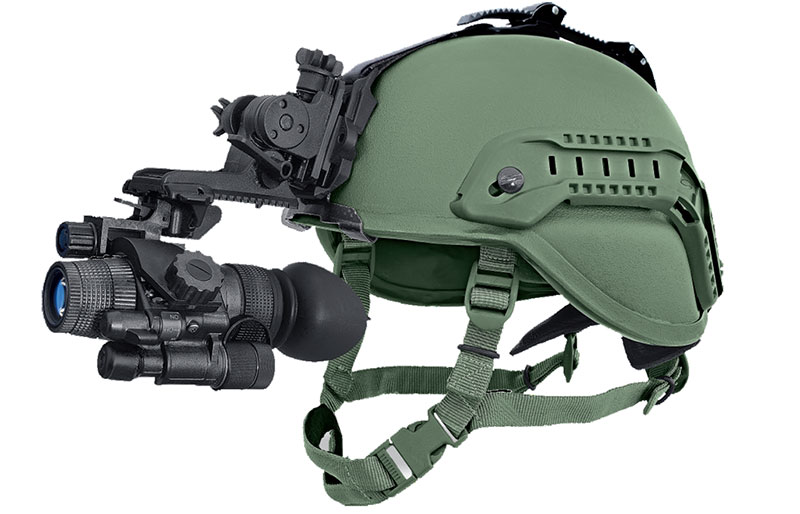
Helmet with NVD
Image Intensification
An article in ‘Photonics’ describes Image Intensification (II) as ‘the basis of night vision is a complex conversion of energy particles that occurs within a vacuum tube. An image-intensifier system works by collecting photons through an objective lens, converting them to electrons via a photocathode, increasing the electrical energy with a microchannel plate (MCP), converting the electrical energy back to light using a phosphor screen and presenting the image for viewing through an eyepiece lens.
‘A sophisticated miniaturised power supply is used to provide the voltage between the elements of the vacuum tube that allow for energy conversion and amplification. All of the elements within the vacuum tube are closely spaced to avoid electron scatter.
‘The main electron amplification occurs within the MCP, a thin disc that contains millions of closely spaced channels. As the electrons pass through the channels and strike the channel walls, thousands of additional electrons are released. When they strike the phosphor screen, the increased energy is reconverted into light thousands of times brighter than that which entered. The phosphor screen emits this light in the same pattern as the light collected by the objective lens, so the brightened, intensified image seen in the eyepiece corresponds to the scene being viewed (or not viewed) in the dark.’
The same article states that, ‘In the night vision world, the word generation (Gen) refers to major advancements in technology. The higher the generation, the more sophisticated the night vision technology. The generation gap is the change in technology that drives the change in nomenclature.
‘During World War II and the Korean War, the art of stealth warfare had taken hold, and formal sniper training had become a part of military manoeuvres. It was during these years that the image intensification progression began.
‘Early snipers used image converters (sniper scopes) that required an infrared light source to illuminate their target. Known as Gen 0, these image converters evolved from RCA’s image converter tube developed in the mid-Thirties for use in televisions. The Gen 0 image converter used an S-1 photocathode, an IR-sensor with a high-voltage electron acceleration electrostatic field and a phosphor screen. The S-1 cathode (AgOCs) did not have as much quantum efficiency as the cathodes used today, but it was able to provide images with the help of the IR illuminator.’








 VIDEO
VIDEO