In the third week of November, the Indian Navy’s Western Naval Command in consultation with Headquarters Integrated Defence Services (HQIDS) conducted a week-long tri-service exercise called Madad 2018 (November 17-23) off the coast of Goa and Karwar. A biennial exercise, Madad, was aimed at sharpening ‘joint war-fighting capabilities and enhance operational synergy’. Several naval assets, such as Kolkata class destroyers, landing ships, fleet support ship with ship-borne helicopters participated in the exercise, along with Indian Air Force’s C-17, C-130J, IL-76, AN-32.
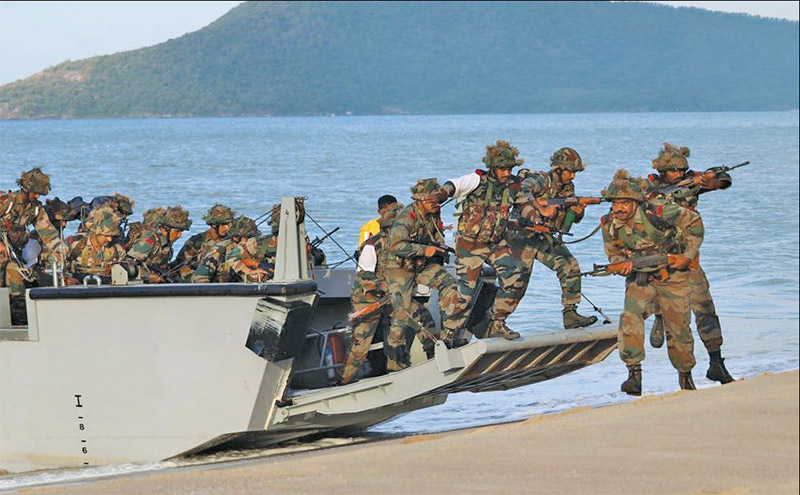
Troops from Army, Navy and Air Force participate in Exercise Madad 2018
In terms of human assets, while the navy had deployed its MARCOS, the IAF its Garuds, the army brought its Special Forces and engineers to the exercise which had a very strong amphibious component, including beach landing operations, air-landed operations, helicopter-borne insertion of Special Forces from sea and combat free fall by the tri-service Special Forces teams. The exercise culminated in tactical follow-on operations on land. By the book, exercise Madad was a comprehensive training tool for amphibious operations, but on the sea, Indian military’s amphibious capabilities are hamstrung by limited air and sealift assets.
With such exercises being held regularly, the level of coordination and synergy between the armed forces to carry out joint amphibious operations has improved. The tri-service command at Andaman and Nicobar islands plays a greater role in this arrangement. However, as reported by FORCE in June 2018, even the Andaman and Nicobar Command has not reached an adequate force level to be able to serve as more than just a deterrent against China in the Indian Ocean Region (IOR).
The most notable conflict where India’s amphibious capabilities were used was during the Indian Peace Keeping Operations in Sri Lanka between 1987 and 1990. The Indian Navy’s operation in Sri Lanka, code name Operation Pawan, saw the navy using its assets to transport and maintain the Indian Peace Keeping Force troops (IPKF). The Indian Navy was involved in the transfer of 200,000 men ferried in both direction, 100,000 tonnes of stores, and 8,000 vehicles. These operations also gave the world its first view of the Indian Navy’s Marine Commandos (MARCOS) (formerly the Indian Marine Special Forces), a Special Forces unit, created in 1987 for special maritime operations.





 VIDEO
VIDEO