The Indian Space Research Organisation (ISRO) is now going through a purple patch of successes and the latest was the highly significant milestone of the Chandrayaan-3 spacecraft, which made India the first nation to land a lunar spacecraft on the south pole of the moon. Chandrayaan-3’s landing site has since been given the name Shiv Shakti by Prime Minister Narendra Modi.
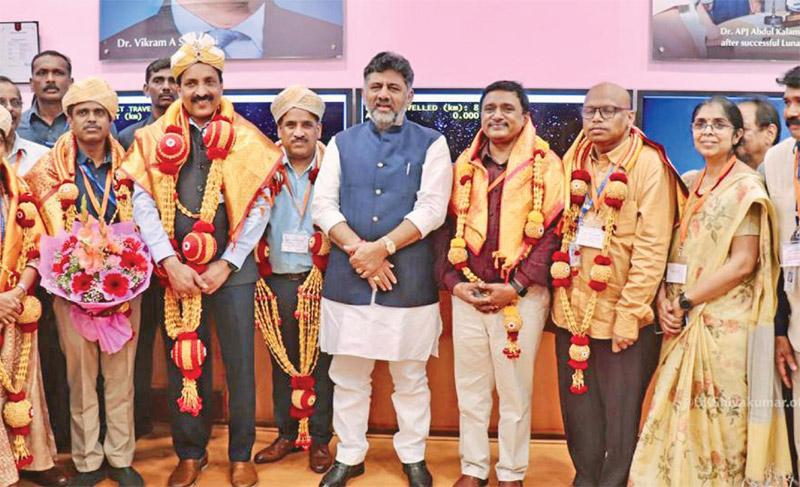
Deputy chief minister of Karnataka D.K. Shivakumar felicitating director, ISRO Dr S. Somnath and other scientists
The ISRO successfully launched the Chandrayaan-3 spacecraft into orbit on July 14 and the Vikram lander’s successful touchdown on the moon’s surface on August 23 made India the fourth country in the world to achieve such a significant technological capability. Following the landing the ISRO successfully deployed the Pragyan rover on the lunar surface. The lander and rover have a mission life of one lunar day, which is equal to 14 earth days.
Chandrayaan-3 is India’s third lunar exploration mission and was launched into space on the fourth operational mission of ISRO’s LVM3 launcher. The approved cost of the Chandrayaan-3 programme was Rs 250 crore, excluding the cost of the LVM3 launcher. The ISRO’s operational heavy lift LVM3 launch vehicle and has now completed six consecutive successful missions. The ISRO is now preparing for the Aditya L1 mission, which will be the first space based Indian effort to study the sun. The Aditya L1 spacecraft will be placed in a halo orbit around the Lagrange point 1 (L1) of the sun-earth system, which is about 1.5 million km from the earth.
Globally Competitive
The ISRO today is one of the world’s sixth largest space agencies. India is one of a handful of countries globally to have built extensive infrastructure needed to manufacture launchers, satellites, other space hardware and an extensive network of ground monitoring stations. India also has one of the largest fleets of communication satellites (INSAT) and remote sensing (IRS) satellites.








 VIDEO
VIDEO