

Leap Across Oceans
Ironically, for a service committed to 100 per cent ‘aatmanirbharta’ (self-reliance) over the next decade and half, Indian Navy is preparing for somebody else’s threat.
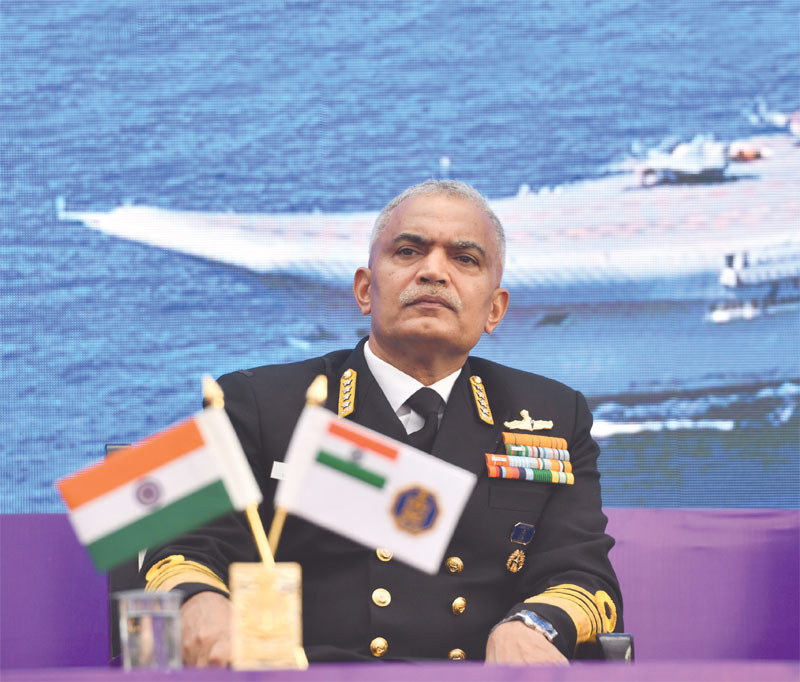
At his annual navy day press conference, the chief of naval staff (CNS) Admiral R. Hari Kumar spent a good part of his interaction with the media on emphasising how the service is committed to realising Prime Minister Narendra Modi’s vision of aatmanirbharta. However, when FORCE asked him, what was the Navy’s appreciation of the maritime threat in the Indo-Pacific for which the service is preparing through aatmanirbharta, he said, “In the Indo-Pacific, there are disputes. And these disputes have the possibility of going out of control or being elevated, they can go into conflict. This is one end of the spectrum. Then there are middle level challenges like illegal fishing, migration, piracy, armed robbery and drug-trafficking. On the benign side, you would find areas prone to disasters… (requiring) humanitarian assistance.” According to him, these challenges require a coordinated effort by all stakeholders because “no force, whatever be its size would be able to tackle them on its own.”
In another context, he mentioned that the Navy is cognisant of the fact that Pakistan Navy aspires to become a 50-ship force with the help of its all-weather friend China. Incidentally, this was the only mention of the ‘C’ word during the press conference. The CNS was careful about not bringing up China in any adversarial context, neither as a threat nor as a challenge. And the media was mostly sensitive to CNS’ caution. In fact, in response to a question on Chinese influence in the Maldives, Adm. Hari Kumar said, “China has legitimate reasons to be present in the Indian Ocean for economic reasons. But we need to keep a constant watch…”
This was in sharp contrast to a decade ago, when China and South China Sea used to dominate the annual navy day press conferences, forcing one navy chief to irritably remark that the South China Sea was not the area of responsibility for the Indian Navy, and hence its role was mostly benign in that region. But a lot has changed since the US discovered the Indian Navy.
Incidentally, India has no maritime dispute in the Indo-Pacific, which may escalate into ‘conflict’ with any of its adversaries. It does have disputes on land, with both its adversarial neighbours-Pakistan and China-which may escalate into ‘conflict’. But at the moment, the Navy’s focus is not on India’s future conflicts in which it may or may not play a role. The focus is on the new ocean construct-the Indo-Pacific, where the CNS said the Navy has maintained high operational tempo, undertaking missions and tasks encompassing military, diplomatic, constabulary and benign roles.
“Our units are mission deployed across the Indian Ocean Region and beyond to protect and promote our national interests,” he told the media in his opening remarks. “These extensive deployments, coupled with extremely large number of exercises at sea have enabled us to keep our platforms and people fighting fit, and also our plans and procedures, contemporary and relevant. As a result, navy has remained a combat ready and future-proof force. Our ships have persistently been present in the Indo-Pacific region, our submarines have done operational turnaround,” he added.
In real terms, the high tempo of operations in 2023 entailed 113 ship deployments in and around the Straits of Malacca and 42 in the Persian Gulf. Indian submarines achieved 1,140 days at sea, and naval aircraft clocked 15,000 flying hours traversing the distance from Australia to Oman. As far as the anti-piracy operations were concerned, the Navy has started undertaking them in the Gulf of Guinea on the western coast of Africa as well, in addition to the eastern coast. The Navy also participated in over 40 bilateral and multilateral exercises through the year, including the mother of all exercises, the Malabar series.
Subscribe To Force
Fuel Fearless Journalism with Your Yearly Subscription
SUBSCRIBE NOW
We don’t tell you how to do your job…
But we put the environment in which you do your job in perspective, so that when you step out you do so with the complete picture.



 VIDEO
VIDEO