

Keep them Flying
Helicopters are used in military as well civilian domains. Known for their ability to hover over surfaces while carrying out different duties, helicopters are first responders during crises. As all the three forces in India are on a spree to ramp up their infrastructure, helicopters have been some of the most important possessions made in recent times. The focus is also on building indigenous helicopters. In the military domain, helicopters play different roles such as search and rescue (SAR), attack, heli-borne operations, suppression of enemy air defence, battlefield air strike, transportation and logistics support, troops and casualty evacuation.
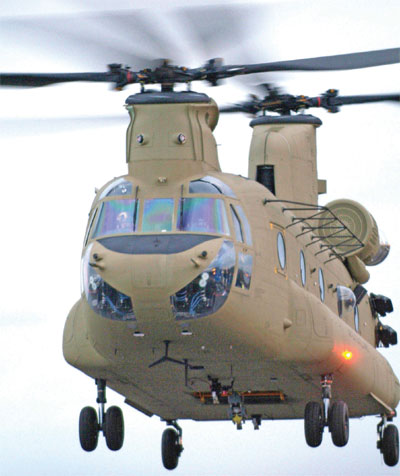 Helicopters have an edge over fixed-wing aircraft in inhospitable terrains. On the western and northern borders which have difficult terrains and harsh weather, helicopters prove to be of immense help to the troops for vigilance as well sustenance.
Air maintenance proves to be a lifeline of the troops stationed in the northern sectors including Siachen glacier and Sub-Sector North in Ladakh near Daulat Beg Oldie (DBO). Helicopters become the main source of mobility, as they fly to remote locations which have meagre infrastructure such as really small and matchbox-like helipads. Air maintenance is a routine every year and helicopters play prominent role in sustaining the troops throughout the harsh weather. Fixed wing aircraft bring logistics material to Leh and Thoise air force stations from Chandigarh, from where helicopters take it to forward bases. While the Indian Air Force (IAF) operates both fixed-wing aircraft as well as helicopters, the Army Aviation Corps (AAC), operates only helicopters. However, looking at the challenges that the army has to face, in 2012 the AAC was allowed to induct weaponised helicopters. Thus, the need to procure helicopters for the army and air force intersects.
An article published by IDSA and written by Group Captain Kishore Kumar Khera (retd) in May 2019, through the data extracted from the IISS Military Balance, points out that while the fixed-wing assets of the three arms of the Indian defence forces had remained nearly static, their rotary wing strength had grown by over 80 per cent. This article was published before the procurement of the Rafale jets. The data by IISS Military Balance states that among all aviation assets (fighters, training, wide bodied, unmanned and helicopters), in 1998, copters formed 23 per cent of the entire air fleet. However, today, they form 36 per cent of the fleet.
Currently, multiple types of soviet-origin aircraft form the backbone of the Indian armed forces; however, as these rotorcraft have started to age, the threes services are now on a lookout for new, modern copters. The helicopter fleet currently includes French, US and Indian-origin helicopters. The replacement of helicopters that have already become obsolete but are still operational with the forces is being undertaken. Number of programmes have been designed to procure helicopters for each service. The function of helicopters varies depending on their weight.
Utility Helicopters
Utility helicopters are used by all the three services. The copters currently operational under this category with the Army’s AAC and the IAF are ALH Dhruv, HAL Cheetah and HAL Chetak. The IAF also used Mi17 V5 copter.
It has been more than two decades now that the services are looking to replace the old HAL Chetak and HAL Cheetahs. Utility helicopters play number of roles, including attack, logistics supply, medical evacuation, command and control and transport among other roles. HAL Chetak and HAL Cheetahs were built under a license from the French-origin Eurocopter, now known as Air Bus Helicopters. While the Cheetah helicopters were first delivered by the HAL in 1976, the delivery of Chetaks dates to 1965. Given the machines’ age, the armed forces have repeatedly been warning against its continual usage. September and October 2020 were plush with reports of armed forces issuing a warning yet again about the Chetak and Cheetah helicopters fast heading for obsolescence. A newspaper report stated that the services had alerted the ministry of defence (MoD) saying that these single-engine helicopters will start to reach their final stages by 2023. The vintage fleet of Chetak and Cheetahs have for so long been used extensively in areas of high altitude. They are, in fact, the lifeline of troops deployed there. The issue of glaring lack of fit-to-use helicopters becomes graver than ever now in view of Chinese aggression and the need for greater troop deployment. In the past few years, number of accidents have also taken place involving copters. While February 2020 saw a Cheetah helicopter crash-land in Reasi with no casualties, September 2019 recorded an accident in eastern Bhutan where another Cheetah helicopter crashed killing both, the Indian and Bhutanese pilots.
Subscribe To Force
Fuel Fearless Journalism with Your Yearly Subscription
SUBSCRIBE NOW
We don’t tell you how to do your job…
But we put the environment in which you do your job in perspective, so that when you step out you do so with the complete picture.






 VIDEO
VIDEO