

Jointness vs Integration
India’s military reforms can be possible only when there is clarity over command
 RAdm. Sudhir Pillai (retd)
AVM Anil Golani’s article in FORCE (October 2025), ‘Move with Caution’, argues that reform must be evolutionary, not impulsive. His caution, rooted in legitimate institutional concern, blurs two questions: whether India is moving too fast or in the wrong conceptual direction. The issue is not pace but purpose. India’s future joint warfighting must rest on doctrinal clarity, not deadlines.
AVM Golani distinguishes between ‘jointness’ and ‘integration.’ Jointness is ‘the synergistic application of force combining the strengths of each Service’, whereas integration ‘structurally combines the forces under a multi-Service command, merging their identities into a composite whole’. As I argued in my chapter, ‘Lessons in Jointness from the Andaman & Nicobar Command Experience’, in Force in Statecraft: An Indian Perspective (NDC, KW Publishers, 2022), each Service is raised and trained for specialised ends. The goal is not to fuse them into a single ‘purple’ entity but to make the army, navy, air force and coast guard operate in mutually reinforcing ways. The challenge is to integrate diversity into one coherent fighting force.
History warns against mistaking unification for integration. Canada’s 1968 experiment of merging its Services under the Canadian Forces Reorganization Act led to a collapse in morale and ethos; by 1975, Canada had restored distinct identities. The lesson endures: integration succeeds when it harmonises capabilities, not when it homogenises cultures.
Integration, Command and Doctrine
What AVM Golani’s formulation omits is crucial: the word ‘command’. In his framework, jointness emphasises coordination, and integration refers to structure; yet neither defines who commands or who is accountable.
After Air Chief Marshal A.P. Singh’s remarks at Ran Samvad 2025 in Mhow, director general, Centre for Aerospace Power and Strategic Studies (CAPSS), AVM Golani presented the IAF’s case for an India-specific model. His argument, consistent with the Joint Doctrine of the Indian Armed Forces, 2017 (JDIAF), restates the air force position with clarity yet leaves open the question: how will conceptual caution translate into a command system that unifies authority without eroding individual identities?
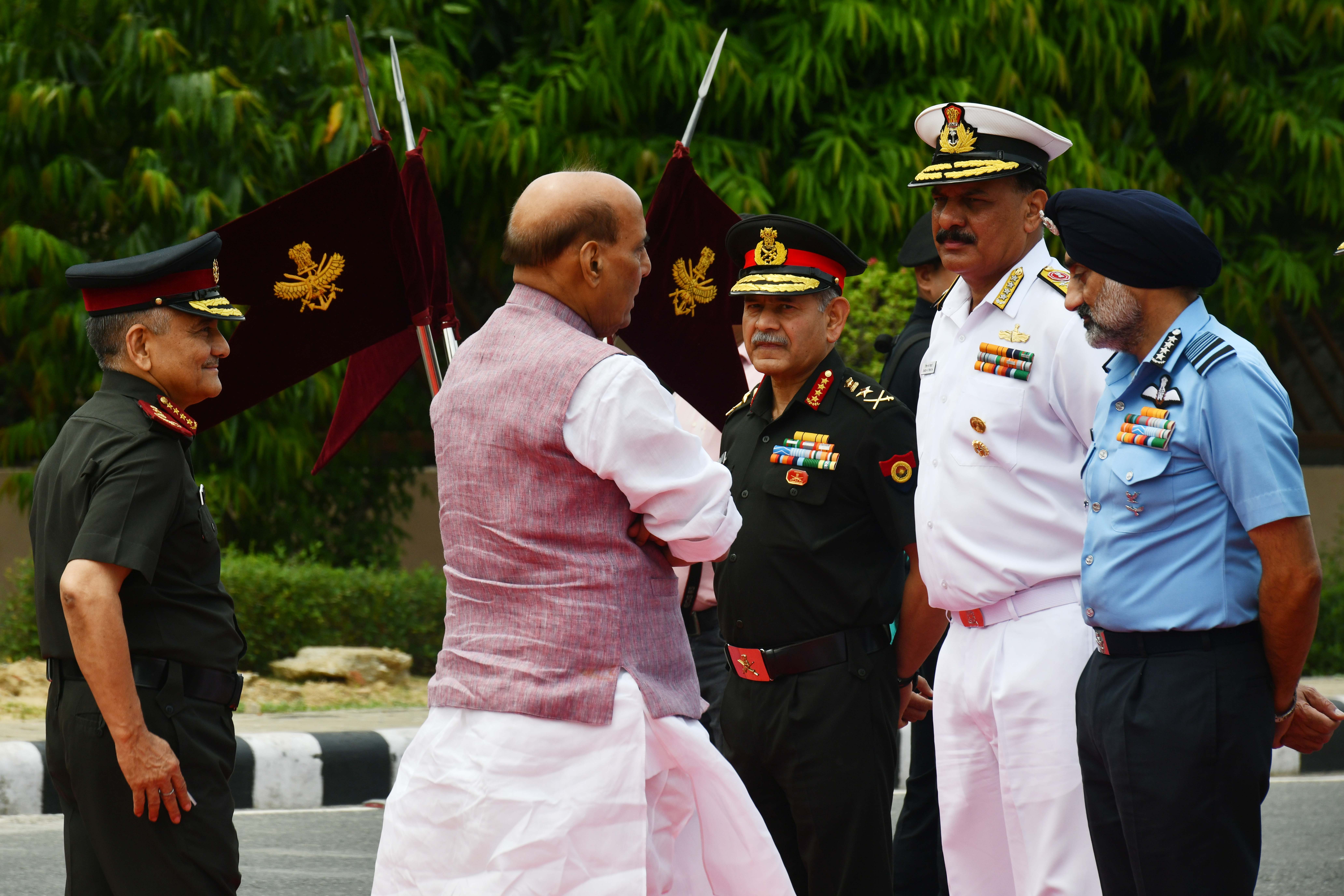
PECKING ORDER Defence minister Rajnath Singh talking to three Service Chiefs along with CDS Gen. Anil Chauhan
At Mhow, the air chief proposed a Joint Planning and Coordination Centre in Delhi comprising the CDS and Service Chiefs, rather than the immediate creation of theatre commands. Citing Operation Sindoor, he warned that “creating a new structure while disrupting everything is not a good idea.”
At the same forum, the Chief of Defence Staff (CDS), General Anil Chauhan emphasised that jointness, the ability of the three Services to operate as one, is the foundation of India’s transformation. He called for a consultative, India-specific process so the forces ‘fight together and think together.’
The JDIAF promotes co-operative centralised planning across domains—land, sea, air, space and cyber—but never states who commands when these forces act together. It recognises that modern warfare is unpredictable and calls for intent-based, delegated leadership and mission command, yet stops short of prescribing how authority should converge under a single commander.
India, therefore, remains in a doctrinal gap: integration accepted in theory but unsupported by command structure in practice. Updating doctrine to establish clear authority lines for integrated commands would align India with global best practice and bridge the divide between coordination and command.
A Microcosm of Integration
Air Defence (AD) best illustrates integration in practice. Protecting India’s skies is primarily an air force responsibility; yet, no single service can sustain coverage across every vital area, from Vadinar to Paradip, the islands, offshore fields, and sea lanes spanning the Arabian Sea, Bay of Bengal, and the wider Indo-Pacific.
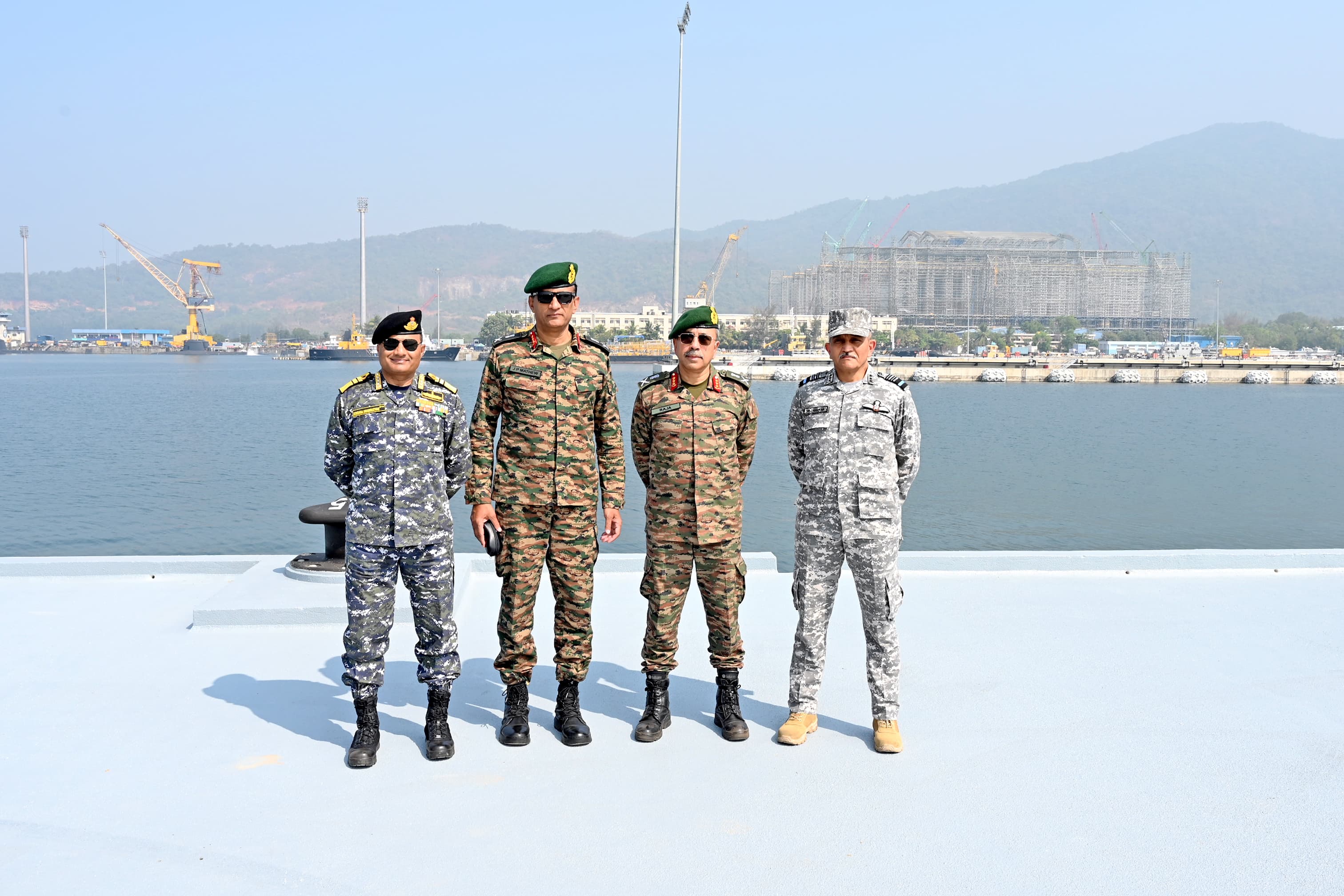
COORDINATION Indian military officers during tri-service Exercise Tropex 2025
AD demands a system where sensors, networks, and response options from all three Services, backed by space and cyber assets, operate within one coherent design. The Indian Air Force (IAF) provides the picture and expertise; the navy and army contribute within the same framework. Each layer complements the other: one air picture, shared responsibility, common purpose.
Subscribe To Force
Fuel Fearless Journalism with Your Yearly Subscription
SUBSCRIBE NOW
We don’t tell you how to do your job…
But we put the environment in which you do your job in perspective, so that when you step out you do so with the complete picture.






 VIDEO
VIDEO