

It’s All in the Network
The single most important activity in war is command and control. It cannot by itself drive home an attack against the enemy or thwart one that is launched against its own troops. It does not destroy any target, provide supplies or carry out a medical evacuation. Yet without command and control none of these or any other military activity will be possible. Without command and control armies will be reduced to mobs carrying out random acts of violence. It is only with command and control that commanders can optimise their resources so that a military force performs its task in an organised manner towards a stated goal.
Command and control is something that commanders do. It includes, but is not limited to, gathering and analysing information, making decisions, organising resources, planning, communicating instructions, coordinating, monitoring results and supervising execution. With time and technological advances, the instruments of exercising command and control have evolved and expanded to encompass communications, computers, intelligence, surveillance and reconnaissance. Within this, battlefield networks are used to detect what is happening on the ground, process that data into actionable information, decide on a course of action, communicate decisions among forces, act on those decisions and assess the effectiveness of the actions taken.
It is important to understand that this process is sequential and not conforming to it can lead to lapses and errors with deadly results. A decision should be taken only after the information has been processed. Similarly, action should not precede the decision.
Battlefield Networks
Primarily, a battlefield network is a combination of target acquisition sensors, target localisation sensors, command and control (C2) elements, weapons, weapon platforms, and electronic communications linking them together. Battle networks are also referred to as the ‘sensor-to-shooter kill chain,’ or just the ‘kill chain.’
This system, or the network, is not a new phenomenon though the components of the same have changed over time. While scouts and couriers were used earlier, satellites, drones and aircraft do the task of reconnaissance now. Similarly, semaphore flags, telegraph and field telephones have largely been replaced by more modern communication systems. The new systems have given the capabilities to look and strike deeper but this capability, coupled with speed and ubiquity of communications, means that there is an exponential increase in the amount of information being generated by sensors that needs to be processed in time before arriving at a decision. This puts a lot of pressure both on the network and the commander, and poses some major challenges.
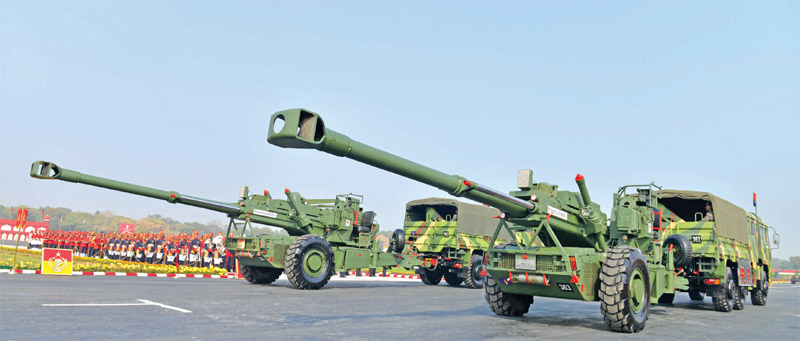
Shakti Artillery Combat Command and Control System (ACCCS) at Army Day Parade
Better Options
The objective of a battlefield network is to enable better options for commanders, speed up the decision making process and optimise effects in the battlespace. This is achieved by connecting platforms and systems across domains by seamlessly passing surveillance, targeting, damage assessment, and other information from one platform to another to improve the accuracy, range, persistence, and speed of effects. As the network integrates more platforms, sensors, communication paths and other nodes, the efficiency increases in a nonlinear manner so that the battlefield network is transformed from a force multiplier into a force exponent. The ultimate objective is to see farther with greater clarity and to act faster with more precision than one’s adversary while denying the other side the ability to do the same.
Five Elements
The battle network is made up of five functional elements each with a combination of personnel, platforms, processes and technology to carry out a given task. Some of the platforms and payloads can be part of multiple functional elements simultaneously. These elements are:
Sensor element: The first element comprises the sensors, both active and passive, to collect data. This data is used to detect and geolocate forces, identify and classify them as friendly or hostile. The sensors are also used to assess the effectiveness of actions taken, that is battle damage assessment.
Communications element: It provides the data links that pass information among systems and operators. The information transmitted can include voice, video, one-way data broadcasts or two-way data links.
Processing element: This is one of the most critical components of a battle network. It is used to analyse, aggregate and synthesise data from a variety of sensor sources to inform decisions. A key discriminator in the processing element is where the processing occurs: on-board the sensor, in the cloud or at the tactical edge. The platforms that carry some sensors may also have sufficient size, weight and power (SWAP) to carry the computational components needed to process the data they produce before transmitting it. Cloud-based processing offers the advantage of essentially unlimited processing and data storage capacity without the SWAP limitations of many platforms. Sensors can transmit raw or partially processed information to data centres on the ground for final processing and analysis.
Decision element: This is the most important part of the battle network because it is where information is translated into action. Where the decision is taken, how it is made, and who is involved depends on what types of actions are being considered. For the foreseeable future, major decisions such as the use of lethal force, will likely involve a human-in-the-loop at some level. Human-in-the-loop decision-making can still involve many forms of computer-assisted or artificial intelligence and machine learning (AI/ML) augmented processes to better inform decisions and accelerate the process, e.g. all engagements beyond visual range already use computer-assisted decision-making.
Subscribe To Force
Fuel Fearless Journalism with Your Yearly Subscription
SUBSCRIBE NOW
We don’t tell you how to do your job…
But we put the environment in which you do your job in perspective, so that when you step out you do so with the complete picture.






 VIDEO
VIDEO