China’s hostility towards India in the recent past has kept Indian authorities on their toes. As a result, the past few months have seen a shopping spree of military equipment for the armed forces. In focus is India’s ‘Make in India’ policy, wherein policies are being made for making and exporting Indian defence arms and equipment.
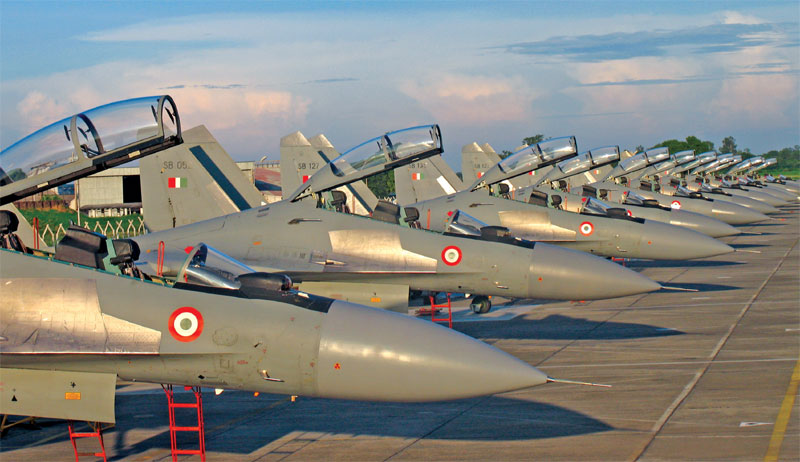
Su-30MKI
The Indian Air Force (IAF) plays a crucial role in combat. If one looks at the contemporary situation in Ladakh where a standoff between the Indian and Chinese troops is ongoing, the role played by the IAF becomes critical to keep a vigil, carry personnel and equipment to the border and be combat-ready to take on the most adverse of situations. The IAF has now been using attack helicopters such as MiG-29, Sukhoi-30, Apache-64 E and the CH-47F (I) and transport fleet including the AN32, C-130J and C-17. As per reports, Mirage 2000 fighter aircraft has also been moved to the bases near Ladakh region, so it can reach Ladakh in the shortest possible time, if and when required.
The Indian government in 2019 announced spending USD130 billion to modernise all three defence forces in a period of five-seven years in order to ‘bolster their combat capabilities over rivals in the region’ as reported by PTI. The plan sought to procure a range of weapons, missiles, air defence systems, fighter jets, submarines, warships, drones, surveillance equipment and developing infrastructure for extensive use of Artificial Intelligence. At the time of announcement, the government had said that its key focus is infantry modernisation. Among the procurements that the government wanted to fast-track were 110 multirole fighter aircraft for the IAF. The current aircraft used by the IAF are of third or fourth generation, whereas, India’s adversaries, China and Pakistan, have been inducting Generation-V aircraft into their squadrons.
Chief of Air Staff RKS Bhadauria during recent interviews and events has said that the IAF was now rooting for indigenised combat platforms.
Fighter Jets
Tejas MK-1 FOC: Hindustan Aeronautics Limited’s (HAL’s) indigenously developed Tejas Mk1 LCA Initial Operational Clearance (IOC) became operational for the first time in July 2016. The drawback of this aircraft was its limited range and lower fuel carrying capacity. It had two fixed tanks of 1,200 and 800 litre capacity.
The IAF commissioned an advanced-level Tejas Mk1 LCA of Final Operational Clearance (FOC) standard at Tamil Nadu’s Sulur Air Force Station on 27 May 2020, operationalising its second LCA Squadron No 18 ‘Flying Bullets’. This aircraft has an added fuel-carrying capacity of 725 litre installed at the centre fuselage. LCA FOC will have the capability to be refuelled mid-air, something which was lacking in the earlier version. The aircraft includes close combat gun, additional drop tanks, Beyond Visual Range (BVR) missile capability, updated avionics and improved flight control software suite.








 VIDEO
VIDEO