It was the Indian Army that first acquired Unmanned Aerial Vehicles (UAVs) in the Nineties, procuring it from Israel; the other two services followed soon after. The catapult launched UAVs, developed by Aeronautical Development Establishment (ADE) under the Defence Research and Development Organisation (DRDO), were the first indigenous drones to be acquired by the armed forces. Today, majority of UAVs in the three services are imported from Israel.
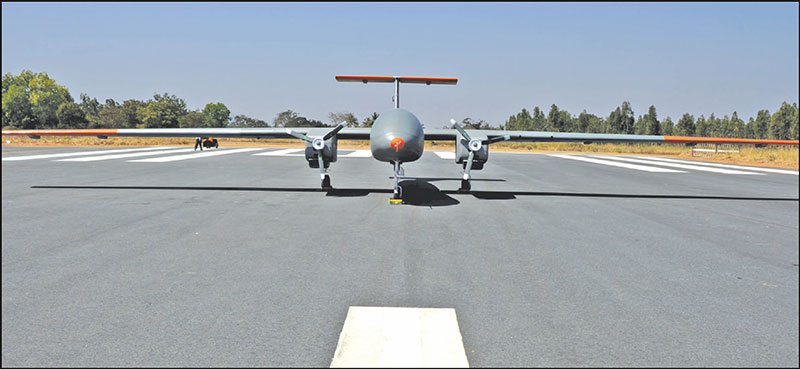
DRDO’s Rustom II MALE UAV
As the current Indian government opened the doors for private defence manufacturers under ‘Make in India’, drone technologies are being increasingly improved by indigenous manufacturers. The country’s premier defence company DRDO, which has been working on UAV technologies for decades, is slowly passing the torch to private industries, who have ramped up their research and development efforts. The UAVs, which were originally used for aerial reconnaissance, are now increasingly deployed for communications, electronic warfare, equipped with weapons to attack enemy installations, and a variety of other roles.
However, there is a preference for a special class of UAVs, the medium-altitude long range (MALE) UAVs, rather than high-altitude, land-based unmanned aircraft, among the armed forces around the world because these UAVs have efficient combined surveillance and strike capabilities. The MALE UAVs go up to an altitude between 25,000 and 50,000 feet with an ability to carry out 24-hour missions. The ability of this class of UAVs to loiter round the clock provides an armed force with constant surveillance, and with added strike capability, which makes the MALE UAVs the most sought-after assets.
Searcher Mark I and Searcher Mark II of the Searcher family were the first MALE UAVs deployed by Indian armed forces, which operated at an altitude ceiling of 15,000 feet. Designed by Israel, these multi-mission aircraft were first used by the army. This was followed by the acquisition of Heron; whose altitude range went to 30,000 feet. Later, the IAF followed, acquiring the Searcher Mark I and then Mark II. The Indian Navy was not far behind, the force started to acquire Heron UAVs soon after, deploying them for long-range maritime surveillance.








 VIDEO
VIDEO