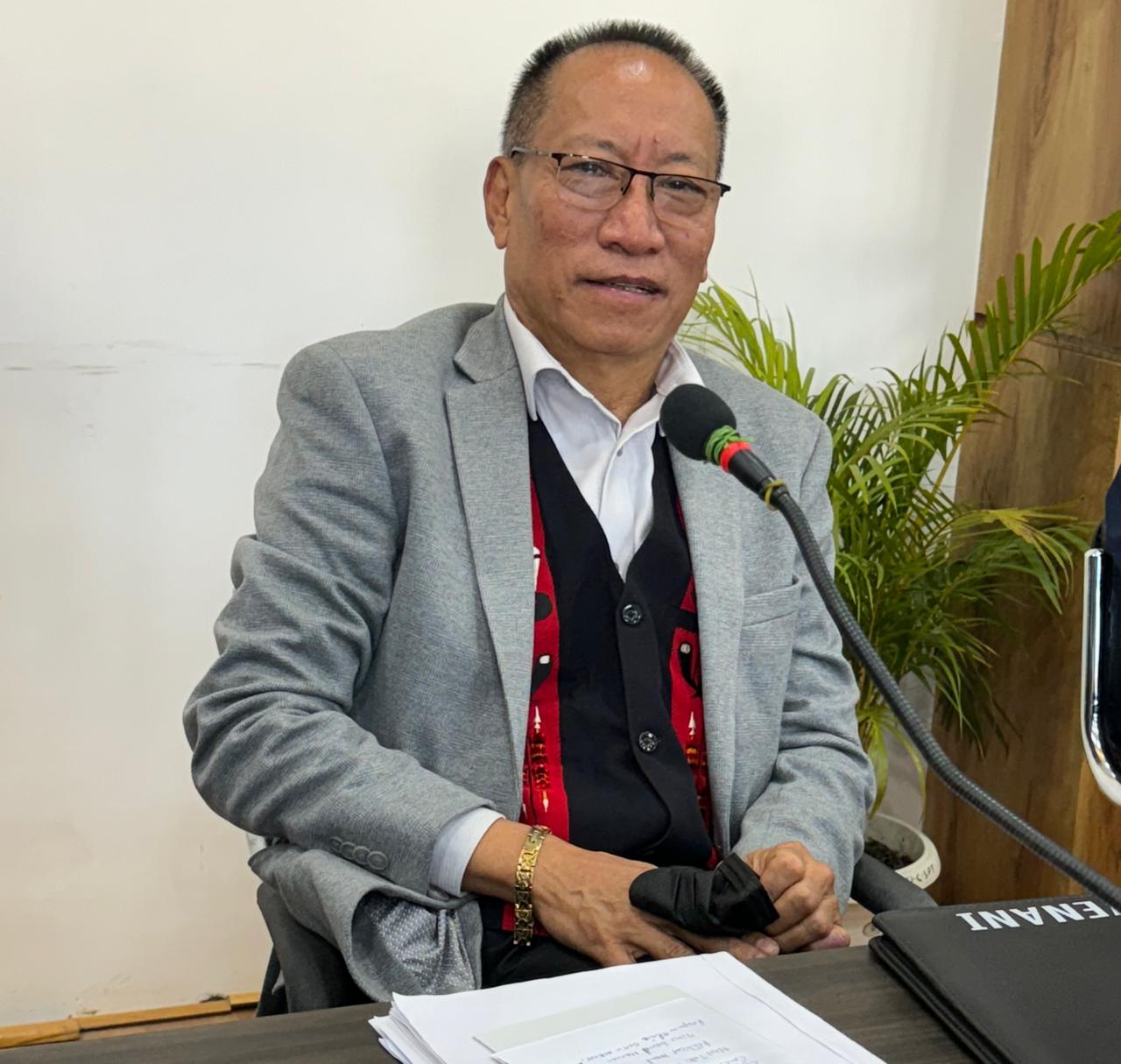
Interview | L. ADANI MAO


L. ADANI MAO is a senior Naga civil society leader from Manipur, based in Dimapur. He has been involved in Naga politics in Manipur since his student days when he worked in the All Naga Students Association of Manipur (ANSAM) during 1984-86 and also with the human rights movement. He belongs to Memei Naga (Mao) Naga tribe, concentrated in Senapati district on the Nagaland-Manipur border.
L. Adani joined the National Bank for Agriculture and Rural Development (NABARD) and was based in Guwahati from 1989-2008. He left his permanent job to dedicate his life to finding a political solution to the complex Indo-Naga conflict.
In 2011, he was elected as president of the United Naga Council (UNC), the apex body of the Nagas living in Manipur. He served his tenure from 2011 to 2014. During his tenure as president, he was involved in the Indo-Naga peace process, especially in tripartite talks between UNC, Union home ministry and Manipur state government.
L. Adani was appointed to the 51-member committee established by the central government to help establish peace and security in the state.
Known for his quiet diplomacy and mature understanding of the complexity of the political situation, L. Adani has been engaged in the recent hostage crisis which began on the 13 May 2026. He was in Delhi recently, accompanying the UNC team to discuss the situation in Manipur. He did not speak directly on the hostage crisis but his interview by Nandita Haksar covers several issues which have arisen in the course of the violence in Manipur.
Adani, thank you very much for taking time off for this interview because I know it is a difficult and stressful time. The Nagas group of more than 30 tribes have come together and have been fighting for the integration of Naga-inhabited areas under one administration. Among all the ethnic groups and tribes living in the Northeast, the Nagas were the first to raise the banner of revolt against the Indian State on 14 August 1947.
Over time several pan-Naga organisations have sprung up including the Naga Student Federation, the Naga Hoho and the UNC in Manipur which represented the Nagas. And they have worked together with common tribal platforms. Since around 2020s, Nagas have started describing themselves as ‘indigenous’ or ‘native’. I am referring to organisations such as Federation of Haomee and Native People’s Committee. This raises a very difficult question of whether citizenship should be based on ‘indigeneity’. This demand has repercussions beyond Manipur. How will you distinguish between an outsider and an indigenous person in the context of Manipur? Can people, who are not indigenous, then be denied citizenship?
Much before India became an independent nation, that is prior to 15 August 1947, the first settlers or indigenous communities were already living in the land for centuries which now covers the state of Manipur. I agree that citizenship does not and cannot be based purely on indigeneity. Any person can become a citizen if prescribed norms are fulfilled and the reasons for application of citizenship are in order.
In the context of Manipur, the influx of illegal immigrants particularly from across the Indo-Myanmar border bypassing the due process for being granted citizenship after India’s independence, and in increasing numbers over the years has overwhelmed those communities living there for centuries. Issues of land ownership, cultural practices, demographic changes upsetting balance of power and opportunities, and inter-community relations have come into play.
This feeling, as well as fears, is real and is being lived out in the state in the last four decades or so. The Nagas in general do not shift their villages, and they have lived settled lives in their own ancestral domains since centuries. The Meiteis in the valley also have a similar concept of ancestral domain. When this age-old practice is aggressively intruded upon, naturally there will be reactions in the form of fear, distrust and exclusiveness. Taking these sensitivities and background into consideration, one should be able to distinguish outsiders from indigenous persons in the context of Manipur.
How do you define the role of the UNC? How have problems been tackled during your time as president of the UNC?
The UNC is the apex body representing all the Naga tribes in Manipur. It is not an NGO nor is it like any other social organisation. But it is a distinctive model based on the tribal traditional system and practice of representation in Naga society.
The UNC was formed to uphold the unity and solidarity of the Nagas; to protect our identity, history, land and natural resources; to preserve and promote our cultural heritage and the democracy of our village republics; to secure for all a just and equitable society; to safeguard human rights and to foster peace and fraternity among all peoples.
To give a sense of how UNC has to deal with complex political situations, let me give an example from the time I was president of the UNC.
The second Indo-Naga peace process began in 1997 (the first was in the Sixties) with a ceasefire between the National Socialist Council of Nagalim (NSCN-IM) and the government of India. As a gesture of goodwill, the government of India gave clearance for the NSCN General Secretary Th. Muivah, to visit his ancestral village, Somdal in Ukhrul district of Manipur. He had expressed his desire to visit the graves of his parents. He had not returned to his native place for the past 40 years. Th. Muivah’s visit to his village was planned for early May 2010.
The Congress-led Ibobi Singh government of Manipur objected to Muivah’s visit. The Nagas protested against Ibobi Singh’s objection and held a rally on May 6 at Mao Gate in Senapati town which borders Nagaland. Manipur security forces responded violently with tear gas, mock bombs and firings from automatic weapons. In that firing, two promising undergrad students were killed and more than a hundred protestors, most of whom were women, were grievously injured.
Following this, the Nagas in Manipur held a Naga People’s Convention on 1 July 2010, wherein they declared the severance of all political ties with the government of Manipur and empowered the UNC to constitute a committee for pursuing the establishment of an Alternative Arrangement. This declaration was based upon the unmistakable fact that it was impossible to protect our right to life, land, time-honoured institutions, customary practice and values under the administration of the dominant and communal government of Manipur.
This refusal to allow Th. Muivah to visit his ancestral village despite the fact the central government had given its clearance was an illustration of how Manipur government had never recognised nor respected the identity and dignity of the Naga people.
This was the context in which the Nagas demanded an alternative arrangement for the administration of Naga areas because living under Manipur government was unbearable and intolerable. We demanded an alternative administrative arrangement without prejudice to our demand for the integration of Naga-inhabited areas under one administration.
In support of our demand for alternative administration, the UNC declared a strict blockade of National Highway 39 which is now called NH 2. This National Highway connects Manipur with the rest of the country via Nagaland and Assam.
After our two-month long economic blockade, UNC was invited by the Union ministry of home (MHA) for dialogue. The UNC and the newly-constituted Committee For Alternative Arrangement (CFAA) met the then home minister P. Chidambaram in New Delhi on 14 September 2010. As a result of the discussions during seven rounds of talks between December 2010 to February 2014, the Manipur government, on the insistence of the UNC agreed to be a part of the negotiations and they were represented by two state cabinet ministers and senior bureaucrats.

CALL FOR ACCOUNTABILITY Manipur’s civil society members ask for action after Kuki group apologises for killing six Naga hostages

GRAVE MISTAKE Kuki Zo Council chairman Henlianthang Thanglet apologises for the killing of six Naga hostages on June 25
The government of India was represented by the Northeast desk of MHA, including the joint secretary, officials from the intelligence bureau, director general military intelligence and Indian Army’s 59th Mountain Brigade based in Manipur.
The Naga team was represented by officials of the UNC, members of CFAA, Naga Women’s Union and All Naga Students’ Association, Manipur.
After exhaustive deliberations, it was agreed that a high-powered committee of eight members will be constituted which will include members nominated by the UNC to look at the demand for an alternative arrangement outside the government of Manipur.
The Tripartite talks were put on hold after the signing of the ‘Framework Agreement’ by the government of India and the NSCN (IM) on the 3 August 2015 because we hoped we would have a final settlement. But that was not to be.
What are the challenges faced by the UNC in the context of 2023, when Nagas maintained neutrality between the Meiteis and the Kuki-Zo, and 2026 violence, when Nagas themselves are being attacked?
When the Kuki-Zo and Meitei clash erupted on 3 May 2023, the Nagas took a neutral position. Going beyond that, the UNC constituted a peace committee with members from amongst former UNC presidents and met both the Meiteis and the Kuki-Zo groups to explore ways and means of containing the violence. Even in the midst of that volatile situation, Nagas intervened where possible, to save people from both the communities by providing safe shelters, care for the wounded, food and other essential needs to those cut off from means and access.
While we were not a party to the violent conflict, several Nagas fell victims of the violence that had engulfed the state. Some were killed, beaten up, their houses burnt, insulted and provoked—which were owned up by the perpetrators as lapses of mistaken identity. Notwithstanding the anger, loss and hurt, Nagas resolved all such incidents through customary laws in the interest of peace and with the hope that such gestures would be respected and reciprocated. Nagas thereby stirred clear of full-blown confrontations.
The 2026 violence in hindsight was an explosion waiting to happen. With the civil war situation in neighbouring Myanmar, especially after the military coup in February 2021, trained and armed Myanmarese Kuki militants, KNA(B), have been crossing the border into Manipur and spreading themselves across the Kuki-Zo settlements in the hill areas around the Imphal valley. They teamed up with the Kuki militants in Manipur which were under the Suspension of Operation (SoO) Agreement with the government of India and had been engaged in active violence against the Meiteis of the Imphal valley. Pushed by the civil war in Myanmar, trained and armed Kuki militants fleeing from the onslaught of the Junta crossed over to the Indian side and began to aggressively target Naga villages in the hill areas of Manipur.
There are indications that a pre-meditated strategy was followed by the Kuki militants to increase their area of domination in the hills of Manipur and to thereby stake claims over such areas as Kukiland. Using an otherwise isolated case of a brawl at Litan in Ukhrul district, Naga houses were burnt and there was indiscriminate firing at Naga villages. Taking hostages, attacking innocent Naga villagers at work in their paddy fields with gun shots and firing upon Naga travellers on the Imphal-Ukhrul road with sniper guns on 13 March 2026, killing two in cold blood. Thereafter there have been ceaseless firings upon Senakeithel village by Kuki militants from a vantage point, keeping it under siege for days together and preventing the villagers from working in the paddy fields.
The SoO agreement signed with the Kuki militant groups by Union and state governments was a strange arrangement. Prior to this agreement there was no record of exchange of fire and hostilities between the Kuki militants and the state/central government forces. There are no plausible explanation or reasons to doubt that Kuki militant groups were promoted and patronised to carry out proxy wars against the Nagas who had been struggling since India’s Independence for their land, identity and self-governance as a people. The Naga issue, tabled, discussed and a framework agreement remains unresolved even after more than 11 years.
In 2023, the Nagas and Kuki-Zo had united under the banner of the All Tribal Students Union of Manipur (ATSUM) and organised the Tribal Solidarity march against the demand of the Meiteis to be included as tribal/ indigenous. Now the tribal unity seems to have broken. But does the issue of Hill-Valley divide still stand as far as the lack of development in the Hills is concerned?
It still does very much with regard to inequality in development and utilisation of resources. To some extent, the movement of the Nagas in Manipur for an alternative arrangement was fuelled by the very issue of neglect of the hill tribal areas as compared to the striking difference in development of infrastructure and modern city-like living conditions in the valley. Though about 90 per cent of the area is occupied by the tribals, there is disproportionate low allocation of funds/ resources and consequently low level of infrastructural development and services in the hills. This disparity must be addressed for the return of peace and normalcy in the communally vitiated and conflict torn state of Manipur.

What has been the impact of the civil war in Myanmar on Manipur, especially on Nagas in Manipur (and Nagaland)?
In a wider perspective, there are Nagas in Myanmar whose lives are badly affected by the civil war in Myanmar. Forced conscription of Naga youth are reportedly being carried out by the People’s Defence Force and anti-Junta armies. Nagas in Manipur and Nagaland are also affected by the situation in Myanmar. Their traditional trade and commerce across the border are affected. Some Naga population from the eastern side (Myanmar) have fled into the Indian side to escape the civil war.
Do you think the building of a smart wall along the Indo-Myanmar border will solve the problem of drug and arms trafficking?
To have the border fenced over a stretch of 398km across Nagas areas, or a total of 1,643 km in the entire stretch from Mizoram to Arunachal Pradesh will not solve the problem. Apart from the high cost, maintaining and guarding the long fence would require a huge number of security personnel. Speaking for the Indo-Myanmar border falling in Naga ancestral land, the most workable and practical policy to solve arms and drug trafficking would be to settle the long-standing Indo-Naga issue through which the Nagas can be empowered to effectively engage and control the said activities. There are Nagas on both sides of the border, which is a plus point in that there would be a Naga buffer zone against arms and drug trade which by all consideration beats fencing and walls which will not stand when they divide the Naga people, guarded or not.
Is there any democratic space in Manipur for Nagas, Kuki-Zo, Thadou, Meiteis, Pangals and other communities to discuss openly and freely without fear of intimidation from insurgent groups, and now even the vigilante groups such as Arambai Tengol and Meitei Lepun? When the Thadou met the Meiteis to discuss their differences it was in Delhi and even their attempt was condemned by their communities in Manipur.
The entrenched positions taken particularly by the Kuki militant groups and also within the other communities does not provide space for dialogue now. The popular state government has also not been able to build up public trust and confidence and does not have a viable road map to peace and normalcy. The state leadership seems to be tied down from taking any independent decision regarding violence in the state which is escalating by the day and dependent on instructions and strictures from the Union home ministry.
Given the level of distrust between the communities and even within themselves, a clear, impartial and resolute policy which addresses both the hopes and fears of the different communities to the extent possible, and piloted by an empowered state government is the need of the hour and the only viable approach. Cosmetic treatments and arbitrary patch works will only provide temporary reprieve.
Would you agree that all ethnic identities (even religious) have been weaponised to the extent that there is no democratic space for open discussions and people to opt out of these identities. For instance, Kom have declared they are neither Kuki nor Naga, but they are under pressure from both sides.
Communities who have not been entangled in the conflict are getting armed because of threat perceptions. The attitude ‘if you are not with us, you are against us’ is pervasive. The Nagas under the UNC have a decision-making process which is incumbent upon all Nagas to respect and abide by. This is not the case with Kukis and the majority Meities. When the KIM (Kuki Impi Manipur), supposedly the apex Kuki organisation, issues official statements, they are often contradicted by different organ of the organisation and are also seen to be disobeyed on the ground. With the Meities, they do not have an apex organisation and hence differences arise in terms of positions and actions. Koms have an associate membership in the UNC but some sections within the tribe do not subscribe to this position.
The Union home minister has announced that he will end insurgency by 2029 and soon after General Officer Commanding of the Spear Corps, Lt Gen. Girish Kalia visited Manipur to assess the prevailing security situation. According to media reports, a major focus of the visit was ‘Army’s growing emphasis on technology-driven warfare capabilities’ at the Red Shield Drone Lab in Leimakhong Military Station and the Drone Training Laboratory at Kakching. Can more military repression solve the problem in Manipur?
Military repression and action cannot solve the problem in Manipur. The government cannot exterminate everyone who have strong views about their history, identity and rights. Harsh and excessive force will generate more anger and greater violence in the long run. Ernest and sincere dialogue should be taken up to settle issues, unlike the one that has been taken up by the government with the signatory organisations of the SoO agreement. As mentioned earlier, the SoO agreement was just a proxy instrument used by the government to counter the Naga movement, and we can now see where this misadventure has led to.
What was the most difficult part of negotiating during the hostage crisis in which the Nagas were holding 14 Kukis and the Kukis had six Nagas who were killed?
Six Naga male civilians were taken hostage by the Kuki militants on May 13. Fourteen Kukis were detained by Naga volunteers as a security to ensure the safety, lives and release of the Naga hostages. Nagas decided that no harm should be done to the Kuki detainees. After weeks of exploring ways of resolving the issue, it became certain that all was not well with the six male Naga hostages being held by the Kuki militants and that they could have been already killed.
Strong appeals were made by international, regional and state church bodies, the chief ministers of Nagaland and Meghalaya, Naga tribes and organisations from across Naga areas for the safe release of the innocent 14 Kuki detainees. After receiving assurance from the state security agencies that the six Naga hostages would be produced dead or alive within 24 hours of release of the 14 Kuki detainees, the UNC released the 14 Kukis on June 9, and they were handed over to the state police for onward reunion with their families.
It was a trying time. When the word first got out that the Kuki detainees were being planned for release, there was outrage on June 1, and the UNC office was stormed by angry Nagas and UNC executives were targeted. However, it soon subsided and on endorsement by the presidential council of the UNC, the release was finally put in place.
On June 10, it was communicated to the UNC by the state government that the dead bodies of the six Naga hostages had been recovered and were being taken to JNIMS Hospital morgue.
The Nagas are demanding justice. Their demands include the immediate resignation of the deputy chief minister Nemcha Kipgen. Her husband, ST Thangboi Kipgen is chairman and president of the Kuki National Front (P) which we believe was involved in the killing of the six Naga hostages. She should resign till a proper enquiry into the murders has been conducted.
How far can the committee set up by the Governor, of which you are a member, play a role in bringing stability to Manipur? Do you have any ideas on how political stability can be brought to Manipur?
The Peace Committee set up by the Governor was a non-starter from the beginning. I, for one, was not officially informed of my nomination to the Committee and came to know of it only when a state government notification was posted in the social media. No communications were also received subsequent to the notification.
For political stability in the state, I feel we will have to go back to the basics such as a) Equal representation where all constituencies are of average/ uniform population; b) Only eligible citizens should be allowed to contest and vote in elections; and c) A totally independent Election Commission who go by the rule and the law to administer the election processes.
Let us have an appropriate committee from the government of India to translate this into reality. I am in Delhi accompanying the UNC members and we hope to have meaningful discussion both on how to resolve the hostage issue and justice for the Nagas, especially the families who have lost their loved ones and also for a resolution to the growing violence in Manipur.
Let us hope and pray something concrete comes out of our meetings otherwise the situation in Manipur will get even worse and many more innocent people will die, and there will be huge loss of homes and means of livelihood.
Subscribe To Force
Fuel Fearless Journalism with Your Yearly Subscription
SUBSCRIBE NOW
We don’t tell you how to do your job…
But we put the environment in which you do your job in perspective, so that when you step out you do so with the complete picture.


VIDEO