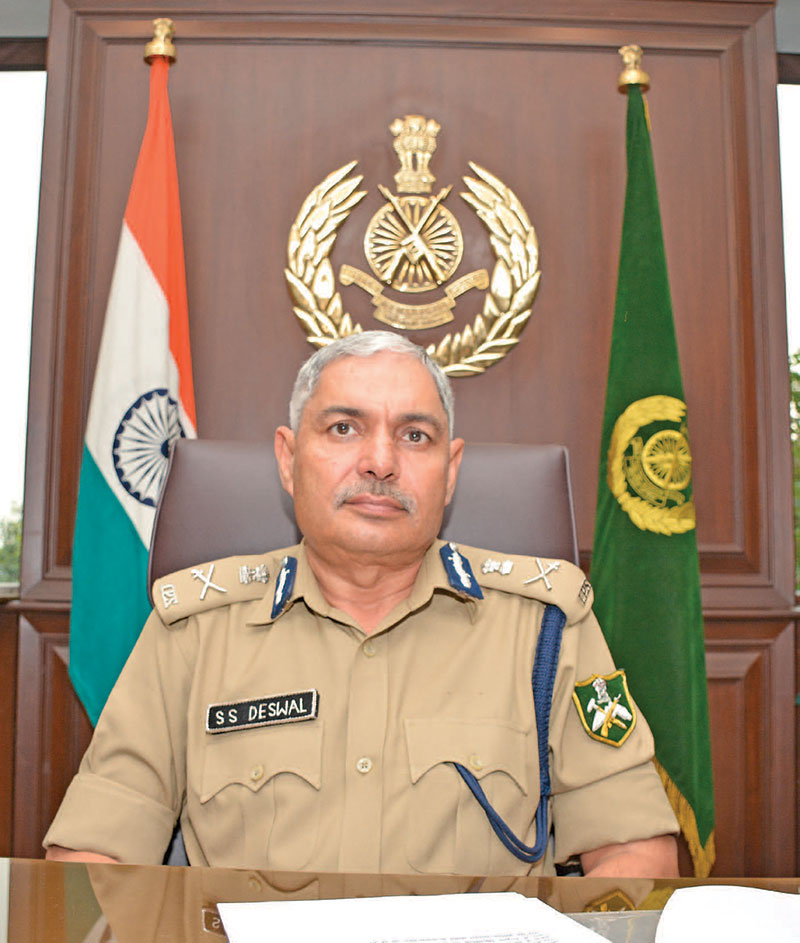
The roles and responsibilities of ITBP have been changing since its inception, the force is now deployed in counter-insurgency operations, such as in left-wing extremism areas and in J&K. What challenge is the force experiencing?
The Indo-Tibetan Border Police (ITBP) was raised immediately after 1962 Indo-China war, and the immediate task was to confront and stop the enemy at the border. It was created as a guerrilla force initially with four battalions, but later as the situation at the borders and the internal security of the country changed, the role of the force changed. The second change was in the Seventies when it was made a regular border force, i.e. the ITBP. And with the Kargil war and afterwards, group of ministers again studied border security and the government took the final decision regarding the force. Subsequently, a one-force policy was adopted after the Kargil war, and the complete Indo-China border was handed over to the ITBP.
Before that, it was only the Ladakh area which was being protected by the ITBP. As the training and efficiency of the force has been very good and it has rendered unblemished service, it is now being utilised in internal security also. We have a heavy deployment in anti-Naxal operations for last several years now. We have many companies operational in Chhattisgarh. The force is also deployed for VVIP protection and protection of vital installations in the country. The ITBP is presently also protecting the Indian Embassy and missions in Afghanistan; earlier it was deployed at the Indian High Commission in Sri Lanka. It has been deployed in UN missions; till recently ITBP was working in Congo.
Evidently, the capability of the force is multifarious and it can face and handle all kinds of internal security situations in the country. We are upgrading the training pattern as we get involved in new theatres as per requirement. The role will always be dynamic and it will continue.
The ITBP has the prime responsibility in high-altitude areas, being the main force in those areas. Is the force sufficiently equipped with all equipment and wherewithal, training and weapons?
There are two challenges. One – we have a big and well-equipped country across the border (China). Secondly, high-altitudes and tough terrain in the Himalayan mountains present a big challenge for the force. Out of our 179 Border Out Posts (BOPs) at higher altitudes, almost 138 BOPs are stationed and work above the height of 11,000 ft. And in most of those places, there is a shortage of oxygen and an extremely inhospitable weather, and living in those conditions is a great challenge. Therefore, we have been training our troops acclimatisation. That is how we keep rotation of the troops from plains to these high BOPs and vice versa, so that high terrain and tough climate does not adversely affect the health of the jawans.
Recently, you said that you will be raising more mountain battalions for the ITBP, post the Nanda Devi tourist incident. Can you give us more information?








 VIDEO
VIDEO