

Interview | GULAN FEHIM
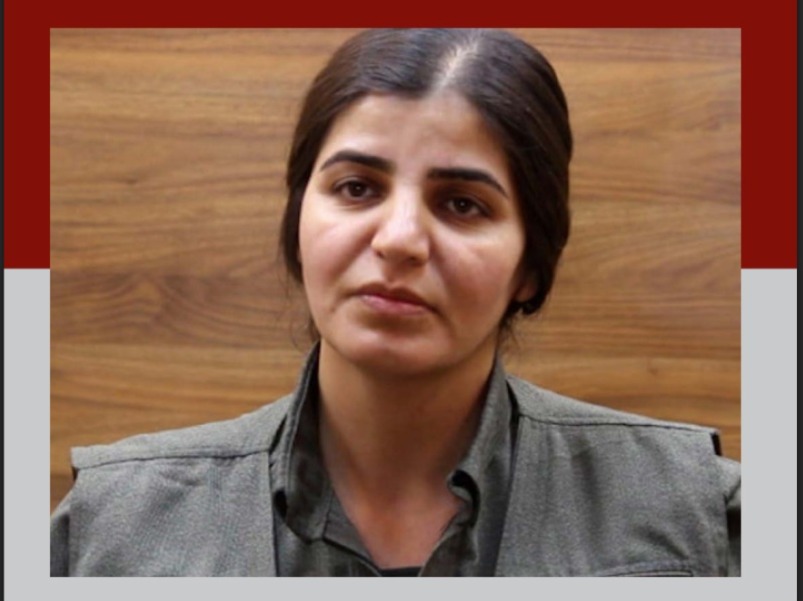
GULAN FEHIM is a senior member of the executive council of the Kurdistan Free Life Party (PJAK) and former co-president of PJAK. She is an Iranian Kurd and currently lives in Iran. In this exclusive interview to NANDITA HAKSAR, Fehim, an important voice from West Asia, counters two kinds of propaganda: that the US imperialist war is welcomed by the people in Iran and that the Kurds would help the US and/or Israel ground forces invade Iran.
The situation is far more complex, and as she points out, the weaponisation of women’s rights and human rights by imperialist forces cannot lead to liberation. Perhaps, it has lessons for us in South Asia too.
The Kurds are the largest minority within Iran, with a distinct language and culture. The 50-million Kurds are spread across four countries: Turkey, Iraq, Syria and Iran. Guided by the ideas of Abduallah Ocalan (in jail for more than 27 years), the majority of Iranian Kurds are Sunni Muslim, but there are also Arabs, Christians, Jews, Alevis etc.
The Kurds are fighting for a democratic confederation with a strong emphasis on women’s rights. They oppose extremist nationalism and extremist religious ideologies. They neither support the US imperialist war nor Israeli aggression as they know that they cannot liberate them or the Iranian women from state repression.
The interview was translated from Kurdish to English by ZAGROS ENDERYARI, a member of the Foreign Affairs Committee of the PJAK.
I am aware of the circumstances under which you have agreed to give this interview. It is important for the readers to understand the conditions under which you speak to us. Has the city you live in been bombed? Do you have access to basic necessities, and do you have shelters?
As you said, our conditions are difficult. We are in West Asia, which is amid a burning fire. We live and work in Kurdistan, which has been in the midst of war for 100 years. Several generations have grown up in this situation. Because of that, we live with a unique psychology. We live with feelings such as danger, fear and anxiety. But we still try to think well and strongly. We have learned to create the necessary conditions for life and struggle where we live. Of course, due to security issues, I cannot tell you in detail about where I live. But we have created the conditions for life and our access to the world. Therefore, I am in a position to answer your questions.
Being a Kurdish woman living in Iran is not easy. It is for this reason that I ask you to clarify your position. Would it be correct to state that your position, and that of the organisation, the PJAK, is that you were committed to fighting for a more democratic society and polity in Iran, but you do not support this war against Iran by the US and Israel?
The PJAK has been fighting against the Islamic Republic of Iran for more than 22 years. This struggle continues in East Kurdistan (North-West Iran), Iran and abroad. For years, we have been organising and educating our people, especially women and youth. During those 22 years, we have worked for the democratisation of Iran and the democratic solution of the Kurdish people’s problem. In other words, we have tried to solve the problem in a political and democratic way. Despite all our efforts, the Iranian regime has continued its attacks against us both in the mountainous areas and within society. During these years, many of our friends were martyred. And many friends, such as Shirin Elemhuli, were executed. In addition, during those years, we have taken many protective measures to protect our forces. These measures have been taken through the work of the freedom-loving guerrillas of East Kurdistan in the mountains.
As I mentioned above, we want to solve the Kurdish problem by democratising Iran. Because our issue is not only the solution of the problems of the Kurdish people, but of all the peoples of Iran. The issue of women’s freedom, the issues of the demands of national and religious diversity, ecological and economic problems. These are all fundamental problems that our society faces today. These important issues cannot be solved by changing the government alone. That is why our demand is to solve the problem democratically. In recent years, during the ‘Women, Life, Freedom’ revolution, the people’s demand was very valid, and no violent methods were used by the people. However, the Islamic Republic of Iran did not pay attention to those people’s demands. Therefore, society and the state ended up in a confrontation and the Iranian state was completely cut off from society. Foreign powers saw this as an opportunity and increased their pressure. We have never chosen to act according to those contradictions. We have our own programme. Whether before or after the war, we will always work according to our own programme. We organise and educate our society. We try to democratize our people and teach them ways of self-defence. Whether there is war or not, we will move forward in our own direction. Regardless of the environment and atmosphere that develops, we will always renew our position. Of course, we will take into account the interests of our people and all peoples and act accordingly, not according to external programmes.
Mahsa Amini or Jina Amini, who died in a hospital under suspicious circumstances on 16 September 2022, was a Kurdish Iranian woman. She had been arrested for not covering her head. Her death sparked huge protests across Iran. Yet, even during the protests, the Iranian women, including Kurdish women, did not call for intervention by the West to liberate them. Is that correct? And now Iranians, including women living in the West, are dancing and celebrating this war because they believe that the US will liberate them by placing the Pahlavi dynasty back on the throne. Do you think those women (and men) are serving your cause?
As you know, a week before the murder of Jina Emini, a state guard named Goran tried to rape a woman named Şiler Resuli. Şiler tried to free herself from him and threw herself off a building, thus ending her life. That incident caused protests and a serious uprising of the people, especially women. Just a week later, Jina Emini was killed in Tehran. This shows that the mentality and structure of the current power system attack women in all areas of life. We saw how during the ‘Women, Life, Freedom’ revolution, the leaders of the uprisings were women. All segments of society were on the streets together with them. Because they believed that they could solve their problems themselves. This is also our belief.
The struggle of the people also showed that the people themselves must formulate their problems, find solutions, fight for those solutions and thus solve their problems. Of course, we know that alliances are important in the struggle and provide strength for it. But the Kurdish people and other peoples also know that they must rely only on their own strength. Some of the attitudes you mentioned in your question may be found outside of Iran. But this is not a general attitude. The basic view of women is that self-administration and democratic governance are possible with the will and determination of the people and democratic and free citizens in society. Until this kind of personality and view are formed, it is difficult to talk about freedom. Freedom is not something that can be brought to a person just like that. Freedom is something that a person achieves for herself. Therefore, we are not talking about taking freedom from someone or from a force. We are talking about the struggle for and the creation of freedom.
Let us begin with the larger picture of the Kurds, a nationality of some 50 million people qualifying it to be the largest nationality without a state and spread over four sovereign states: Turkey, Iraq, Iran and Syria and parts of the former Soviet Union. The Kurds have a common culture and language, but the majority are Sunni Muslim with substantial number of religious minorities living among them. Is that correct?
According to current data, the Kurdish population is between 50 and 60 million. This includes Kurds in places such as Khorasan, Central Anatolia, cities such as Tehran, Istanbul, Baghdad and Damascus, as well as the Kurdish diaspora. There are Sunni, Shia, Alawite Kurds (they are not Shia and this should not be confused), Yarzan and Êzidî. There are also a small number of Christian and Jewish Kurds. There are Kurds affiliated with almost all the religions of West Asia. Kurdistan is a country where many different nations and religious groups have lived and still live. Therefore, the common life has continued for a long time until today. No matter how diverse Kurdistan is, this has never been a problem for the Kurds. Because the Kurds have always had the idea and philosophy of a common life. One sect or religion may be more numerous in Kurdistan, but this does not mean that others are inferior or weaker. Nation-states portray such a wealth of diversity as a reason of conflict to survive. But this diversity and prosperity has never been a problem for the Kurdish people. The problems that have arisen have been created by the governments. But all parts of the Kurdish people, as well as the neighbouring peoples of the Kurds, have lived together in peace and harmony.
I understand each part of Kurdistan has specific problems, both as a minority and as women. For this interview, we will largely restrict ourselves to the situation in Iran. Can you tell us why you found the ideas of Abdullah Öcalan (in jail on a Turkish Island since 1999) attractive and what particular aspect drew you towards his ideas and ideals? How did his ideas of radical feminism attract you as a Muslim woman?
As a young Kurdish woman in East Kurdistan, I faced many difficulties due to the existence of the nationalist and sexist system of Iran, both because of my national and my female identity. These two led to contradictions for me and made me think and realise that both were social problems. Therefore, I wanted to look for a way to solve these contradictions. Of course, this issue was not only an individual one and not only limited to me. Thousands of Kurdish young women were thinking and searching for the same. We all saw that the only idea and method that showed the possibility of a solution to the national and women’s question was the idea and philosophy of the Kurdish people’s leader Abdullah Öcalan.
When we read and learned a little, we saw that one of the basic pillars of the paradigm of Öcalan was on women’s freedom. That was certainly interesting to us. The situation of women was so clear that one could not deny it. When Öcalan talked about this issue, of course, we were drawn to him and the perspectives he showed for the women. The same happened when it came to the national question. Öcalan’s ideas explained and defined the national question very well, and its position on the solution of the Kurdish question was very clear. That’s why we were attracted to it. The way Öcalan and his movement started their organisation and within the involvement of the women as well, their struggle for liberation in the centre of the common struggle was an example for many Kurdish women in all parts of Kurdistan.
We were also influenced by these ideas and began to look for a concrete field of struggle where we could organise ourselves. In this context, we became involved in PJAK, which was founded in 2004 and established within Iran as its own political organisation. I, like other thousands of women, became a member of PJAK. There we saw that we women could exist as themselves, be active and not be under the shadow of patriarchy. That is a great opportunity for women. I believe that any woman who recognises and learns this will become a supporter. I am not aware of any other example like this.
Within PJAK, we also developed our own autonomous and own women’s structures, including an independent women’s organisation and women’s defence forces, which allowed women to organise and act with their own will. At the same time, we were influenced by the broader experiences of Kurdish women’s movements in the different parts of Kurdistan. In 2008, Öcalan, together with the Kurdish women’s movement within the PKK, developed ‘Jineolojî’ as a women-centred science. This became an important reference for us. We were deeply influenced by this perspective on women’s knowledge, identity, and freedom. We sought to develop and integrate this approach within our own organisation and practice in PJAK. This science was so interesting and important that it crossed the borders of Kurdistan and has now resonated in the whole region and the world. We as women learned and tried to make men understand that in order to learn social sciences, one must move away from the existing male-dominated sciences. Because the existing sciences do not include the issue of women’s freedom and identity.
In other words, we went from a search for freedom to a gender-based freedom and knowledge. On this basis, we started to found our own organisations of and for women who work independently. This autonomous women’s organisation was also established in (Rojhilat) East Kurdistan and is called the East Kurdistan Free Women Society (KJAR). The autonomous organisation of women within the general organization is an unprecedented opportunity and system because it allows women to better participate in work and life with their own identity and on an equal footing with men. For many years, we have been reaching out to women, educating and organising them.
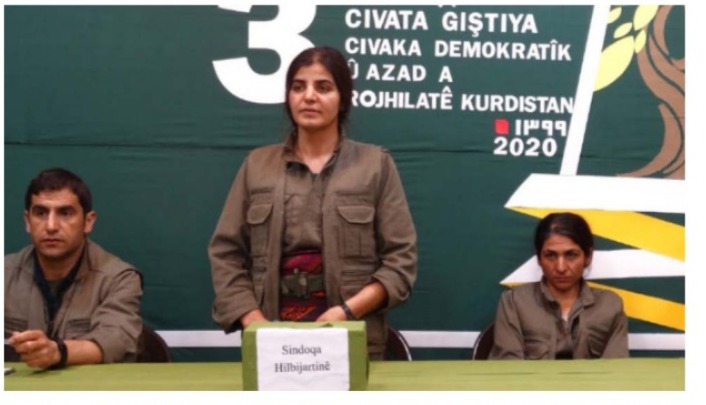
In what ways did you relate to the idea of Democratic Confederalism rather than forming an independent Kurdistan?
The philosophy of the nation-state is based on one flag, one language, and one culture. Its opposite is democratic confederalism, a system that builds and develops itself based on a democratic, ecological society and women's freedom. Democratic confederalism includes diversity and is based on it. In other words, in the system of democratic confederalism, every community joins this system with its existing identity. I mentioned above how important women’s freedom is in this system. Because we believe that until women are free, society will not be free. Women in the world have struggled a lot to have equal representation in decision-making mechanisms. But equality has not been achieved in this regard so far.
In the system of democratic confederalism, in the political sphere, in war and in peace---all these are areas of strategic decision-making---there is a co-chair system and joint representation. Therefore, women and men have an equal place in decisions. We are trying to transfer those values to the entire society and also influence the states accordingly. This is how we understand independence. In our view, independence is not just about specific borders, flags and other issues. Those who believe in the nation-state create conflicts around those issues. Our effort is to unite all Kurdish forces around those values and thus achieve our freedom.
Is it correct that in early March 2026, US-Israeli strikes on Iran increasingly hit security targets in Kurdish majority provinces, with over 40 sites reported destroyed in Sanandaj alone? Do you think the US or Israel can liberate Iranian Kurds, especially women? Have you taken a stand against the weaponisation of women’s rights during this war? It seems that the US and Israel tried to justify this war as a war which would liberate the women of Iran?
War in general does not serve the interests of society, and especially not those of women. Therefore, war is not a solution. We have seen in the history of the world wars that society, and especially women, children, and the weakest segments of society, suffer the most from war. If any power wants to solve problems democratically, it must resort to democratic methods, not violence. Indeed, many areas of East Kurdistan have been the target of the recent war and attacks. Unfortunately, the policy of the Iranian state has caused the entire society to suffer from war. As a result of this war, everything is changing. It is not at all clear who will benefit in the end. It is not clear that women and other people will benefit in the end. Only if they struggle and act on their own can they benefit. Of course, that war is not being fought for women’s rights. The Iranian regime oppresses women. But at the same time, the regime claims that it does not oppress women. Women should look at the situation, and if they see that a beneficial atmosphere has been created as a result of the war, they should do what is necessary to achieve their rights. Women should not pity the patriarchal system. If women can weaken this system and achieve their rights, that is what they should do.
There have been several statements in the social media showing the Iraqi Kurdish army saying that they would fight against the Iranian army as they did against the ISIS? Would Iranian Kurdish armed groups take up arms on behalf of the US?
For PJAK, in addition to efforts to educate and organise society, the duty to protect the values of society is also a principle. We call it the ‘principle of self-defence’. The current situation is complicated. State forces may decide to increase their pressure on the people. Why do we say that? Because we have seen the Iranian state do this many times. When pressure and oppression is exerted on society and its values, we definitely protect society. We have clearly proven that we are able to do that. We do not use weapons on behalf of anyone. We do not wage wars. What we do is legitimate self-defence. Therefore, the term ‘war’ is not correct to describe what we do. The issue at hand is self-defence and we are clearly able to defend ourselves. We cannot defend Israel or the US. Self-defence is a principle of our party. On the other hand, we do not forget about our rights. We want the Iranian state to officially recognise our rights so that we do not have to talk about these other issues any more. Our society can, of course, sometimes make emotional decisions. But it has reached a high level of awareness. It is therefore wise and serious enough not to fall into traps. In our opinion, it is also up to the Iranian government to decide how many threats it sees and wants to solve. The question that needs to be asked is, are you still not ready to give the people, women, and others their rights? Much will be determined by their answer.
Would you like to share your thoughts about being a Kurd, an Iranian citizen, a Muslim, and a feminist? Are these necessarily contradictory identities, and how far are these seeming contradictions a result of colonialism and imperialism?
We always express our views openly. No one expresses their views as openly as the members of our organisation. Of course, these identities are not opposed to each other and are different aspects of a person. Being Kurdish is our ethnic identity. Being Iranian is a political, historical, legal and citizenship issue. Also, being a woman is an individual and gender identity for me. I would also like to say that our idea of Jineolojî has some things in common with feminism, but we are not completely the same. These issues are all clear to us. That is why we easily get involved in politics. Because our minds are clear.
During the ‘Women, Life, Freedom’ revolution, the uprising of the people led by women in 2022 after the assassination of Jina Amini, we saw that all people see their freedom in the freedom of women. Women led the united people. Women have a clear role in the unity of people and the whole society. There is a huge gap between society and all the ruling powers, whether it is the Iranian state or the powers that are currently at war and in conflict with Iran. Sometimes the ruling powers want to create differences based on identities. But society insists on unity. The issue of Islam and religion is an individual matter and should remain so. One can only respect beliefs and leave them to their believers.
Do you have a message for India and the Indian people/women at this time?
India is a place of diversity. It is a melting pot of religions, beliefs and languages. It is very beautiful and interesting for us. Many human values have survived in India to this day. We saw that the slogan ‘Women, Life, Freedom’ was also chanted in India. This means that the people of India support the democratic demand of the Kurdish people and all components of Iran. This has made us very happy. Our demands are very democratic and legitimate. Some of them have been implemented in India and are considered very natural there. The Iranian regime puts a lot of pressure on people. In prisons, hundreds of women like our friends Zeyneb Jalalian (who has been in prison for 18 years and is the oldest female political prisoner in Iran), Warishe Moradi and Pakhshan Azizi are still under threat of the death penalty. We see that young people are being executed every day, but no one is aware of their situation. This silence carries a great danger. Therefore, the support of the people of India is a source of strength for us and can be a good help in supporting us. We send our greetings to all of them. We hope that relations between the Kurdish and the Indian people, as well as the institutions and organisations of your country, will grow even stronger in the future.
We also see it as important to deepen the dialogue between our civilisations about diversity and coexistence, but also to the process of democratisation in Iran by strengthening understanding and solidarity between the peoples of Iran and India. Therefore, we hope that the development of these dialogues will be meaningful both for our societies and humanity.
 VIDEO
VIDEO