

Intelligence Matters
The events on the island nation, which is India’s neighbour just 53 km across the Palk Strait, should ring alarm bells in Delhi’s corridors of power. That the horrific chain of happenings in Sri Lanka has been traced to Islamic State (IS) subordinate is indicative of the penetration of the transnational terrorist organisation, which seems to be relocating to South Asia even as it is virtually being uprooted in Syria and Iraq. IS footprints have been found in Afghanistan, Pakistan and Bangladesh as well as Kashmir, although the terror outfit has not made much progress in India, except for enlisting young men and even women for its operations in the Levant.
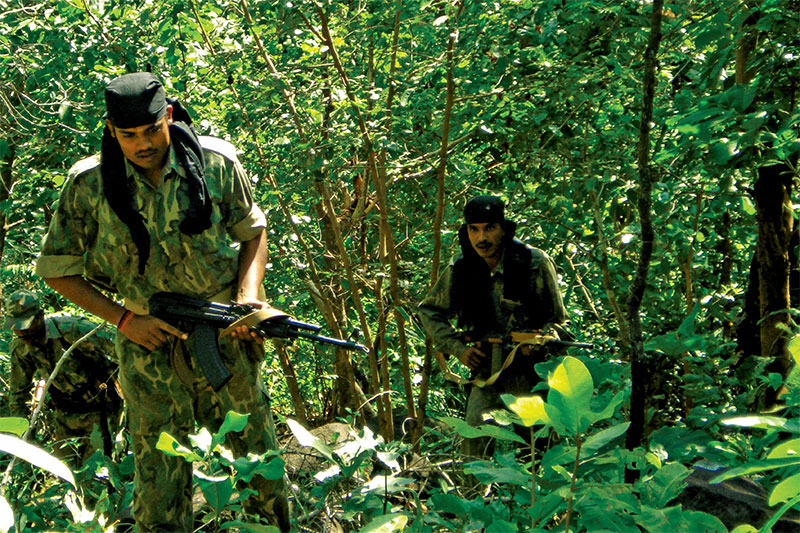
CRPF personnel conducting a patrol
For India, which has for two decades faced a grave threat from Taliban relocating to Kashmir from Afghanistan, the threat is dire.
The horrific Easter bombings on April 21 that killed close to 253 people and injured more than 500 in Sri Lanka shocked the world with the sheer scale and barbarity of the attack. While the IS claimed responsibility for the bombing, the Sri Lankan government blamed the local group, National Thowheed Jama’ath (NTJ), for the attacks. Compounding the failure of the Sri Lankan security agencies in anticipating the attack was a botched raid on terrorists hunkering down in a house near Kalmunai town in the Eastern province of the island nation that left 16 dead, including six children, three women and two suspected terrorists. The police seized a large cache of suicide kits, explosives, detonators, 10,000 ball bearings and IS uniforms and flags.
There is a global consensus that the tragedy happened because of a colossal intelligence failure on the part of the Sri Lankan authorities, which the government has now acknowledged. The Indian intelligence network claims to have raised at least three alerts, including on the day of the attack, the first one was sent at least 17 days back, sources claimed. India’s National Investigation Agency (NIA) stumbled upon a video of Maulvi Zahran Bin Hashim, the leader of NTJ, while it was probing the IS Coimbatore module. The inputs mentioned possible targets and locations of the terrorists’ hideouts in great detail and were passed on to the Lankan authorities on time.
However, considering the bitter differences between the president and the prime minister and the lack of coordination between different departments, no action could be taken on the valuable intelligence reports. The island nation emerged from a severe constitutional crisis last year when the country’s President Maithripala Sirisena tried to remove Prime Minister Ranil Wickremesinghe and replace him with former leader Mahinda Rajapaksa. The failed coup gave rise to an unstable and weak government, widening the chasm between the top leaders, and eroded the trust amongst them.
Notwithstanding the failure by the Lankan authorities to thwart the barbaric attack, the developments later represented a significant success for the Indian intelligence agencies. It’s now becoming increasingly clear that the NIA, including India’s spy agency, Research and Analysis Wing (R&AW), had been actively monitoring the IS activities in the South, which led to the tip-off. The agencies analysed in detail the video evidence of Hashim, in which he had exhorted Muslim youth from Sri Lanka, Tamil Nadu and Kerala to establish an Islamic rule in the region. The evidence was further investigated by R&AW, who subsequently alerted Sri Lanka.
Also Read:
The BJP’s 2014 manifesto reiterated the cornerstone of India’s policy on Jammu and Kashmir – that the state would remain an integral part of the Union of India.
Also Read:
Jammu and Kashmir - Article 370
In the last five years, BJP claims to have made all necessary efforts to ensure peace in Jammu and Kashmir through decisive actions and a firm policy
Also Read:
Jammu and Kashmir
The Congress claims it has long held the view that dialogue is the only way to understand the aspirations of the people of the three regions of Jammu and Kashmir and find an honourable solution to their issues and promises.
A significant role was played by the nodal agency, Computer Emergency Response Team (CERT-In) in revealing the contents of the digital evidence connected to the bombings. This agency, which looks after the computer and digital content, retrieved deleted files from hard discs, laptops, mobile phone and other materials seized during the searches of the IS-Coimbatore module. The Indian intelligence agencies acted in unison in unearthing the plot.
While the role of Indian intelligence was globally acknowledged in the Sri Lankan bombings, security analysts compared it to the February 14 Pulwama attack, another brazen bombing which resulted in the deaths of over 40 Central Reserve Police Force (CRPF) personnel. The attack was carried out by a vehicle-borne suicide bomber at Lethpora on the Jammu-Srinagar National Highway in the Pulwama district. This was the first time that a suicide bomber in an explosive-laden vehicle rammed into a CRPF convoy, with explosives estimated to be about 80 kg. The scale and the modus operandi of the attack raised serious questions on the intelligence agencies, which in Jammu and Kashmir had been very successful in the past in all militancy related operations. The Special Operation’s Group (SOG) of Jammu and Kashmir, along with CRPF and the army have a strong security network with an enviable success rate. However, in the case of Pulwama, questions such as ‘how such a large scale of explosives went undetected’ or ‘why such a large convoy was allowed to travel alongside civilian traffic’ have left everyone stunned.
Security agencies have failed to answer how such a large quantity of explosives was collected and preparations for the attack went undetected. Questions have been raised on how there were no footprints for intelligence personnel to identify and take action on. No interceptions of communication links between the suicide bomber and his handler were detected. The political leadership and policymakers in New Delhi, and police and security officials involved, were answerable for the lapse of this proportion. The Pulwama attack exposed serious flaws inside the intelligence agencies and the need for reforms in their daily functioning.
Talking of intelligence failure and internal security as a whole, another prominent example was the 6 April 2010 Dantewada attack. It was when close to a thousand Maoist insurgents laid an ambush near Chintalnar village in Dantewada district, Chhattisgarh and killed 76 CRPF policemen in the deadliest attack by Left-wing Extremists (LWE) on Indian security forces. Waiting on hilltops, in the Tadmetla forests, they opened fire and triggered an improvised explosive device (IED) blast as the convoy appeared. The Naxals were aware of the CRPF movement and executed their attack with fierce precision, giving the jawans no chance to react. The Union home ministry admitted the failure in security apparatus and lack of intelligence inputs. Nine years on, the situation hasn’t significantly improved as far as the Naxal areas are concerned.
Subscribe To Force
Fuel Fearless Journalism with Your Yearly Subscription
SUBSCRIBE NOW
We don’t tell you how to do your job…
But we put the environment in which you do your job in perspective, so that when you step out you do so with the complete picture.






 VIDEO
VIDEO