The punitive raid carried out by the Indian Air Force (IAF) on Jaish-e-Mohammad (JeM) bases in Pakistan Occupied Kashmir (PoK) has focused attention on Optical Targeting Pods (OTPs). The Mirages that carried out the raid were fitted with Litening precision targeting system. Litening and similar optical targeting facilitators are systems that track, identify and designate targets with laser beams. The laser beams reflected off the targets are caught by the laser beam identifiers in the nose cone of advanced precision-guided munitions that lock on and home in the target with amazing accuracy.
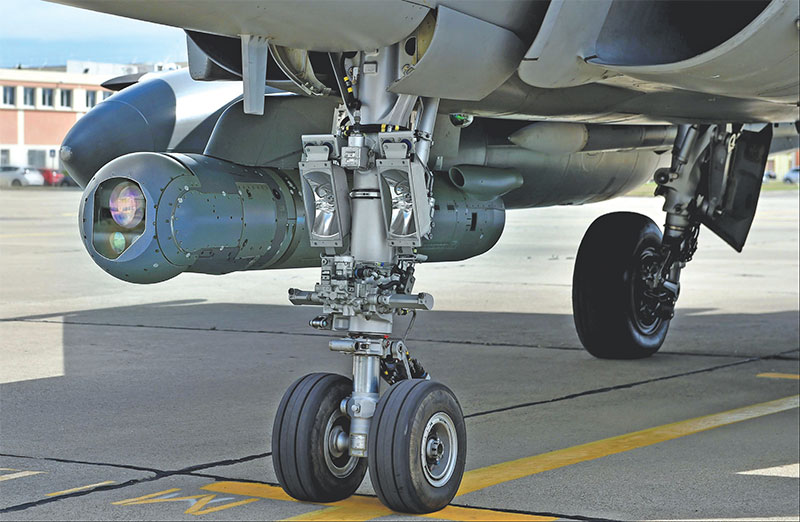
Thales’ TALIOS optronic pod fitted on a Rafale
The advances in optical electro-targeting systems across the world have been spectacular in the past three decades. The comparatively small plug and play systems, which are in size and weight the equivalent of an air-to-ground missile, can be force-multiplier for an aircraft, increasing the targeting acquisition time, accuracy of strike and lethality many times, and enhancing stand-off-and-kill capability of the strike aircraft.
Optical targeting systems have come a long way from being just target designators. The latest systems have electro-optical sighting capability during the day and infra-red sighting during night, providing the strike aircraft ability to operate round the clock.
Bombers have come a long way from the primitive zeppelins and bi-planes of World War I. The two World Wars led to development of more sophisticated technology in target acquisition, but for most of the duration of the two wars, the sighting was visual and manual. Surveillance and Target identification that began with low-flying zeppelins, balloons, and photography by Kodak cameras by the first flying aces of World War 1 saw little development through World War II. However, the rapid advancement of electronics in the Seventies and Eighties changed the whole scenario.








 VIDEO
VIDEO