

India Pushed to the Edge
How to promote peace in the Asia Pacific was discussed at the recently held 9th Beijing Xiangshan Forum (October 21-22) — an annual congregation of defence ministers, military leaders and defence experts from across the globe — in China. Under contention were two competing security architecture models led by China and the US — Asia Pacific and Indo Pacific respectively. Whichever nation’s model gains maximum acceptability amongst smaller, developing and littoral countries would dominate geo-politics, geo-economic and geo-strategy in the vast area across two oceans — western Pacific and Indian Ocean —, which is universally acknowledged as the fulcrum of global power in this century.
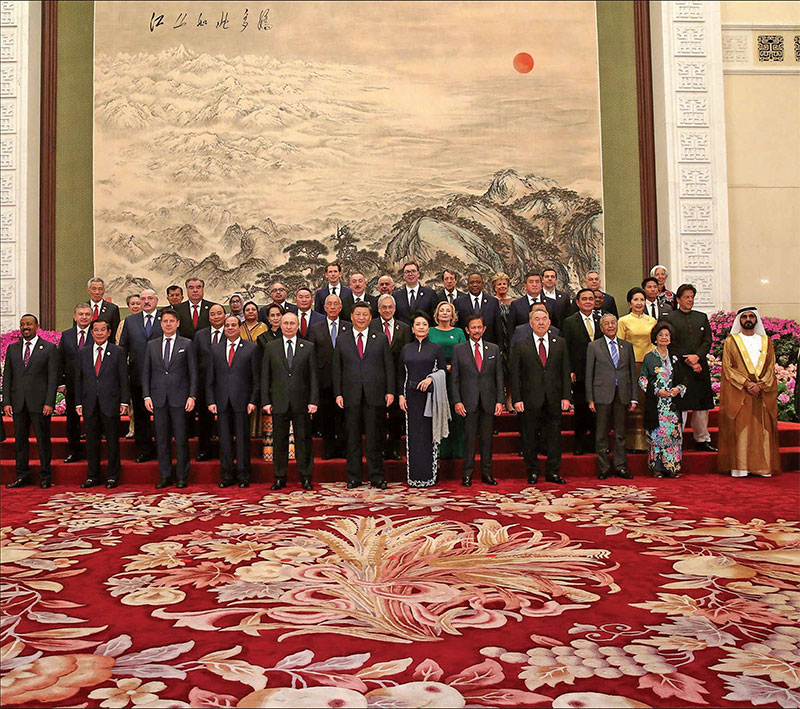
International leaders at the second Belt and Road Forum for International Cooperation in April 2019 in Beijing, China
India has not positioned itself well with either security architecture. Perhaps the significance of the security architectures is not understood. Or, there is complacency that India’s geo-political status — given its geography, demography, economic potential and huge landmass — is unassailable. Whatever be the reason, India, unfortunately, faces prospects of strategic irrelevance in its own neighbourhood.
Unwittingly or deliberately, US helped two geo-strategic nations (with ability and will to influence events beyond its geography) — China and Russia — to come together and collectively oppose its security architecture model. In its Indo-Pacific strategy report released by the US department of defence on 1 June 2019, China has been described as ‘revisionist power’ while Russia is called ‘revitalized malign actor.’
Not to miss the opportunity to beat the US, China made a deviation in its Forum presentation. Instead of earlier year’s Forums when Chinese defence minister alone delivered the keynote address to mark the beginning of plenary sessions to open discussions, this time there were two keynote speakers: Chinese defence minister, Gen. Wei Fenghe and Russian defence minister, Gen. Sergei Shoigu.
Talking about the US, Gen. Shoigu said: “The US wants to create tensions in Asia-Pacific and Europe. They will create conditions for conflict. The terms of Indo-Pacific strategy are vague, it does not include all nations in the region, it is an alliance of interests with grave consequences, it will undermine multilateralism and they (US) will have no choice but get involved in conflict. The Indo-Pacific concept will harm common security concerns by not strengthening military cooperation for all nations. This will also lead to an arms race.” Gen. Shoigu added that Russia “would work with its Asia-Pacific partners, will be ready to provide bilateral and multilateral military cooperation to all nations for common security in Asia Pacific.” With this the mood of the Forum was set.
Coming to China’s Asia Pacific model, since it has a defined strategy or roadmap and the mechanism to accomplish it — encapsulated in the 2013 Belt and Road Initiative (BRI) — it has taken lead over the US model. The BRI offers both prosperity and security (since the two are indivisible) to nations which join it — an attractive proposition for developing nations. With finances from the Asia Infrastructure Investment Bank and the One Belt One Road fund (both with maximum Chinese stakes) China would help, with mutual consultation and mutual agreement, develop infrastructure comprising roads, ports, railways, energy plants and so on for nations which join the BRI. Having learnt lessons from the Hambantota port case of alleged debt-trap, China recently, offered more openness, transparency and funds commensurate with a nation’s financial state so as not to get a bad name for the BRI.
China has also offered to take the BRI assistance to the higher digital level of trade and commerce to integrate BRI nations into the global business chains. This would be done by the Digital Silk Road which was incorporated in the BRI in 2015.
In South Asia, where except for India and Bhutan, all nations are onboard BRI, Chinese companies have started laying submarine undersea cables, fibre optics cables, and Huawei 5G telecommunications infrastructure. By 2020, once the Chinese Beidou global navigation satellite system becomes operational, the BRI nations would get its benefits. China, thus, has promised both traditional and new age digital means for development and prosperity. Moreover, since China is competing with the US in the fourth industrial revolution — the age of Artificial intelligence (AI) — its unprecedented commercial benefits too would be available to BRI nations when they are integrated into its AI-backed networks.
Subscribe To Force
Fuel Fearless Journalism with Your Yearly Subscription
SUBSCRIBE NOW
We don’t tell you how to do your job…
But we put the environment in which you do your job in perspective, so that when you step out you do so with the complete picture.






 VIDEO
VIDEO