That India lacks vision to make the most of the once-in-a-century global geopolitical opportunity to improve lives of its 80 crore (800 million) poor people was apparent by its reactive foreign policy observed on a single day: January 27. This day, a full week after his inauguration, US President Donald Trump, on India’s request, spoke with Prime Minister Narendra Modi. This was a clear indication that for Trump, India was important but not a high priority in his second term which promises to be as disruptive as his first one.
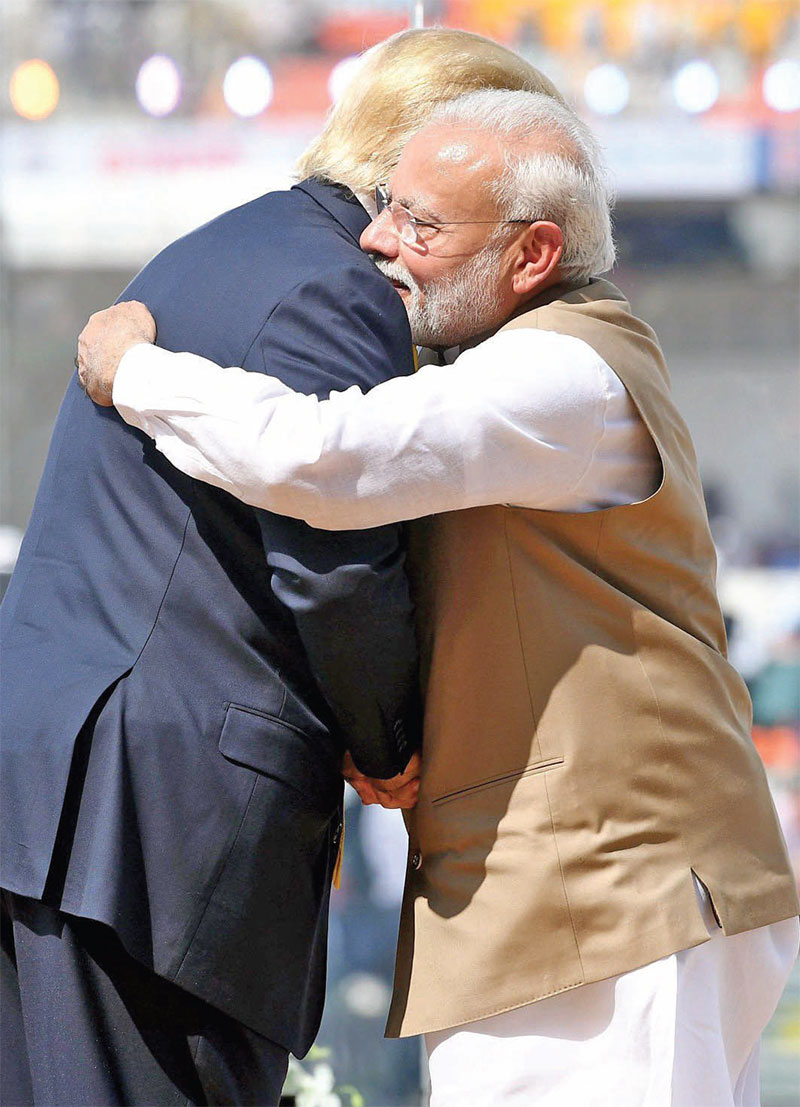
In his first term, by banning Chinese Huawei from the US market in 2017, and by naming China and Russia as US’ pacing competitor and a revisionist power respectively in his 2018 national security strategy, Trump declared trade war on China and the need to strengthen US’ military power in Asia Pacific which he re-named Indo Pacific in May 2018 to give centrality to India.
In his present term, he intends to actualize his election campaign slogan of Make America Great Again (MAGA) by isolationism and ending wars. Isolationism does not mean the US will withdraw from the world, but that it will concentrate on freeing western hemisphere (Canada, Greenland, and Latin America) of Chinese and Russian influence, and by building national power (the sum of innovation, manufacturing, deterrence and war fighting capabilities) which has declined relatively against China. And, ending the wars in Ukraine and West Asia would allow the US to focus on its top priority—MAGA.
The issue where Trump has yet not shown his hand is the security competition in the Indo Pacific against China, where India has a major role in the Indian Ocean Region. For India, this is hugely troubling as the Modi government has aligned its national strategy with the US. Believing that the US will remain the single greatest power in the foreseeable future, India formulated its two-pronged approach to handle China’s rise: One, by not normalising ties with China, India wants to tell its domestic audience that it is capable of regional geopolitical competition with China since both nations are rising in stature. And two, it hopes to get technological support from the US and its allies for building its national power.
This dependence on the US had created unease, if not outright panic, in the Modi government. What if Trump, unlike the Biden administration, decides to go slow on the security competition by not provoking China on Taiwan and South China Sea, two issue which could escalate beyond the grey zone operations. Since Trump prefers dealmaking and tariff threats to security competition which could lead to wars, there is good reason for the Modi government to review its foreign policy afresh with China. This it hesitates to do. After all, it will be tough justifying normalisation of ties with China when it continues to occupy Indian territory in east Ladakh.
Hence, on the one hand, the external affairs minister, S. Jaishankar’s visited the US twice within a month. He went in December to meet with the Trump transition team for perhaps an invite for the Prime Minister to attend Trump inauguration, failing which for himself to attend the inauguration as the special envoy of the Prime Minister. The Modi government’s message which Jaishankar delivered to the US secretary of state, Marco Rubio, following the Trump inauguration betrayed extreme anxiety. At a time when the world, especially US’ allies were sizing up Trump’s agenda, Jaishankar told Rubio that India wanted to take the bilateral relationship to greater heights with bolder and bigger steps. Such a cart blanche amounted to offering strategic loyalty to the US.


 VIDEO
VIDEO