Nothing could have better encapsulated the ebb and tide of India-US relationship than the recent visit of Prime Minister Narendra Modi. Despite the hype in India, even his greatest admirers conceded that the new US administration was remarkably cold towards the Indian Prime Minister in the sharp contrast to his last visit during Donald Trump’s tenure.
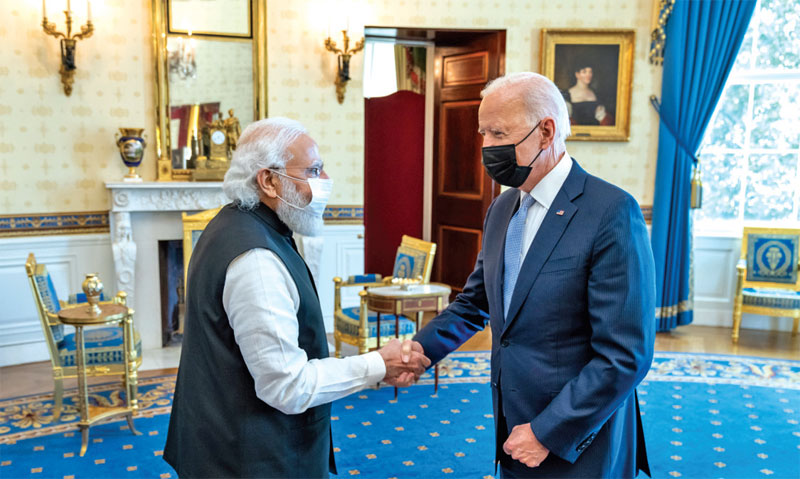
Prime Minister Modi meets President Biden at the White House
Either President Joe Biden was still smarting from Modi’s partisanship in announcing ‘abki baar Trump sarkar’, or he was conscious that post-Taliban sweep in Afghanistan, the geopolitics of the region has changed so rapidly that it really has nothing much to offer India at the moment beyond what has already been served.
Those with a sense of history would dismiss this as the nature of the relationship between two ‘natural allies’. While democracy is frequently invoked as a natural binder, India and the US have several other shared interests and concerns. Equally, the national interests of the two often conflict with one another. The biggest example of this has been India’s strategic ties with Russia.
Washington has frequently expressed displeasure with India for buying defence equipment from Russia, which remains one of India’s biggest suppliers of military hardware. A year ago, when India was poised to sign the USD 5.5 million agreement with Russia for the S-400 air defence missile systems, the US warned India that the deal could attract US’ Countering America’s Adversaries Through Sanctions Act (CAATSA). A senior US official was reported to have said, “We urge all of our allies and partners to forgo transactions with Russia that risk triggering sanctions under the CAATSA. CAATSA does not have any blanket or country-specific waiver provision.” India went ahead with the S-400 deal.
“The problem we face with respect to India must be separated from the larger issue that’s about the CAATSA legislation,” says Ashley Tellis, Tata Chair for Strategic Affairs and Senior Fellow, Carnegie Endowment for International Peace. He was speaking at the recent event, ‘Implications of CAATSA on US-India Relations’ organised by the USISPF. “I am actually quite sympathetic to the CAATSA legislation because I see that as a justified response on the part of the US to what Russia has done… One can hold that the CAATSA legislation is justified but its application to India is not... The CAATSA legislation that is applied to India is fundamentally counterproductive,” he said.
According to Tellis, there are two clear reasons for why this waiver justification is tellable here. “First is that India is not a US ally and therefore, India’s freedom to trade with Russia should not be impacted by the US domestic legislation. We never had the expectation when we were working on the transformation of the US-India relationship that India would cut off ties with its own partners around the world. We had very difficult discussions that time, with respect to India’s relationship with Iran and we reached mutual accommodations because both sides were respectful of the autonomy in foreign policy-decision making that both sides treasure. It is completely consistent in my mind to hold Turkey to sanctions because its alliance membership subverts our collective obligation to mutual defence in a way that a waiver for India does not in any way implicate because we have no collective defence agreement. India’s acquisition of the S-400 does not undermine the US military policy in any way.”








 VIDEO
VIDEO