

India and the World | Conflict and Cooperation
During the Doklam stand-off between Indian and Chinese armies in 2017, the Indian public was quick to react by engaging in a discourse around banning Chinese products from India. The fervour around it was so much that several Ganesh pandals during the religious festival known as Ganeshostav, which is celebrated across Maharashtra adopted the banning of Chinese goods as a theme.
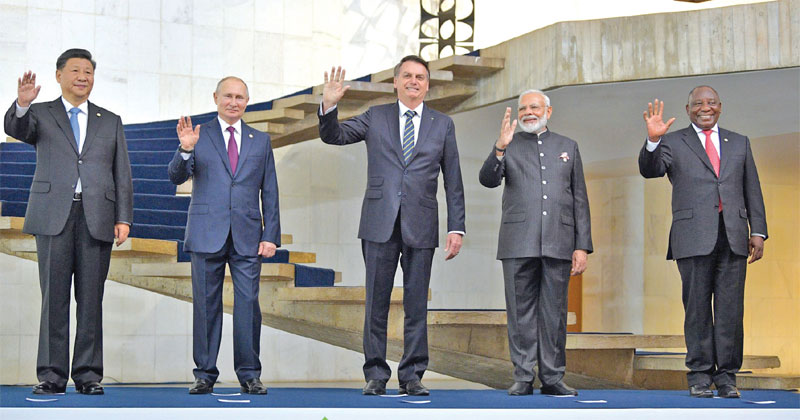
Chinese President Xi, Indian Prime Minister Modi, Russian President Putin, Brazilian President Jair Bolsonaro, South African President Cyril Ramaphosa during BRICS 2019
This was repeated when the Ladakh stand-off started in 2020. This time, the campaign was driven by Sonam Wangchuk, an engineer, innovator and education reformist based in Ladakh. In a video that went viral, Wangchuk called on Indians and people the world over to use their ‘wallet power’ to weaken Chinese economy. He asked people to stop using Chinese software and hardware, including phones and computers. “If we boycott these goods, it’ll send a clear message to China that the world is not happy with you,” he said.
His message failed to hit home. According to government of India data, India’s imports from China rose by 33 per cent in the April-June quarter of last year. In fact, the Chinese city of Yiwu, which is the world’s largest wholesale market of small commodities makes its money from export. India is its number one market. Chinese technology is integral to our everyday lives, despite the Indian government banning 59 Chinese apps in January 2021 under Section 69A of the IT Act.
Most recently, according to China’s General Administration of Customs’ (GAC) data published in December 2021, the India-China trade has crossed USD 100 billion. This figure was up by 46.4 per cent year-on-year from January to November recorded last year. While India’s exports to China reached USD 26.358 billion (a 38.5 per cent increase), India’s imports from China amounted to USD 87.905 billion (a 49 per cent increase). Trade deficit stood at 61.547 billion, a 53.49 per cent increase.
Take the example of Chinese video conferencing platform ‘Zoom’, which was the lifeline of people forced to work from home during the pandemic. An Indian Express report from May 2020 quotes Zoom India head and general manager, Sameer Raje as saying, ‘We have grown from 10 million participants a day to over 300 million participants a day on our platform and that’s happened in a period of 12 weeks.’ He added that India’s chunk was quite significant. Zoom became the most downloaded app in India, beating TikTok, Instagram and WhatsApp.
The civilian population is not the only one hooked onto Chinese technology. Recently, Indian Space Research Organisation (ISRO) signed an agreement with the Chinese firm Oppo, an electronic device maker. This agreement aims at strengthening research and development (R&D) of the NavIC messaging service, which provides detailed regional navigation services covering the Indian mainland and an area up to 1,500 km beyond the Indian mainland. In addition to its primary function of providing PNT (position, navigation and timing) services, NavIC is also capable of broadcasting short messages.
In a statement, Oppo India said, ‘The memorandum will pave the way for future collaborations between ISRO and Oppo India to develop indigenous solutions by incorporating the NavIC short messaging feature in the smart-phones released by OPPO India.’ The application will provide exchange of technical information of NavIC messaging services to build rapid, ready to use, end-to-end application-specific solutions. ISRO Chairman, K. Sivan urged Oppo India to include NavIC in all their upcoming platforms.
Furthermore, major Indian start-ups such as Zomato, Swiggy, Big Basket, Policy Bazaar, Flipkart, Ola etc., have huge Chinese investments. India’s pharmaceutical sector too is a major recipient of Chinese FDI.
After a gap pf nine months after the Ladakh border skirmish, the Indian government in February 2021 started clearing FDI proposals from China on a ‘case-by-case’ basis. In March, the government announced that Chinese investments in sectors critical for India or where local companies don’t have adequate capacity will be considered for approval.
Subscribe To Force
Fuel Fearless Journalism with Your Yearly Subscription
SUBSCRIBE NOW
We don’t tell you how to do your job…
But we put the environment in which you do your job in perspective, so that when you step out you do so with the complete picture.




 VIDEO
VIDEO