During the 2016 Republic Day parade, a foreign contingent for the first time marched down the Rajpath alongside the Indian Army. It was the French Army’s 35th Infantry Regiment and the Musical Infantry Regiment. That year, the chief guest for the parade was French President Francois Hollande.
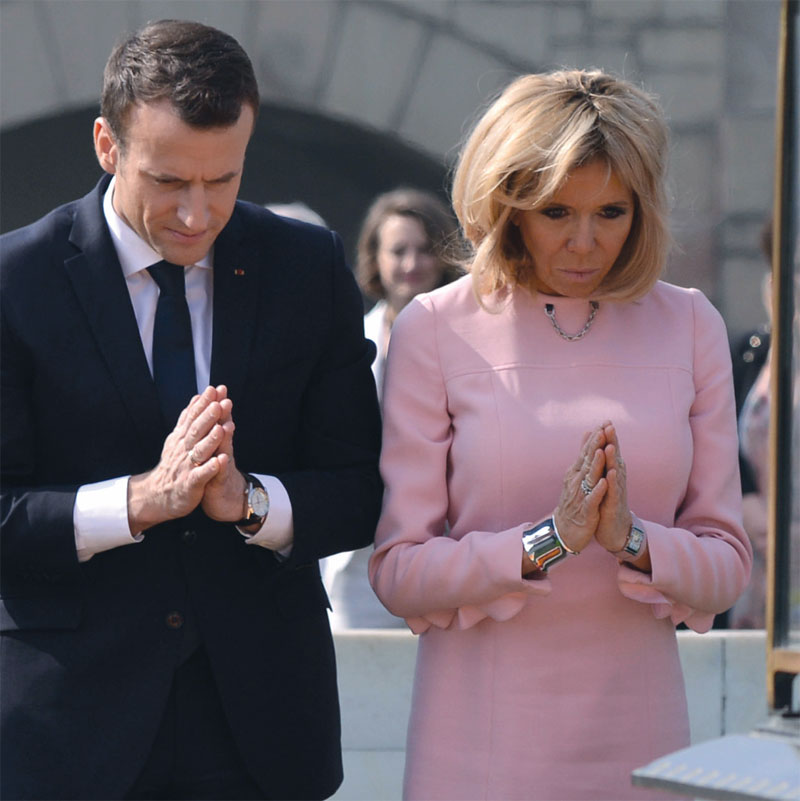
French President Emmanuel Macron and Brigitte Marie-Claude Macron during their India visit
The past few years have seen the Indo-French bonhomie grow. There are historical, cultural as well strategic reasons for this multi-sectoral growth, from the time bilateral relations between the two countries were first established. The French first came to India in 1673 and purchased land at Chandannagar in Bengal. In 1674, they took Pondicherry from the Sultan of Bijapur, which later became a French enclave. Even after the British took over most of India, including the Madras Presidency, France retained influence over Pondicherry, Karikal, Yanam, Mahe and Chandannagar. Even today, Pondicherry, now called Puducherry, recognises French as an official language.
Strategic Cooperation
India and France have been working with one another in a number of areas, ranging from art & culture (in January 2020, the two announced that they would work together in the field of museums, art research and festivals), energy, space, trade and defence. In defence, France is one of India’s key supplier of equipment, as well as partner. Even during the Cold War, Indo-French relationship remained an exception.
Writing in Carnegie International, C. Raja Mohan says, ‘Postcolonial India’s emphasis on strategic autonomy seemed to resonate with Gaullist France, which revelled in its independent foreign policy during the Cold War. In the early decades after India’s independence, France emerged as an important partner in the high technology domain, making crucial contributions to India’s heavy water production and nuclear fast breeder reactor programme, as well as its rocket programme, especially powerful liquid-fuel engines. France also became a major defence partner in the early 1980s, as India began to diversify the sources of its military hardware and decrease reliance on the Soviet Union. Among other hardware, France has supplied Mirage fighter aircraft, Scorpene submarines, and Rafale fighter jets.’
France was one of the earliest powers, with which India signed the strategic partnership agreement, way back in January 1998, during President Jacques Chirac’s visit. This was the consequence of France’s consistent support of India through the 1950s, when the US and UK had imposed wartime information censorship on atomic energy. The chairman of the French Atomic Energy Commission (CEA) Frédéric Joliot-Curie visited India in January 1950 and offered technical cooperation during a special meeting with the Indian Atomic Energy Commission (IAEC) in Delhi. Curie offered to share information on the purification of uranium, graphite reprocessing, and designs of a low power reactor in exchange for India’s export to France of thorium, beryllium, and uranium.
The following year, the countries signed the bilateral agreement for the research and construction of beryllium-moderated reactors. By 1968, the two countries were on the same page regarding most international issues. This included the Nuclear Non-Proliferation Treaty (NPT), which neither India nor France signed, deeming it discriminatory.




 VIDEO
VIDEO