

India and the BRI | Why Thailand Matters
China’s ambitious Belt and Road Initiative (BRI) is about making strategic investments in various countries. The multi-billion dollar BRI project aims at connecting Asia, Africa and Europe. The Indian Ocean Region (IOR), which includes the Bay of Bengal and the Andaman Sea, plays a key role for China to further its economic, political and military aspirations. To the east of the Bay, lie the 10 Southeast Asian countries which form the regional intergovernmental grouping—Association of Southeast Asian Nations (ASEAN).
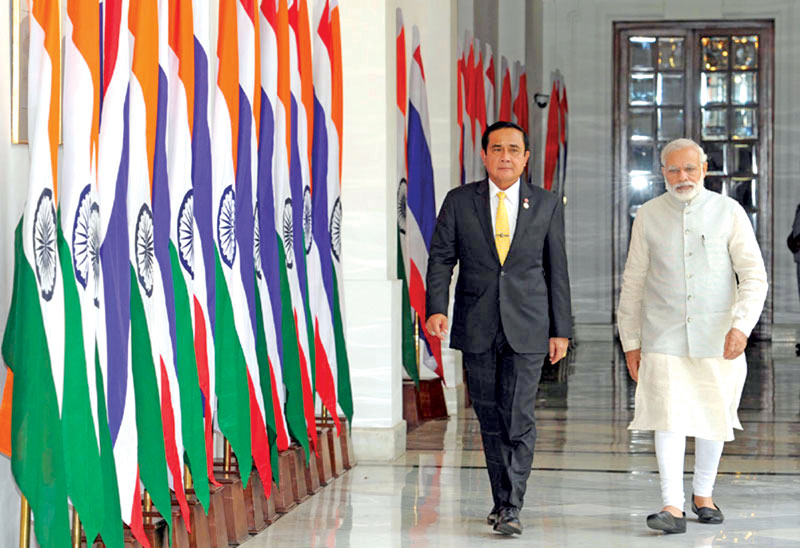
Prime Minister Narendra Modi with the Prime Minister of Thailand,
General Prayut Chan-o-cha at Hyderabad House, in New Delhi on 17 June 2016
What makes ASEAN a promising destination for investments? The answer lies in its geography and economic growth. As per recent data by Statista, the GDP of ASEAN has seen a steady growth in the past decade. In 2019, the estimated total GDP of all ASEAN countries amounted to approximately USD9.34 trillion. Recognising the potential that ASEAN holds, world powers including the US and Japan have made heavy investments in the region.
A small part of the north-eastern Indian Ocean is known as the Andaman Sea, which is bound by the coastlines of Myanmar and Thailand. As equations between countries change and China asserts presence in the Indian Ocean, the Andaman and Nicobar islands and the Andaman sea hold strategic importance for India. The Malacca Strait, which is the eastern gateway to the Andaman sea, joins the Bay of Bengal with the Indo-Pacific to reach Europe, thereby, enabling trade. The IOR, through its various sea lanes of communication (SLOCs) and chokepoints, facilitates almost 80 per cent of global maritime oil trade. India alone is dependent on the IOR for almost 70 per cent of its own oil imports. The strategic location of the Andaman and Nicobar islands enables them to secure SLOCs through chokepoints such as the Preparis Channel to the north, Six Degree Channel to the south of the islands and the Ten Degree Channel that lies in between the two island groups.
It is also important to note that while the Indian Ocean may be very important for trade, these waters are equally volatile with the increasing numbers of conflicts among countries. That’s one reason why a significant number of developed countries, and not just India and China, have stationed their militaries in the IOR.
As a result, experts in the field of international relations have pointed out a number of reasons why India must tighten its grip over the Andaman Sea. With China undertaking projects like the Kra Isthmus with Thailand, which shares a maritime boundary with the Andaman and Nicobar islands and with the China-Myanmar Economic Corridor (CMEC), China is not only fulfilling its trade-connectivity aspirations by the way of acquiring ports and undertaking different constructions in the Indian Ocean, but it is also growing closer to realise its agenda of surrounding India militarily which threatens India’s Andaman and Nicobar Command (ANC).
An important aspect about the Andaman and Nicobar islands is that they are located away from mainland India but comparatively closer to Southeast Asia, which makes them an asset for India’s Act East policy. The islands can, therefore, help India in safeguarding its space in the Bay of Bengal. It is also because of these islands that China has expressed its ‘Malacca Dilemma’. In the past few years, the number of Chinese submarines making forays into the IOR has gone up. A growing number of Chinese projects in countries of IOR would make it easier for China to dominate the Indian Ocean, threatening India’s presence. Famously, the Andaman and Nicobar islands are known as India’s assets in the IOR. Safeguarding them would mean both, a strong Indian naval presence in the IOR and in turn security to the whole of India.
India and Thailand
Even as India and Thailand established bilateral relations in 1947 and shared cordial relations, it was only after the end of the Cold War that India and Southeastern nations, including Thailand began forming ties while understanding the potential each held for one another. Former Prime Minister Rajiv Gandhi became the first Indian prime minister to visit Thailand only in 1986. Three years later, in 1989, then prime minister of Thailand Gen. Chatichai Choonhavan visited India.
In the early Nineties when the Cold War ended with the collapse of the Soviet Union, India introduced its Look East policy in 1991. In 1996, it was complemented by Thailand’s Look West policy. Eventually, Look East policy became Act East. Presently, the two countries focus on trade, security cooperation and infrastructure building. Thailand is both India’s and China’s strategic point to dominate the Andaman Sea and in turn the Bay of Bengal. The two countries undertake joint military exercises to boost interoperability, undertake maritime security to counter insurgencies and terrorism. A safe Indo-Pacific works in the interest of both these countries.
Subscribe To Force
Fuel Fearless Journalism with Your Yearly Subscription
SUBSCRIBE NOW
We don’t tell you how to do your job…
But we put the environment in which you do your job in perspective, so that when you step out you do so with the complete picture.



 VIDEO
VIDEO