

India and the BRI | The Great Game Redux
In 1991, when Soviet Union disintegrated, the tremors were felt all around the neighbourhood, including as far as India, which had regarded the USSR as its closest strategic ally and a defence industrial partner. From the debris of the USSR emerged 15 independent countries, including five Central Asian Republics.
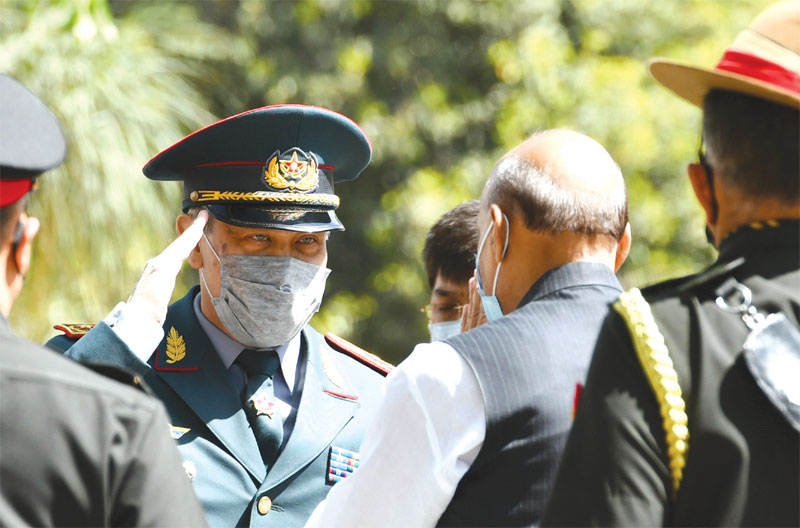
Defence Minister Rajnath Singh with Kazakhstan Defence Minister Lt Gen. Nurlan Yermekbayev in New Delhi
For India, the challenge was establishing diplomatic ties with each of these new countries. This required a delicate balancing act. A few of the newly-formed countries were inimical to Russia, the successor state of USSR. While India inherited its ties with Russia (from the USSR), its military hardware compulsions demanded that India build good relations with them (for instance, Ukraine) independent of Russia.
However, with some countries restoration of ties was dictated by history and strategic imperatives, including gas and mineral resources. The Central Asian Republics (CAR) comprising Kazakhstan, Kyrgyzstan, Tajikistan, Turkmenistan and Uzbekistan, fell in this category. These countries lie at the heart of Eurasia, a region that clubs together influential countries which are rich in terms of natural resources. It is the largest ‘continental’ area which covers 35 per cent of the land surface and is home to nearly 90 countries across two continents—Europe and Asia.
The region hosts the biggest world powers, that are economically, politically and culturally influential. Given the strategic position of CAR--sitting at the crossroads of Asia and Europe—the region is of geostrategic interest to all the major powers. CAR holds the potential for being the transit route that would allow easy flow of energy and goods, as a result of which an increasing number of countries are looking to partner with this region for trade.
Apart from geography, CAR is wealthy in terms of natural energy resources, especially, oil and gas. This attracts regional as well global attention. CAR nestles between such countries as Russia (to its north and west), China (to the east), Iran (southwest) and Afghanistan(south). The region has proximity with South Asia, Southeast Asia, the Middle East and Europe. The five countries that make up CAR thus have bilateral and multilateral partnership opportunities because of their geostrategic location. For instance, Tajikistan is located in close proximity with Pakistan Occupied Kashmir (POK) and is separated only by a narrow strip called the Wakhan Corridor, of about 65km. In some places, it gets as narrow as 15km. This corridor also is the closest land route between northern Afghanistan and China’s Xinjiang or east Turkestan province. The closeness in terms of geography makes the country strategically important for India too. This narrow strip is regarded as a bridge between Southeast Asia and Europe.
Towards its west, CAR has the Caspian Sea which is rich in natural resources. Caspian Sea has an abundance of natural resources. The littorals surrounding the sea are Azerbaijan, Iran, Kazakhstan, Russia and Turkmenistan. Given its geographic position, Kazakhstan has a better standing as compared to the other four countries including Uzbekistan, Kyrgyzstan, Turkmenistan and Tajikistan. Of these, Kyrgyzstan and Tajikistan are the poorest. In terms of area, Kazakhstan occupies the largest area, Turkmenistan comes second while also being the southernmost country, sharing a border with Afghanistan. Despite slow rate of economic growth and political instability (in some parts), the Central Asian region is rich in natural resources and therefore holds a lot of promise.
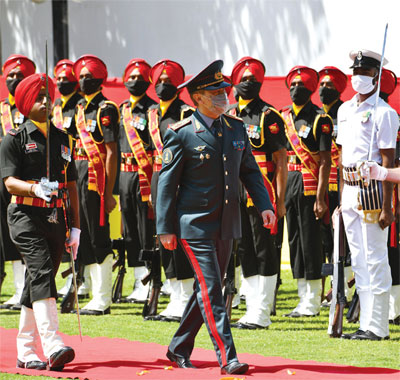
Kazakhstan Defence Minister Lt Gen. Nurlan Yermekbayev
inspecting the Guard of Honour
A 2017 report in Diplomat magazine said that the Central Asian states and South Caucasian states are the ‘best (and worst)’ places to invest. This analysis that coincided with 25 years of independence of these nation states said, ‘In 2016, all of the five Central Asian and three South Caucasian countries celebrated the 25th anniversary of their independence. Those two-and-a-half decades provided sufficient time for each state to form a new economic model, identify long-term development goals, and work out interaction patterns for both internal and external investors. Yet it’s a fact that almost all of the countries in these regions have failed to achieve major success in creating competitive, diversified, open economies, with effective protection for both private property and investor rights.’
Subscribe To Force
Fuel Fearless Journalism with Your Yearly Subscription
SUBSCRIBE NOW
We don’t tell you how to do your job…
But we put the environment in which you do your job in perspective, so that when you step out you do so with the complete picture.






 VIDEO
VIDEO