

India and the BRI | Gateway to the East
On the world map, Myanmar sits at a geographically strategic position. It shares borders with both India and China; and as the world stares at the power tussle between India and China, the Asian context of Myanmar increases manifold.
The Southeast Asian country shares 1,643 km of border with four Northeast Indian states that include Arunachal Pradesh, Nagaland, Manipur and Mizoram. The two countries also share a maritime border of about 725 km. Apart from India, Myanmar shares border with Bangladesh, China, Thailand and Laos. Myanmar is famously known as India’s ‘gateway’ to Southeast Asia, and is among the countries flanking the Bay of Bengal. As China bids to increase its influence globally to realise the Belt and Road Initiative (BRI), investing in growing Asian economies helps realise its objectives. Myanmar is one such country with its distinct geographic location.
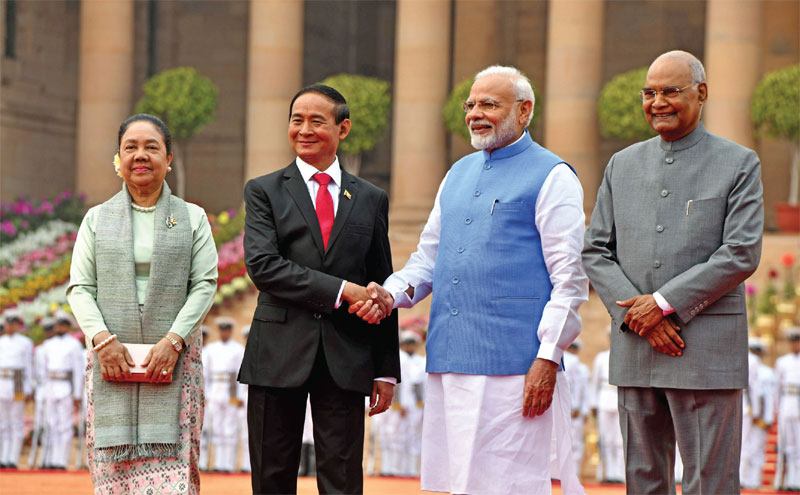
Prime Minister Narendra Modi and President Ram Nath Kovind with Myanmar’s
President Win Myint and First Lady Daw Cho Cho at Rashtrapati Bhawan
The Bay of Bengal
It stretches more than 2,173,000 sqkm and lies in the north-eastern part of the Indian Ocean. It is of importance for several littoral and landlocked countries for trade and transit. The Bay of Bengal, beginning from the southwest and taking a long curve to reach the southeast (to end there), holds together the coastlines of Sri Lanka, India, Bangladesh (the head of the Bay), Myanmar, Thailand, Malaysia and Indonesia’s Sumatra. Apart from these states, landlocked countries in the vicinity of the Bay—Nepal and Bhutan—are dependant on it. Consequently, its strategic and economic potential cannot be overemphasised.
Historically, the Bay served as a maritime highway for countries surrounding it, resulting in exchange of trade and cultural ties. As centuries progressed and European powers began staking control of different Asian countries along the Bay, and although a change in geostrategic relations took place, the importance of the Bay of Bengal remained intact. Later, when agricultural production began booming in these countries, a migration, that later came to be recorded as one of the largest in the history, took place via the Bay of Bengal.
Over a period of time, with the advent of steam ships, the Bay of Bengal played a vital role in connecting countries with one another. As time went by, countries around the Bay, including India, adopted a largely internal stance. Gradually, the economic interdependence and free trade was put to an end. The defocus was further strengthened when the countries in the region came to be divided into two parts—South Asia and Southeast Asia. While the northern and western countries of the Bay were regrouped in South Asia, the eastern part came to be called Southeast Asia.
The Bay regained importance gradually. The aforementioned countries surrounding the Bay have a GDP around USD 2.7 trillion and an economic growth of around 5.5 per cent, according to a report published by Carnegie India. “With the economic reforms of the Nineties in India and across South Asia, however, the Bay of Bengal’s geo-economic centrality and legacy of integration was slowly reactivated. Driven by the new logic of interdependence and comparative advantage, states in the region began seeing borders as connectors and invest in the infrastructure of connectivity to permit greater flows of goods, services, capital and ideas. No longer a gulf of disintegration, the Bay of Bengal slowly began assuming the role of a hub to leverage synergies between South and Southeast Asia,” the report states.
China’s strategy in the region lies in connecting the landlocked southern provinces with the Indian Ocean. The Bay stands out as a key transit zone between Indian and Pacific oceans along with being the main route for energy trade to east Asia. With the central position of the Bay, other major world powers like Japan, the US and Russia, too, are trying to assert their power in the region.
BIMSTEC
In 1997, Bay of Bengal Initiative for Multi-Sectoral Technical and Economic Cooperation (BIMSTEC), a seven-member regional intergovernmental group was formed. For India, an active participation in this grouping would help protect its regional influence and interest in the Indian Ocean.
BISMTEC has a large economic and development potential. Home to 23 per cent of world’s population, the grouping brings together economies that amount to USD3 trillion which translates into four per cent of global GDP and 3.7 per cent of the global trade. This grouping has an enormous trade potential of USD760 billion. However, in 2017 the intra-regional trade stood at USD83.90 billion.
BIMSTEC is a group that unites five South Asian countries including India, Bangladesh, Bhutan, Nepal and Sri Lanka with two Southeast Asian countries, Myanmar and Thailand. Myanmar has a greater role to play as it shares a land border with India and lies between India and the southeast. Experts believe that the fact that India has increased its cooperation with the BIMSTEC states is because it is wary of China’s increasing presence in the Indian Ocean Region (IOR). Many have termed this as ‘reactionary regionalism’ that arose out of the growing concern of Chinese influence. It is of great significance that in the BIMSTEC grouping, all countries, except India and Bhutan are signatories to the BRI, with huge Chinese investments. From the Indian perspective, the grouping gives a way to Myanmar to tilt towards South Asia and balance its cooperation between China and South Asia. As the disputes between India and Pakistan increased, India shifted its focus from SAARC to BIMSTEC. The latter does not include Pakistan. Under the grouping, India has signed several development projects with Myanmar for greater scope for trade and connectivity. The intra-regional trade among these countries is still low due to the lack of implementation of the Free Trade Agreement.
Subscribe To Force
Fuel Fearless Journalism with Your Yearly Subscription
SUBSCRIBE NOW
We don’t tell you how to do your job…
But we put the environment in which you do your job in perspective, so that when you step out you do so with the complete picture.



 VIDEO
VIDEO