

India and the BRI | Chinese Checkers
On 24 January 2019, China honoured the ambassadors of Pakistan, Sri Lanka, the Maldives, Malta and Bosnia-Herzegovina with ‘Super Ambassador Awards’ for their contribution to the Belt and Road Initiative (BRI) in Beijing.
The BRI, which is China’s ambitious project, aims to build major infrastructural projects with Chinese investments around the world via the ancient silk route. India has a problem with China-Pakistan Economic Corridor (CPEC), a flagship project under the BRI as it cuts through Pakistan Occupied Kashmir (PoK). China has made huge investments in the Maldives as part of its development programme which had made the Maldives join the Chinese camp.
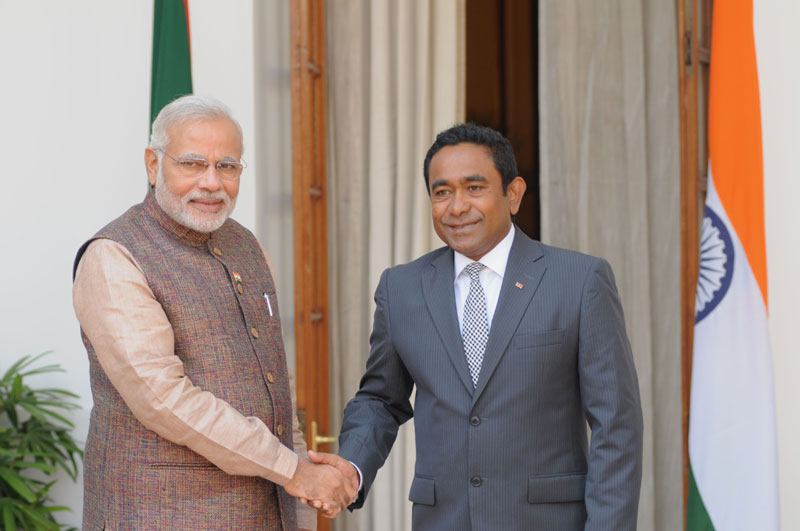
Prime Minister Narendra Modi with former Maldivian President Abdullah Yameen during a meeting at Hyderabad House, New Delhi
While it was former Maldivian president Abdulla Yameen Abdul Gayoom who signed the Free Trade Agreement (FTA) with China in 2017, it was former president Mohamed Nasheed’s government in 2011 that allowed the Chinese to open their embassy in Male. India had signed a preferential trade pact with Maldives in 1981, as per which, India supplied essential commodities and other goods to Maldives without restrictions and in return Maldives could export to India. Tuna fish was one of the many export items.
Through FTA, as Chinese goods make their way into the Maldivian market, India fears that they would make their way into the Indian market by a way of re-export.
Chinese presence in the Maldives means its presence in the Indian Ocean Region (IOR). Maldives’ northern-most islands are closest to India’s southern peninsula. The Chinese building its strategic bases in that area would mean direct interference with India. Similarly, Yameen’s government had started to do away with Indian presence from its Southern atolls where China has a number of investments and has also built the Male and Hulhule real estate projects in Hulhumale and the Laamu atoll. This would ensure a strong vigil and access to the 1.5-degree channel which is an important area for a coverage of the Indian Ocean.
China and Maldives have announced the construction of the Joint Ocean Observation Station, a planned maritime observatory to be built on Makunudhoo, the western-most atoll of Maldives. India’s concern here is that China would use it for military purposes against India.
Maldives and India
It was during former president Abdulla Yameen’s regime that a discomfort had crept up between the two countries. Male was downplaying India and favouring China by letting them take up large-scale projects like the airport project which an Indian company, GMR, had won a contract for and was worth USD500 million.
Historically, India and Maldives have enjoyed cordial relations. India was among the first countries to have formed diplomatic relations with the Maldives after they won independence from the British in 1965. Seven years later, in 1972, India established its mission in Male.
India and Maldives share cultural and linguistic similarities and Maldivians come to India for education, medical treatments, business or tourism. Similarly, thousands of Indians have been working in the Maldives for decades. The Maldives is one of the few neighbours that India does not have any border dispute with.
On the economic front, India exports medicines, textiles, agriculture and poultry produce to Maldives worth USD100 million.
Geographically, Male is closer to India than the Indian Union territory of Andaman and Nicobar islands. Haa Alif is located closer to Minicoy part of southern Lakshadweep than it is to Male. Dhivehi, which is the national language of Maldives, is spoken in Minicoy too. Interestingly, Maldivians are exempted from travel restrictions in Minicoy while Indians are not.
However, it was only during Yameen’s term that Indians living there faced difficulties and feared being jobless. The Maldives had and continues to have an India-First policy, which the Yameen-led government systematically tried to change to give way to China. Visa renewal was stalled and work visas were denied.
Indo-Maldivian relations started under former prime minister Indira Gandhi’s regime with diplomatic visits and signing of agreements. Since then India has provided the Maldives help in whichever area it was required at different times. In November 1988, a large group of 80-200 militants belonging to the People’s Liberation Organisation of Tamil Eelam (PLOTE), supported by the Maldivian businessman Abdulla Luthufi, threatened a coup in the Maldives. After infiltrating the capital, the militants spread out and seized other key areas in the city in an attempt to overthrow the then President Abdul Gayoom. He escaped and took refuge in the National Security Service Headquarters.
Subscribe To Force
Fuel Fearless Journalism with Your Yearly Subscription
SUBSCRIBE NOW
We don’t tell you how to do your job…
But we put the environment in which you do your job in perspective, so that when you step out you do so with the complete picture.
 VIDEO
VIDEO