

India and BRI | Vying for Attention
The closest distance separating Sri Lanka and India is 26km. The north of Sri Lanka is connected to India by a chain of islands and sandbars known as Adam’s Bridge. It is divided into an inland Vani region and the Jaffna peninsula on Palk Bay, a 15,000sqkm area nestled between Sri Lanka and south-eastern part of India with a coastal length of 250km on the Indian side. This geographical proximity and historical ties with India have made Sri Lanka a strategic partner. But more significantly, its strategic location in the Indian Ocean Region (IOR) makes it a much sought after partner.
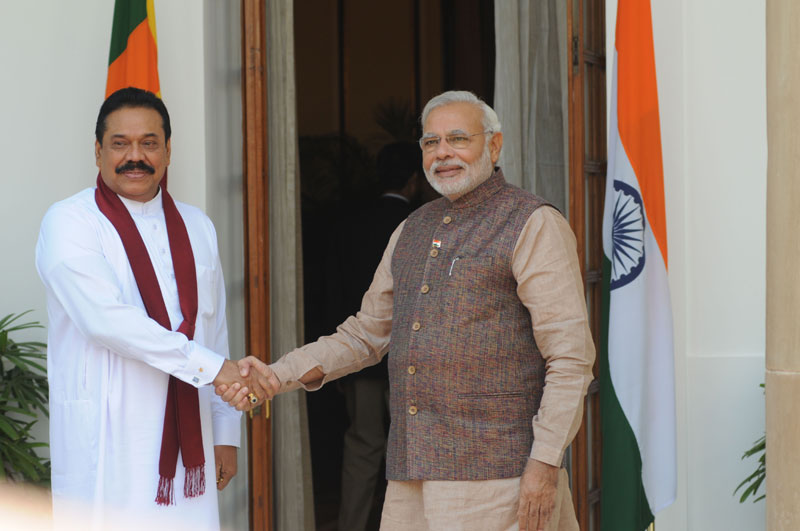
Prime Minister Narendra Modi with the President of Sri Lanka Mahinda Rajapaksa during a meeting at Hyderabad House in New Delhi
The country is located along east-west sea lanes and sits near the centre of the Indian Ocean just northeast of the Maldives island chain. Also, Sri Lanka is a signatory to Beijing’s ambitious Belt and Road Initiative (BRI) which is sometimes billed as the New Silk Road. Proposed in 2013 by China’s President Xi Jinping, the project is estimated to cost USD4-8 trillion. It aims to connect Asia with Africa and Europe via land and maritime networks along six corridors. Along with India, China is investing on a large scale in the island nation.
Ties with India
Sri Lanka is one of the largest trading partners of India in South Asian Association for Regional Cooperation (SAARC). The bilateral trade between India and Sri Lanka amounted to USD4.59 billion in 2019. However, in 2018, according to the Sri Lankan Customs, Colombo’s bilateral trade with New Delhi amounted to USD4.93 billion.
The signing and entry into force of the Free Trade Agreement (FTA) in 1998 and 2000 respectively gave much of the impetus to the current level of economic interaction between the two countries.
The Indo-Sri Lanka Free Trade Agreement (ISFTA) provides duty free concessions to an enormous range of products traded between the two sides. Sri Lanka got a fully duty free access to the vast Indian market under the ISFTA since the end of March 2003. Thus, entrepreneurs based in Sri Lanka can export more than 4,000 product lines to India duty free.
Indian investments in Sri Lanka are primarily in the areas of petroleum, retail, tourism and hotel, manufacturing, real estate, telecommunication, banking and financial services. Sri Lanka, on the other hand, exports textiles, garments, tea, spices, gems, coconut products, rubber and fish to India.
With cumulative investments of over USD1 billion, India is also among the top four investors in Sri Lanka since 2003.
As recently as on 23 May 2020, Sri Lankan President Gotabaya Rajapaksa and Prime Minister Narendra Modi agreed on the need to accelerate Indian-assisted development projects in Sri Lanka. They also discussed the possibilities of promoting investments and value-addition in Sri Lanka by the Indian private sector.
Ties with China
The fast-growing trade relationship between China and Sri Lanka is driven by a huge influx of Chinese imports which, however, has been leading to an expanding trade deficit between the two countries.
In 2000, Chinese imports were a mere 3.5 per cent of Sri Lanka’s total imports which had risen to 20 per cent by 2017.
Nearly four years ago, in 2016 China also became Sri Lanka’s largest source of imports, surpassing India. This feat was, however, brief and transient as the value of the Indian imports had marginally increased the Chinese imports subsequently.
However, unlike India, Colombo does not have any FTA with Beijing yet. However, both Sri Lanka and China along with India are part of the Asia-Pacific Trade Agreement (APTA) which was formerly known as Bangkok Agreement.
According to Commercial Counsellor of the Embassy of People’s Republic of China in Sri Lanka, Yang Zuoyuan, “The value of bilateral trade in 2018 has exceeded USD405 billion.”
Subscribe To Force
Fuel Fearless Journalism with Your Yearly Subscription
SUBSCRIBE NOW
We don’t tell you how to do your job…
But we put the environment in which you do your job in perspective, so that when you step out you do so with the complete picture.





 VIDEO
VIDEO