Palak Gupta
India is wary of the growing Chinese influence in the region and is working to keep Bangladesh from falling into Beijing’s orbit. Foreign secretary Harsh Vardhan Shringla made his first official visit to Bangladesh from 2 to 3 March 2020. During the visit, the foreign secretary also met minister of road, transport and bridges Obaidul Quader and security affairs adviser to Prime Minister of Bangladesh Maj. Gen. Tarique Ahmed Siddique (retd).
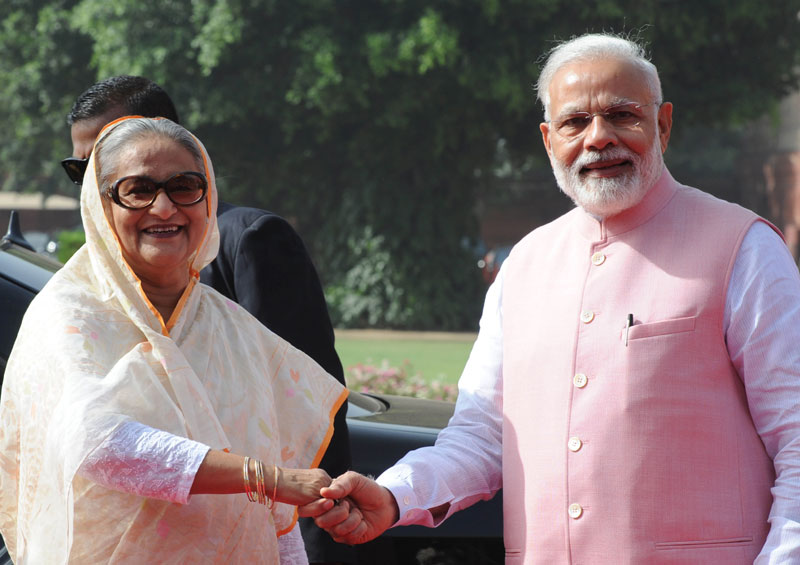
Bangladesh PM Sheikh Hasina with PM Modi
In South Asia, Bangladesh is the second-largest recipient (after Pakistan) of Chinese loans under Beijing’s ambitious Belt and Road Initiative (BRI) which is also known as the New Silk Road. The project, estimated to cost an estimated USD4-8 trillion, aims to connect Asia with Africa and Europe via land and maritime networks along six corridors. Dhaka is also an important player among South Asian states which holds a great deal of significance for China on trade, military, strategic and diplomatic fronts.
Bangladesh’s strategic location in the Bay of Bengal, with a coastline of 580km, adds to its importance as both a trading and defence asset. Diplomatic relations between Bangladesh and China were established in 1976, five years after Dhaka's independence.
Trade Ties
On 4 July 2019, touting her country’s ballooning economic prosperity, Bangladesh Prime Minister Sheikh Hasina invited Chinese businessmen to ‘explore full trade potentials with Bangladesh.’
Local reports quoted Hasina as saying, “The total volume of trade between our two countries was USD12.4 billion in the 2017-18 financial year. However, majority of this trade consisted of imports from China.” She added that China has already emerged as the largest trading partner of Bangladesh.
When Chinese President Xi Jinping visited Bangladesh in 2016, the two countries signed 27 agreements for investments and loans worth some USD24 billion. This was an addition to the already existent USD13.6 billion investments in joint ventures, crowning Beijing as the biggest single investing state in Bangladesh.
Indeed, China overtook India as Bangladesh’s primary trading partner in 2003. However, the trade deficit between India and Bangladesh stands at less than USD7 billion and the trade gap between China and Bangladesh is USD11 billion higher than India. In July 2019, at the two-day B2B trade summit held in Kolkata, Sheikh Fazle Fahim, president of the Federation of Bangladesh Chambers of Commerce and Industries (FBCCI) stated that bilateral trade between Bangladesh and India was USD9.5 billion in FY2017-18 with exports to India pegged at USD0.87 billion and imports at USD8.6 billion.
In Making the Most of Bangladesh-India Trade, author Mustafizur Rahman, a distinguished fellow at Dhaka-based think tank Centre for Policy Dialogue notes that Bangladeshi traders often complain about non-tariff barriers (NTBs) when exporting to India. NTBs or Non-Tariff Measures (NTMs), as they are also known as, are trade barriers that restrict imports or exports of goods or services through mechanisms other than the simple imposition of tariffs. NTBs include quotas, embargoes, sanctions, and levies. Bangladesh roughly imports 80 per cent of goods from India through the land ports. India, which largely exports raw-materials to Bangladesh for its export-oriented sectors, has imposed anti-dumping and countervailing duties on Bangladeshi exports.


 VIDEO
VIDEO