

Improvised Deaths
At the United Nations Security Council’s open debate on mine action in April 2021, the Secretary General António Guterres said that land mines, explosive remnants of war and improvised explosive devices maim and kill indiscriminately. “They are left in the path of women walking to work, a family displaced by conflict and seeking safety, [and] children on their way to school. They crush lives and end livelihoods. Their mere presence can stall development and shatter stability,” he said. He closed his talk with, “…Efforts to eradicate them reflect humanity at its best.”
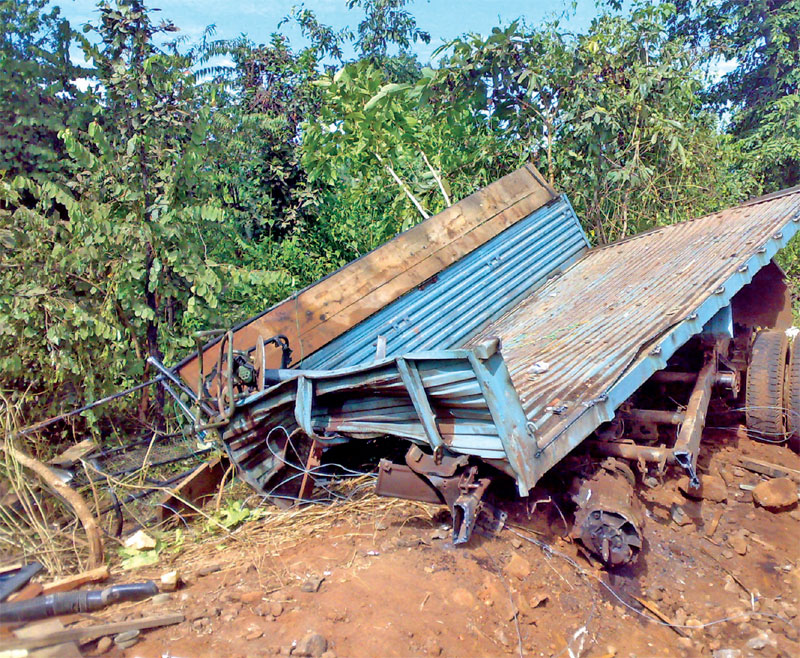
A destroyed CRPF vehicle after an IED blast
The United Nations (UN) deems IEDs as the world’s oldest types of weapons. IEDs are used all over the world but it is the most conflict-ridden countries, that are also the world’s poorest, which suffer the most. In 2018, military adviser in India’s Permanent Mission to the UN Col Sandeep Kapoor had said that an analysis of the fatal casualties among peacekeeping personnel in the last four years indicate that at least a quarter of them were due to IED attacks.
According to Action on Armed Violence (AOAV), a London-based charity, conducting research and advocacy on the incidence and impact of global armed violence from 2011 to 2020, 1,71,223 deaths and injuries were reported across the world from IEDs. They also accounted for 52 per cent of all civilian casualties recorded in the last 10 years.
According to AOAV, ‘At least 14 countries saw more than 1,000 civilian deaths and injuries from IED attacks: Iraq, Afghanistan, Pakistan, Syria, Nigeria, Somalia, Turkey, Yemen, Lebanon, Thailand, India, Egypt, Philippines and Cameroon.’
Iraq has been the worst-impacted country by IEDs, with 3,392 IED incidents, resulting in 53,706 casualties, including 46,093 civilians. Since 2013, the impact of IEDs in Iraq has been steadily decreasing. In Afghanistan, it peaked in 2019, but decreased in 2020.
The World at its Worst
The India-Pakistan border population remains vulnerable to explosives given the decades-long unrest in Kashmir. Land mines and other Explosive Remnants of War (ERW) continue to endanger lives. Among the victims are children under eight years of age. Human Rights activists allege that the IED menace persists because security forces fail to clear the area after operations.
India is a signatory to the United Nations Protocol on Explosive Remnants of War, which requires nations involved in a conflict to ‘mark and clear, remove or destroy explosive remnants of war.’ Under the treaty, it is mandated that civilians must be protected from the risks and effects of ERWs. This might include ‘warnings, risk education to the civilian population, marking, fencing and monitoring of territory affected by explosive remnants of war.’ The buried mines not only threaten people’s existence, but also seriously limit land use for livelihood activities in India’s violence prone backwards border villages along the Line of Control (LC).
Non-state actors rely on IEDs because they are ‘simple to design, and components remain cheap and easily accessible.’ Criminal networks, porous borders, corruption and poor ammunition stockpile management facilitate the use of IEDs. They kill or maim security personnel as well as civilians. Kashmir, Left-wing Extremism, and the Northeast are the main theatres of operations where IED blasts have become a norm.
In Kashmir, two CRPF personnel were injured in an IED blast in Awantipora in the Pulwama district in May 2022. In Jammu, in a suspected terrorist act, one person was killed and 14 were injured when a low-intensity IED exploded outside a court complex in Udhampur district of Jammu in March 2022. In the same month, a few days apart, an assistant sub-inspector of the Indo-Tibetan Border Police (ITBP)’s 53rd battalion on security duty was killed and a head constable injured by an IED blast in Chhattisgarh. In the north-east, an IED attack took place in the heart of Shillong in January 2022 at the entrance of the famous Centre Point building in the commercial hub, Police Bazar (Khyndailad). While no casualties were reported, massive damage was done to public property. The banned outfit, Hynniewtrep National Liberation Council (HNLC), claimed responsibility.
Subscribe To Force
Fuel Fearless Journalism with Your Yearly Subscription
SUBSCRIBE NOW
We don’t tell you how to do your job…
But we put the environment in which you do your job in perspective, so that when you step out you do so with the complete picture.


 VIDEO
VIDEO