Following a 71-month construction-plus-sea-trial effort, the People’s Liberation Army’s Navy (PLAN) commissioned its first domestically-built aircraft carrier, the Shandong CV-17, at the South China Fleet’s Yulin Naval Base, on China’s Hainan Island, five years after the PLAN’s first aircraft carrier, the Liaoning CV-16 (whose hull had been built in Ukraine in the late Eighties) was commissioned (on 25 September 2012). The Shandong has a length of 315 metres, width of 75 metres, draught of 9 metres, and cruising speed of 31 Knots. It is also credited with a standard displacement of 70,000 tonnes and a full displacement of 82,000 tonnes.
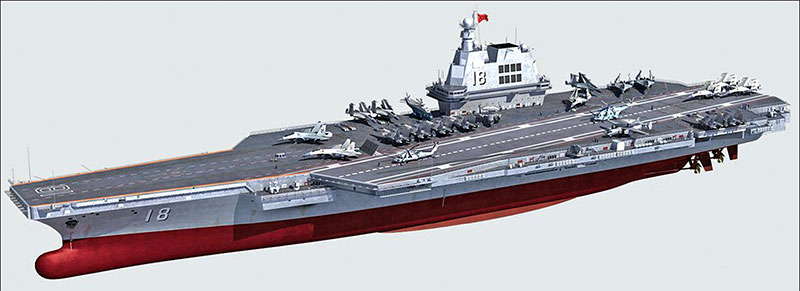
PLAN’s Type-003 aircraft carrier design
Both the Shandong and Liaoning are similar in size and use a Short Take-Off But Arrested Recovery (STOBAR) system for the launch and recovery of aircraft. However, the island of the Shandong is approximately 10 per cent smaller than that of the Liaoning, which provides additional deck space. But like the Liaoning, the Shandong too is limited to six days at sea before refuelling. The Shandong’s aircraft complement comprises 27 fixed-wing combat aircraft (J-15 ‘Flying Shark’ heavy multi-role combat aircraft, or H-MRCAs) and 15 helicopters, while that of the Liaoning is 24 H-MRCAs and 17 helicopters.
The J-15 H-MRCAs, however, due to their weight, cannot be armed in the ‘swing-role’ configuration and hence, they come with three distinct weapons configurations: with four PL-12 BVRAAMs and four PL-8 SRAAMs for air-defence; with two AKD-88 air-to-surface cruise missiles containing optronic terminal guidance seekers, and a data-link pod; and with two YJ-91 (Kh-31P Krypton) anti-radiation missiles. This is because although the J-15 has a maximum weapons load capacity of 6,500kg, the STOBAR takeoff procedure cuts into the J-15’s rate of climb and reserve power margins (see FORCE January 2018, pages 64-65).








 VIDEO
VIDEO