The test launch of Prithvi II nuclear capable ballistic missile on June 27 night is being seen by the Indian Strategic Forces Command (SFC) as a routine exercise to monitor the readiness and capability of the missile forces, but in reality, it signifies much more than that.
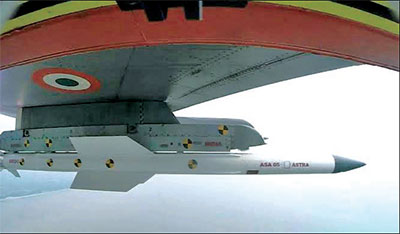
Astra air-to-air missile
Missiles are broadly two generic types – ballistic and cruise. Ballistic missiles differ from cruise missiles in their flight path. A ballistic missile is a guided warhead mounted on a booster that propels it into beyond, and when the booster burns out, it is jettisoned and the guided one re-enters the atmosphere and using gravity goes into freefall, gathering speed as it falls towards its target.
A cruise missile, on the other hand, stays within the atmosphere throughout its flight. In fact, a cruise missile uses the atmosphere for flight, deploying wings and fins to generate lift like an airplane. A cruise missile also typically remains powered and guided throughout its flight from launch to impact against the target, unlike the ballistic missile which is guided in the terminal phase.
And missiles are characterised as strategic and tactical depending on their range. Strategic missiles are the dinosaurs of missile families, essentially carrying nuclear payloads, and capable of traveling half-way across the world. They are essentially a legacy of the US-Soviet Cold War.
Tactical missiles are basically short-range missiles, up to 300 km, although some of the tactical missiles have longer ranges - around 600 to 750km. Unlike strategic missiles, these are essentially designed to carry conventional warheads but that concept could be changing. With Pakistan claiming to have developed tactical nuclear missiles specifically meant for use against India, such as the Nasr, the test launch of Prithvi nuclear capable missile is obviously Indian riposte to the Pakistanis.
The Encyclopaedia Britannica website describes tactical guided missiles as, “generally categorised according to the location of the launch platform and target. There are five types, air-to-air, air-to-surface, surface-to-air, anti-ship, and anti-tank, or assault.








 VIDEO
VIDEO