

Home Fortification
India faces tensions on all its borders presently.
In the north, 20 Indian soldiers were killed a few weeks back in a violent face-off with the Chinese soldiers at the Galwan valley in Ladakh. The western border is plagued with infiltrators coming in from Pakistan, in addition to frequent cross-border firing. On the eastern border with Bangladesh, there are issues of smuggling and illegal immigration. Consequently, tensions are running high between India’s Border Security Force (BSF) and Border Guards Bangladesh (BGB). As if border challenges were not enough, the country also faces internal security challenges in the form of insurgencies, terrorism and sectarian violence.
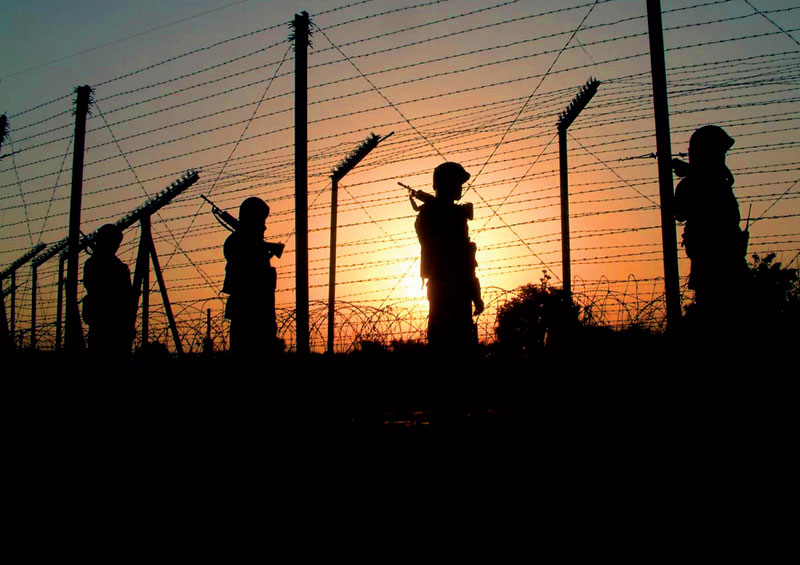
BSF soldiers patrolling the LC at dusk
Five of India’s paramilitary forces/ central armed police forces (CPMFs/CAPFs) with a set of duties assigned to each of them, are in charge of borders as well as internal security. The nature of their duties intersects in certain areas but the challenges they face are unique to their areas of operations. As India faces a barrage of issues with different neighbours, as well as internally, the role played by the CPMFs/CAPFs becomes vital. Hence, it is even more critical that their training, equipment and morale remain on the mark. In this special report, FORCE takes stock of the state of the forces tasked to secure the nation and its borders in peacetime.
Sashastra Seema Bal
While tensions on India’s border with China, Pakistan and Bangladesh are often in news, one particular news that came in this month caught attention. Nepal, a small country sandwiched between India and China, adhering to the current cartographic tensions, deployed Nepali Army at 15 border outposts (BOPs) along the Indo-Nepal border in Uttarakhand’s Pithoragarh and adjacent areas.
At these BOPs, Nepal Prahari was replaced by the Nepal Sashastra Prahari. Earlier in the same month, when the tensions were at their peak and Nepal had been aggressive in its pursuit of staking claim to the disputed Lipulekh, Kalapani and Limpiyadhura by including them in its constitution, one Indian civilian succumbed to his injuries after being shot by Nepal’s Armed Police Force (APF). In the same incident three others were injured and one person was detained. A few years ago, these incidents at this border would have been unimaginable as the two countries shared cordial relations.
This probably comes as an important lesson for India to not take the security at any of its borders for granted, however peaceful they may have been in the past. This is especially true at a time when Chinese influence in the region grows. The 631-km border with Nepal is guarded by the Sashastra Seema Bal (SSB).
The latest development in this area is that the SSB and the APF have increased the frequency of joint patrolling along the 631-km Indo-Nepal border that lies in Bihar. As per reports, after the recent tensions, the SSB has requested senior officials of Nepal’s APF to extend counselling to Nepal’s APF soldiers, keeping in mind the kind of socio-cultural relation the two countries share.
Earlier this month, Indian intelligence agencies and the SSB came up with the information that Nepal’s APF, on order from their home ministry, is planning to increase the number of BOPs along the boundary with India by 100 in the coming year. The current number of posts stand at 121 which are expected to go up to 221. Kedar Nath Sharma, joint secretary and spokesperson at Nepal’s ministry of home affairs, confirmed the same to the Hindustan Times.
The SSB was conceived in 1962 and created in 1963 as Special Service Bureau, and was not an armed organisation. It was formed in order to ‘motivate’ the border population to protect India’s sovereignty by mingling with them and knowing their culture and studying the geography and climate of that region. In 2001, two years after the Kargil war, K. Subramanyam Committee’s report that was evaluated by a Group of Ministers (GoM) decided on ‘one border one force’, under which the SSB was declared a border-guarding force. It was initially decided that this force would be guarding the Indo-Nepal border. The SSB was renamed in 2003 and given the responsibility of guarding Indo-Bhutan border in 2004.
Subscribe To Force
Fuel Fearless Journalism with Your Yearly Subscription
SUBSCRIBE NOW
We don’t tell you how to do your job…
But we put the environment in which you do your job in perspective, so that when you step out you do so with the complete picture.





 VIDEO
VIDEO