Guns, missiles, torpedoes and close-in weapon system (CIWS) are a few names in the treasure chest of the Indian Navy. The world’s seventh most powerful navy is also inching closer to adding directed-energy weapons (DEWs) to its inventory. DEWs–divided into high powered lasers and microwave–are expected to destroy enemy missiles, aircraft and Remotely Piloted Aircraft/Unmanned Aerial Vehicles based on electronic circuitry.
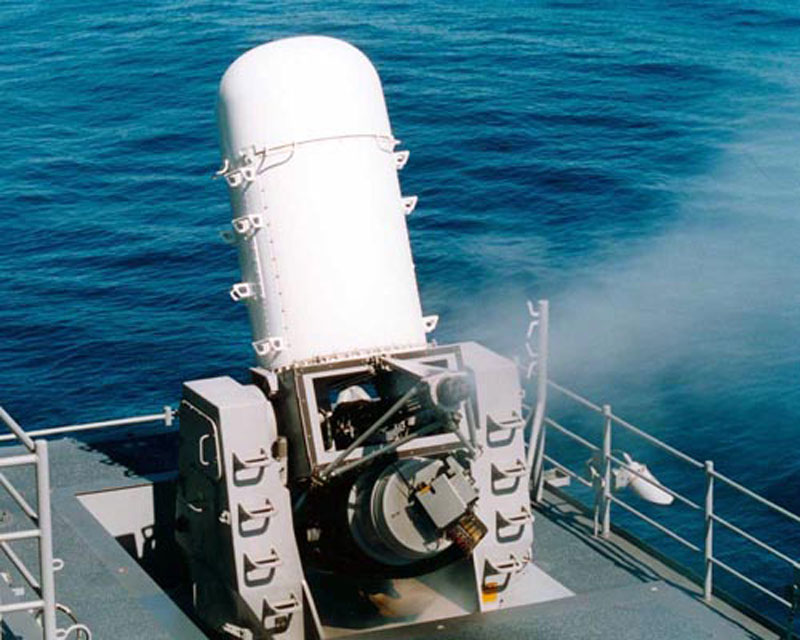
Phalanx
A CIWS (pronounced as see wiz) is the last line of defence against any short-range hostile threat above waterline, and to be really solid, experts believe it should be an amalgamation of both missiles and guns. The gunmount of CIWS moves at high speed with precision enabling the system’s defensive capabilities against incoming targets and threats.
While Kashtan is widely used by the Indian Navy, Barak-8 is touted as one of the most “sophisticated” missile system, technically performing the dual role: one that of a CIWS and the other of an air defence. There was a time when India used Phalanx as well. INS Jalashwa, Indian Navy’s amphibious warfare ship, was armed with a pair of Phalanx CIWS at the time of transfer (17 January 2007) from the United States Navy. India purchased the ship for USD48.44 million and commissioned it into its navy on 22 June 2007. And then Phalanx was removed. The Phalanx CIWS on INS Jalashwa (then 36-year-old USS Trenton) was outdated, obsolete and belonged to an older generation—a fact that was pointed out by Cmde Anil Jai Singh.
For any navy, Phalanx is arguably the most cutting-edge CIWS at this point of time. It is a defensive weaponry aimed at shooting down incoming anti-ship missiles and shells. It also has a forward-looking infrared (FLIR) sensor which detects infrared radiation–i.e. heat signatures–and helps the Phalanx in operating against traditional targets like small surface vessels. The US Navy deploys it on every class of surface combat ship, except the Zumwalt-class destroyer and San Antonio-class amphibious transport dock. Apart from the US, the naval forces of at least 15 other countries use Phalanx.








 VIDEO
VIDEO