On 31 July 2018, at 11 am Beijing time (GMT + 8), China launched the 2,800kg Gaofen-11 (GF-11), its most advanced military-specific high-resolution overhead recce satellite. The launch took place using the Long March 4B, a three-stage rocket that can put 4,200kg into low-Earth orbit (LEO) and into the sun-synchronous orbit (SSO), from the Taiyuan Satellite Launch Centre in Shaanxi Province.
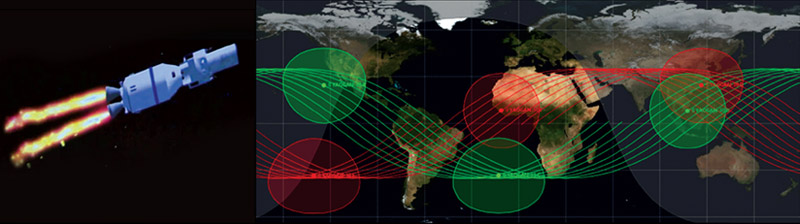
Animation of GF-11 being boosted to its LEO (left) and its final deployment configuration; Yaogan 30 Groups 1 & 2 Orbital Tracks
The GF-11 was developed by five of China Aerospace Science and Technology Corp’s (CASC) subsidiary institutions, including the Beijing Institute of Space Mechanics and Electricity, and the China Academy of Space Technology (CAST), which has developed the CAST-2000 satellite platform used for numerous international commercial contracts.
The Gaofen family of high-resolution Earth observation satellites are part of the China High-definition Earth Observation System (CHEOS) meant for civilian purposes, with the first satellite, Gaofen-1, having been launched in 2013. So far, 12 Gaofen satellites have been launched, including GF-6 in June 2018, and three additional satellites from the Gaofen-1 series launched in April 2018. The Gaofen-7, too, is expected to be launched this year.
The GF-11 was not in the list of planned Gaofen satellite launches, and the launch caught observers by surprise, so most likely it is a military overhead recce satellite operating under the guise of the Gaofen programme. However, Beijing always lifts a bit of the veil of secrecy by releasing footage of not only the launch, with views of the rocket and of the control centre, but also footage of satellite separation.
Interestingly, 3-D computer models were used in the control centre to represent the rocket and its payload, and these models were not censored by the CCTV state television. They even showed those models with some of the military Yaogan satellites, probably as a form of strategic signalling towards their competitors. The most interesting part was an image of the satellite still attached to the third stage of the Long March rocket. Knowing that the stage has a diameter of two metres, and is almost completely parallel to the virtual camera, the diameter of the satellite’s aperture can be estimated at 1.7 metres. That means it carries a big mirror: the largest mirror carried by commercial Earth observation satellites are Worldview 3’s and Worldview 4’s 1.1-metre mirrors, manufactured in the US by ITT Exelis.







 VIDEO
VIDEO