

Hand in Hand
The tragedy of Modi government’s foreign policy is that it does not realise when it overplays its hand. Believing that perception of power is a reasonable substitute for real power, the government has exposed its ignorance of a well-established truism—that the foundation of an assertive foreign policy is formidable national (comprising economy, technology, and military) power.
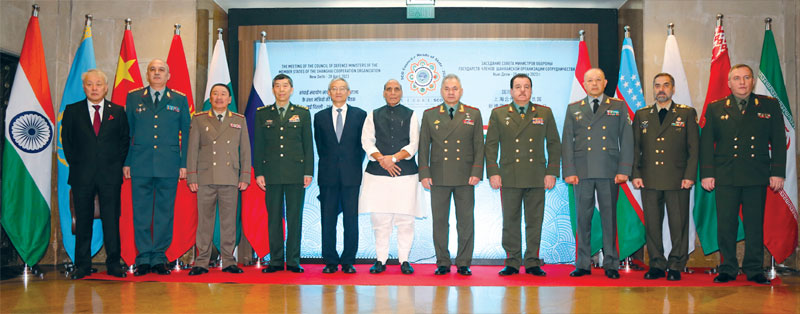
Defence minister Rajnath Singh with his counterparts; Tajikistan’s Colonel General Sherali Mirzo, Kazakhstan’s Colonel General Ruslan Zhaksylykov, Kyrgyzstan’s Lieutenant General Bekbolotov Baktybek Asankalievich, Uzbekistan’s Lieutenant General Bakhodir Kurbanov, Iran’s Brigadier General Mohammad Reza Gharaei Ashtiyani, Russia’s Sergei Shoigu (Rajnath Singh’s left), China’s Li Shangfu (second right from Singh)
Hence, when defence minister Rajnath Singh decided to read the riot act to his Chinese counterpart, Gen. Li Shangfu, on the sidelines of the Shanghai Cooperation Order (SCO) defence ministers meeting in Delhi, he was confusing domestic politics with geopolitics. Worse, he was also exposing his government’s total lack of understanding about China and the regional geopolitical order with global implications that it is ushering in the Asia-Pacific region (which the US calls Indo-Pacific region), in consort with Russia through a competitive security architecture pivoted on the SCO.
For a nation aspiring for a major power role in the world, this level of ignorance is dangerous. Rajnath Singh’s narrative on the border issue has moved India one step closer to war with China—a war that neither nation wants.
Let’s start with the border issue. Rajnath Singh said that peace on the border is necessary for development of bilateral ties; peace was defined as disengagement at the border followed by de-escalation. Since disengagement of forces at Depsang and Demchok was discussed at the recently failed 18th round of military commanders talk, Rajnath Singh meant that these be resolved before de-escalation of troops for border peace.
Gen. Li Shangfu’s narrative was different. He made two points: One, since the border was stable, the two sides needed to work for normalised management. And the two countries should place the border issue in the proper place (on the larger geopolitical canvas).
In these opposing narratives, China has the legal upper hand. After all, both sides had agreed on a joint statement signed by foreign ministers S. Jaishankar and Wang Yi in Moscow under the rubric of the Russia-India-China (RIC) grouping on September 10, 2020. The joint statement neither mentions de-escalation for border peace nor specifies areas on the line of actual control in east Ladakh where disengagement needs to take place. It only says that once disengagement is done, both sides should work on new Confidence Building Measures (CBMs) for normalcy in border areas. The new CBMs are the new modus vivendi since all bilateral agreements after 1993 lost their meaning when the PLA did multi-prong deep incursions to occupy Indian territory. Therefore, Gen. Shangfu’s normalised management implied work on mutually agreed new CBMs.
Moreover, since the RIC evolved into Brics (Brazil-Russia-India-China-South Africa), its present and numerous aspiring members waiting for induction into the group would be wondering why India had developed amnesia on the joint statement. At present, the Brics nations compete with G-7 nations in GDP. In its 2022 summit in Moscow, the group’s bank, the Brics National Development Bank (NDB) had agreed to issue a new global reserve currency to displace (not replace) the US dollar. The Brics is at the centre of the new global economic order and the last thing its members would want is disharmony between India and China just as animosity between India and Pakistan resulted in the demise of the South Asian Association for Regional Cooperation (Saarc).
Subscribe To Force
Fuel Fearless Journalism with Your Yearly Subscription
SUBSCRIBE NOW
We don’t tell you how to do your job…
But we put the environment in which you do your job in perspective, so that when you step out you do so with the complete picture.






 VIDEO
VIDEO