

Halfway House| August 2023
India’s armed forces are tasked with the onerous responsibility of defending the nation’s borders against China and Pakistan. Having traditionally maintained a focus on Pakistan, the armed forces are now in a Catch 22 situation with the need to rapidly build up their capability against an increasingly belligerent Chinese threat on its eastern borders. The need to reequip Indian forces has resulted in sizeable orders for defence equipment in recent times. However, much of this has primarily gone to foreign OEMs as the indigenous defence industry (both public and private) is yet to develop state-of-the-art defence equipment needed by the armed forces.
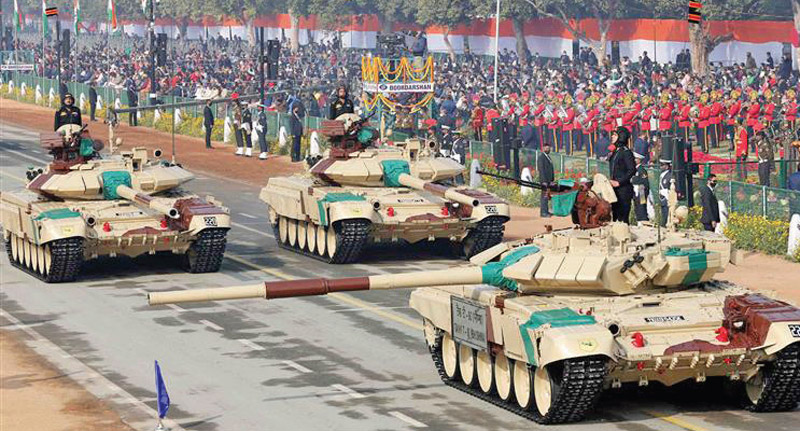
India’s license production of thousands of Russian-origin T-72 and T-90 MBTs have not enabled the development and manufacture of indigenous MBTs
Despite decades of government funding, India’s defence industry is well behind the capability of Israel, South Korea and Turkey, which have all leveraged their defence partnerships with the US to develop highly capable domestic defence industries. Interestingly, no country that is dependent on foreign defence technology has built up a strong and sustainable domestic defence industry. According to a 2020 working paper by the Stimson Center, 70-85 per cent of India’s military platforms were of Russian origin. India’s indigenous defence ecosystem is largely structured towards supporting defence equipment first inducted in the 1980s and 90s and has proved to be unable to pivot to deliver state-of-the-art clean sheet designs, except for a few exceptions when it comes to large defence platforms such as the Hindustan Aeronautics Limited’s (HAL) HTT-40 Basic Trainer Aircraft (BTA), Light Combat Helicopter (LCH) and Light Utility Helicopter (LUH); the Akash Surface-to-Air Missile (SAM) system, etc.
Of course, the Indian defence industry has achieved spectacular successes in the design of development of strategic systems such as long-range ballistic missiles, nuclear submarines, et al. But by and large, defence public sector undertakings (DPSU) appear to be content to deliver minor improvements on platforms produced under licence with a focus on indigenisation of spares. Despite the enormous expenditure in licence-production of Russian origin platforms such as the MiG-21, MiG-27 and Sukhoi Su-30 MKI; T-72, T-90 Main Battle Tanks (MBT) or BMP-II Armoured Personnel Carrier (APC), which were built under licence by the Heavy Vehicle Factory Avadi (HVF Avadi) and Ordnance Factory Medak respectively, the native capability to substantially upgrade these platforms indigenously has not been accomplished, in many cases, decades after these programmes started (and ended in the case of the MiG-21, MiG-27, T-72).
The same is the case with western origin systems such as the BAE Systems Hawk Mk132 or Sepecat Jaguar, which were built under licence by state-owned airframer HAL. While the HAL has undertaken its most ambitious upgrade of a fighter aircraft manufactured under licence in the Jaguar DARIN III programme, it has faced numerous delays and a planned re-engining effort has been abandoned as well. The contract for upgradation of 61 Jaguar Display, Attack, Range, and Inertial Navigation-I (DARIN-I) aircraft to DARIN-III standard was signed with the HAL in December 2009 with Initial Operational Clearance (IOC) and Final Operational Clearance (FOC) originally to have been achieved by December 2012 & June 2013 respectively. The original delivery of all series upgrade aircraft was to have taken place by December 2017. The IOC has eventually obtained in February 2017. The Jaguar DARIN III is a substantially improved variant of the aircraft as compared to the older DARIN II version and features a Multimode ELTA Radar, Glass Cockpit with Dual SMD and EFIS, Open System Architecture Mission Computer, Solid Stage Digital Video Recording Systems and additional functionalities relating to display and data handling.
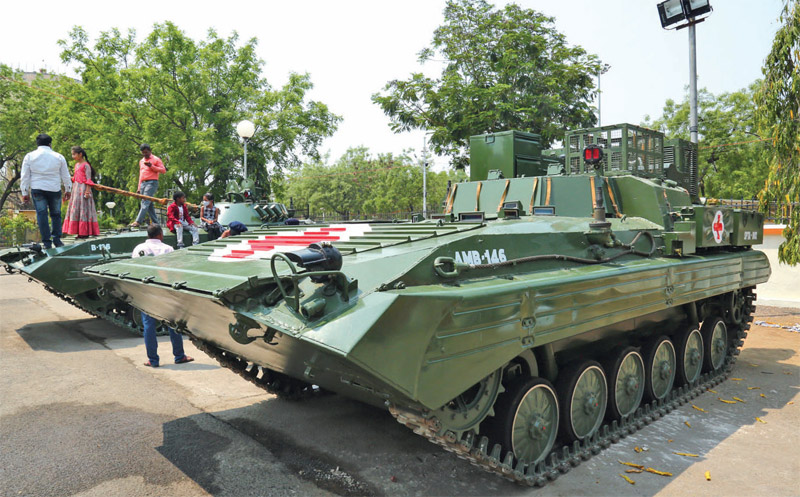
Despite having produced the BMP-II in India since 1987, the state-owned defence industry has proved unable to make substantial upgrades to these Infantry Combat Vehicles
Air Systems
The ministry of defence (MoD) and DPSUs have largely failed to leverage transfer of technology (ToT) agreements gained for its licence production agreements to manufacture Russian and western origin military aircraft in India. Upgrades to these platforms have been limited to avionics and integration of weapons, instead of substantial upgrades including those related to the aircraft structure. One glaring example is the failure to upgrade the IAF’s Su-30MKI fleet, which has only received minor avionics and weapons upgrades in over two decades of operational service. The HAL, however, did successfully complete the structural modifications for carriage of BrahMos Air Launched Cruise Missiles (ALCM) on some portion of the IAF’s Su-30 MKI fleet.
Subscribe To Force
Fuel Fearless Journalism with Your Yearly Subscription
SUBSCRIBE NOW
We don’t tell you how to do your job…
But we put the environment in which you do your job in perspective, so that when you step out you do so with the complete picture.






 VIDEO
VIDEO