

Guns and Triggers
Before union home minister Amit Shah began his three-day tour to Jammu & Kashmir on an unusually freezing cold autumn day (October 23), the security grid went on an overdrive to sanitise Kashmir. Among a slew of measures were switching off some internet towers and seizing two-wheelers from Srinagar’s roads. No reasons were given. The perplexed vehicle owners were asked to collect their scooters and bikes from police stations after unspecified ‘few days’.
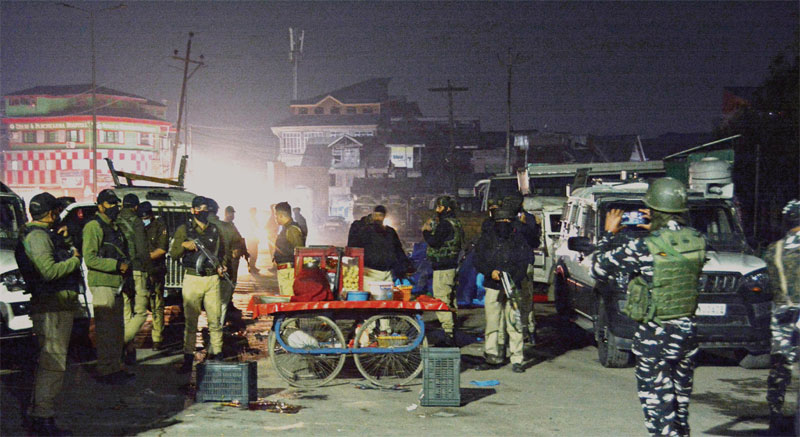
Scene after a Bihari vendor was shot dead in Srinagar
The scooter seizing operation has a precursor. Sometime in the winter of 2020, months after abrogation, a news report mentioned allegations by some people from South Kashmir that their four-wheeled vehicles were being taken away by police in midnight swoop from their homes and returned a few days later. The reports disappeared but activists based in South Kashmir say, on conditions of anonymity, that the practice is now a norm. It is almost a regular story. A lone driver on the road is more likely to be vulnerable and sometimes vehicles are seized from garages inside people’s homes. When the owners are asked to collect them from police stations or security camps, they find them in dusty condition. The aim and purpose of such measures is not known but they are exacerbating the sense of dis-empowerment and helplessness of the public. Such stories, however, rarely make it to the national media.
The dominant narrative in Kashmir during October, preceding Amit Shah’s visit, was the spate in civilian killings, mostly of minorities and migrant workers. 32 civilians were gunned down by suspected militants in Kashmir in 2021, 11 of them in October—two Kashmiri Pandits, a Sikh woman and five migrant workers—revealing an evident pattern of selective targeting. The most distinct signal came on October 7 when masked militants entered a school in Srinagar, scrutinized identity cards of all teachers, singled out Satinder Kaur and Deepak Kumar and shot them in cold blood.
The signs had been visible for some time. In the last several months, civilians and unarmed policemen were increasingly becoming targets of the militants who in recent years had focussed only on targeting security pickets and camps. On September 17, a Kashmiri Pandit railway constable, Bantu Sharma, was killed while he was on his way home in Kulgam district, in broad daylight. Later that day, in the same district, a Bihari labourer, Shankar Kumar Choudhary, was shot dead. That militancy was going out of hands and could come to this point of selective targeting of Kashmir’s religious minorities and non-residents (Muslims included) was already being anticipated.
In the aftermath of the killings, Kashmir is a landscape of panic and repression. About 2,000-3,000 Kashmiri Pandit migrants who had returned as part of Prime Minister’s Relief and Rehabilitation package between 2005 and 2017 fled in a huff to Jammu after October 7 killings. In subsequent weeks, security agencies and the state apparatus carried out busloads of migrant labourers outside Kashmir, cocooned non-migrant Kashmiri Pandits in securitised ghettos and accelerated the crackdown on the Valley’s Muslims with enhanced frisking operations, raids, seizing of two wheelers, detentions, arrests et al.
On 5 August 2019, the Indian government began scripting the story of ‘Naya Kashmir’ with the J&K Reorganisation Act which dismembered the erstwhile state into two union territories and robbed the region of its special status while the population within was put under a spell of curbs. The nation was told that Article 370 was the only impediment to peace, development and communal harmony and the Modi government would usher in an era of peace and development. Subsequent laws, strong armed and intimidatory tactics have helped the government subjugate an entire population into compliance and control the narrative by gagging the media and all forms of dissent in the last two years. The spate in civilian killings coinciding with a massive gunfight between militants and security forces in the sensitive border districts of Rajouri and Poonch, resulting in the death of 9 soldiers, however, reveals that the Valley’s silence is only ephemeral and that things really are not going as per the script. Today, the government is just as clueless as an ordinary civilian about what is happening.
Subscribe To Force
Fuel Fearless Journalism with Your Yearly Subscription
SUBSCRIBE NOW
We don’t tell you how to do your job…
But we put the environment in which you do your job in perspective, so that when you step out you do so with the complete picture.


 VIDEO
VIDEO