

Guest Column | The Debate Continues
The discussions never seem to end. It is commonly known that the armed forces are working towards the establishment of integrated tri-service commands. The primary task of the first ever Chief of Defence Staff (CDS) is to implement this concept and yet there are doubts, discussions and a general feeling that yes, it is necessary and desirable, but…! The devil is obviously in the details. It is not difficult to see where the problems lie but resolving them is another matter altogether.
There are many factors which necessitate integration—the nature of modern war which will be three dimensional i.e., land, sea and air, and which will also have to factor in the dimensions of outer space and the ever-pervading cyber security. All this operates under the threat of nuclear weapons of which no one has any experience whatsoever, as these have never been used except to end the war against Japan in 1945.
As a counter to this, there are equally compelling factors which stand in the way of full integration. First and foremost is the historical perspective where the growth has been heavily weighted towards the defence of land borders. Second is the exponential growth of technology which has necessitated an almost unbearable burden of imports under the shadow of budgetary constraints. There is also the organisational factor where, in India, the civil/ political control of the military has translated into bureaucratic control. Witness the fact that the newly formed department of military affairs (DMA) is under ministry of defence (MoD) and the overall supervision of the defence secretary, who according to rules of business of the government, is also responsible for the security of the country. Add to this the human factor and the fact that the three Services have traditionally operated alone in a specific manner, as they evolved according to their experience in the various wars that India has fought since Independence.
These are not insurmountable problems. Every country that maintains standing armed forces faces the same problems and dilemmas. There is nothing to suggest that one model has proved itself superior. One thing is certain, whatever model has evolved has suited that country’s requirement and periodically needs adjustments. It follows that we must evolve our own unique model; admittedly, it cannot be radically different from what other countries do but must suit the nation’s needs and its native genius. This means that we cannot blindly ape what may have proved successful elsewhere and yet there should not be any hesitation to learn from others’ experience.
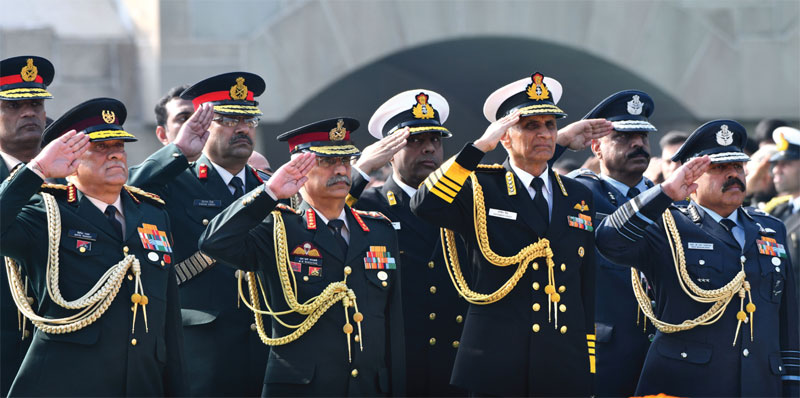
Chief of Defence Staff General Bipin Rawat, COAS General M.M. Naravane, CNS Admiral Karambir Singh and CAS Air Chief Marshal RKS Bhadauria
Political Control
At the apex of this concept is obviously the MoD under its minister. The CDS can only be appointed by the defence minister with the approval of the Cabinet Committee on Security (CCS) and ipso facto the concurrence of the prime minister. This post which has long been the demand of the armed forces has now been brought into existence. The aim is to synergise the working of the three Services and the formation of integrated commands. Additionally, the CDS has been tasked to suggest methods by which the defence expenditure may be curtailed and also to provide advice to the government.
It may be tempting to say that it is a ‘single point advice’, but it is not. The three Service Chief retain the right to approach the defence minister and the prime minister, on matters specific to their Service. The issue is further muddied by the fact that the department of military affairs is only one of the departments of the defence ministry, the others being department of defence, department of defence production, department of defence research and development and the department of ex-servicemen’s welfare. There is also a finance division headed by a secretary to the government.
Subscribe To Force
Fuel Fearless Journalism with Your Yearly Subscription
SUBSCRIBE NOW
We don’t tell you how to do your job…
But we put the environment in which you do your job in perspective, so that when you step out you do so with the complete picture.



 VIDEO
VIDEO