The Indo-Naga peace process remains shrouded in mystery both for the Naga and the rest of the Indians. I have been associated with the peace process; but not officially. It has been in my capacity as a human rights lawyer that I learnt the workings of the peace process.
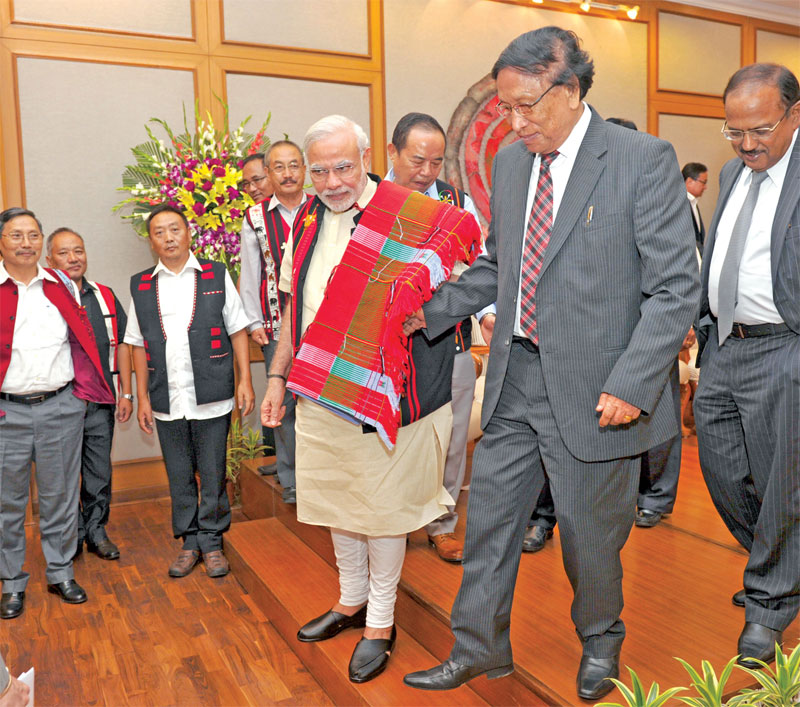
Prime Minister Narendra Modi with Naga leaders during the signing of the Framework Agreement in 2015.
In the picture, PM Modi is holding NSCN (IM) leader Isak Muivah’s hand
On 3 August 2015, the government of India and the National Socialist Council of Nagalim (NSCN (IM)) signed what has been called the Indo-Naga Framework Agreement. Again, for months there was speculation on the contents of the Framework Agreement. Two versions of the Framework Agreement have been released—one apparently released by N. Ravi, the last interlocutor and now governor of Nagaland state, and another ‘original’ version by the NSCN.
Now that the contents of the Framework Agreement have become public, it will be obvious that it has nothing much to offer by way of resolution to the peace process. From the beginning, the peace process has lacked transparency. Both parties have, for their respective reasons, developed a vested interest in keeping the process a mystery so they could misrepresent it to serve their interests.
There are two reasons why the peace talks were remarkable and a historical milestone in the history of Indian democracy.
How It All Began
The origin of the peace process is rooted in a dinner party at the home of a senior Naga police officer, Peter Chiphang. He had invited Deepak Dewan, the editor of the North East Sun, a weekly, and Grinder Muivah, the nephew of Th Muivah, the general secretary of the NSCN.
Dewan, like all journalists was after a scoop. He wanted to be the first to interview Th Muivah who had been underground for almost 30 years. Grinder helped him get that interview and after reading the interview, Muivah gave Grinder permission to contact minister Rajesh Pilot.
As a result of these meetings in July 1995 P.V. Narasimha Rao, the then Indian prime minister, met the two NSCN leaders in Paris. And finally, in 1997 the NSCN leaders and the government of India resolved to sit across and discuss the possibility of peace. The Indian Parliament was informed and the process began.


 VIDEO
VIDEO