There is a considerable satisfaction in the Indian Army that finally a new assault rifle has been selected and that production will soon begin at Ordnance Factory at Korwa near Amethi. It is reported that the Joint Venture (JV) to produce the AK-203 was ‘fastest ever’ created by Russia. The need for an assault rifle has been felt ever since the INSAS was introduced and was not found to be up to the mark. However, given the manner in which our defence acquisition process progresses as also the ever-shrinking allocation for defence in each successive budget has delayed the project till now.
It must also be acknowledged that the big-ticket requirements of the Indian Navy and the Air Force had taken the urgency off this requirement. The fact that the low-level insurgency being faced in Kashmir and parts of the Northeast could be combated by the present small arms used by the army also contributed to the lower priority that came to be accorded to the search for a new and modern assault rifle. The army also has a share in this delay because of the changing qualitative requirements as newer features became available as well as the fact that the ‘incapacitation versus kill’ debate was later changed in favour of the latter at an advanced stage. However, that is now in the past and the present JV should fulfil two needs, one, the requirement of the army and two, a fillip to the ‘Make in India’ policy of the government, which has foundered despite its positive aim.
Another factor that should help is that since the AK-203 incorporates the latest features, it will be possible to export these once the basic needs of the country’s security forces, both military and civil armed police, are met.
The introduction of the AK-203 will help our troops who are deployed in counter-insurgency role, in defending the border, particularly on the Line of Control (LC) and above all the Infantry whose basic weapon is the rifle. Understanding why this should be so, we need to look beyond just capabilities of the weapon, examine its evolution and need, its ability to enhance the fighting potential of the Infantry soldier and indeed all those who are required to fight in close proximity of the enemy.
Prime Minister Modi launching AK-203 rifles facility in Amethi, along with Union and state dignitaries
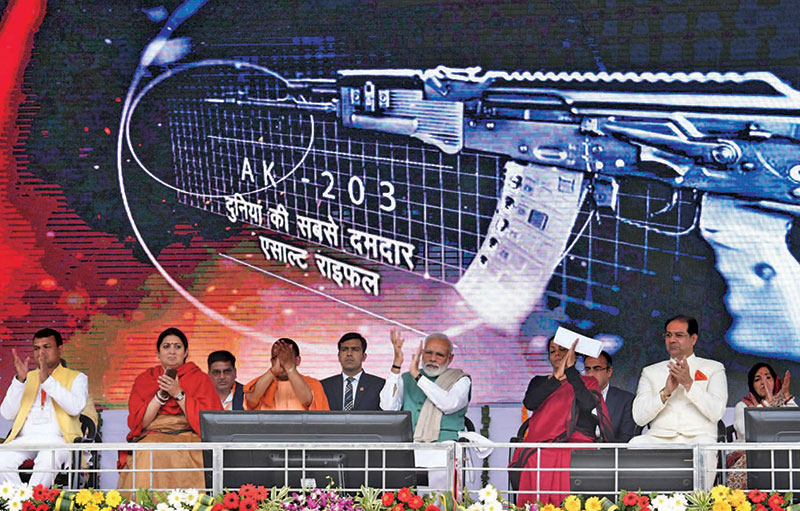 Prime Minister Modi launching AK-203 rifles facility in Amethi, along with Union and state dignitaries
The Need
Prime Minister Modi launching AK-203 rifles facility in Amethi, along with Union and state dignitaries
The family of small arms may be considered to consist of the personal man-portable weapons that a soldier carries in battle and the main user and beneficiary of this is the Infantry. These comprise the pistol, carbine, rifle and the light machine gun. This definition may not satisfy the purist but suffices for the purpose of this discussion. At the time of Independence, we had inherited the World War II weapons which had proved their utility.
However, the limitations of the .303 rifle were embarrassingly exposed during the 1962 war with China as our troops fought with antiquated weapons, mainly the bolt loading single shot rifle. The Infantry was unable to cope with the ‘human wave’ tactics that the Chinese deployed. The situation was worsened by the fact that most of the engagements took place at high altitude which affected the performance of the rifles and carbines. The light machine gun with its automatic capability was of greater use but the restricted weight that the jawan could carry, ill equipped, ill supported and unsuitably clothed as he was, all led to degrading of performance. The .38 revolver then in service was next to useless except for personal defence.








 VIDEO
VIDEO