With the arrival from the United States of the first two M777 Ultra-Light Howitzers, the Bofors ghost has finally been laid to rest. The Indian artillery had been crying hoarse for modernisation over the decades, but the ghost kept raising its ugly head, the United Progressive Alliance (UPA) government continued reacting and A.K. Anthony, as the defence minister, was compelled to turn down all proposals. The Indian artillery firepower remained weak and limited in range, equipment outdated and choice of projectiles restricted. It was very evident during the Kargil conflict, when the army was compelled to induct Bofors from other sectors, solely to support the operation.
In the mountains, there are few Bofors regiments and the balance are the indigenous 105mm guns with a limited range of 17 to 18 kms with restrictions of firing at higher angles of elevations. There were similar problems in the plains as the 130 mm Russian guns had outlived their life, but had to be retained or modified on an ad hoc basis with Israeli support as Soltam, as options never existed. Self-propelled (SP) guns to provide support to armoured formations were outdated and almost non-existent.
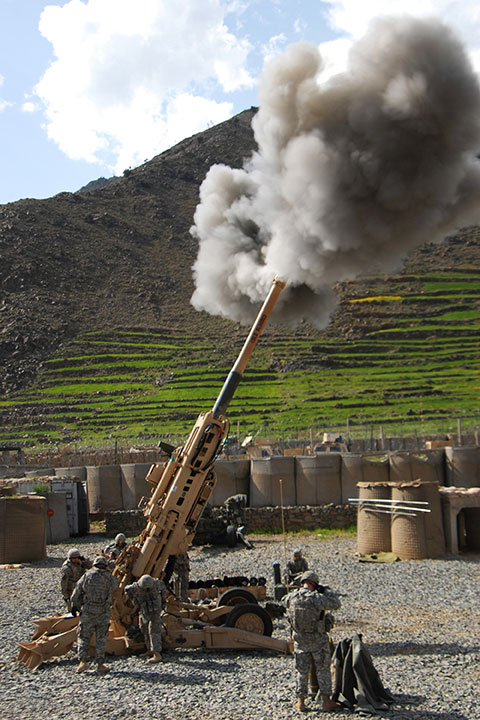 Artillery has always been termed as the ‘Queen of the battlefield’ and is a battle winning factor. Its employment philosophy has been changing over the decades. Initially, it was providing fire support for operations by infantry and armour but is presently destruction of the enemy’s combat potential and degradation of his defences. The concept involves employing preponderance of artillery firepower to ensure success. Thus, there is a requirement of long ranges, higher calibre weapons delivering greater TNT content with deadly accuracy and the availability of a multitude of ammunition choices to engage a variety of targets.
Further, to reduce logistical nightmares of a large variety of ammunition, due to multitude of gun systems, a single calibre gun, using commonality of ammunition is essential. Hence, the Indian artillery desperately wanted to upgrade to the 155-gun systems but their demands remained ignored. To some extent, the initial causes of delay in modernisation were within the service itself. For a few years, there was an internal battle as to which calibre would be best suited. This debate and the Bofors ghost ensured that no guns were even considered for induction. The UPA did issue tenders for a host of artillery equipment in 2012, but claims of bribery resulted in tenders being cancelled, with the wheeled SP gun contract being terminated, post the trials.





 VIDEO
VIDEO