In Part One of this article, I had outlined Op Khukri and the complexities that the operation threw up. The Indian Navy, often out of mind and out of sight, has its share of involvement in many other contingencies that we need to research and document if we are to add to the country’s institutional memory.
Plotting Comprehensive Military Strategy
Admiral Karambir Singh, in public statements, observes rightly, early in his tenure, the geopolitics that is at play and seeks rationalisation of naval plans to cater for what can be very turbulent times in the decades ahead. Given the economic scenario, this can be a planners’ nightmare. Thus, while he highlights short-term threats and confrontations, the potential for a boil over with medium to longer-term implications can't be ignored, in his pronouncements. In a concession to economic realities, he seeks to scale down plans but aims to achieve a balance, through an optimal exploitation of ‘modern technologies’.
Such observations by the country’s naval chief require recognition of the nation’s maritime realities. Competitive dynamics tend to seek a return to a continental or a shore-based mind-set. Such inwards or near-abroad focus can be the bane of countries like India and its imperatives. It may be worth reminding ourselves that it was just such thinking that saw us hopelessly unprepared in 1962.
To look at ‘the right of spectrum’ tasks, we could do well to look at the observations of an air and naval platforms enthusiast. Rick Joe observes in The Diplomat that ‘as of mid-2019, Chinese carrier development was evolving beyond their initial experimentation with CV-16 the Liaoning and the ski-jump route. Expectations and focus are moving onto catapult carriers like 003 and its successors and their related air wings’.
While China goes about building a formidable transformed military with a focus on her navy, they can afford to do so, given their USD 12-14 trillion economy. India, meanwhile, finds the headwinds daunting as it seeks to grow from a three-trillion-dollar base to higher levels, so essential if it has to be able to cater for development necessities while at the same time finding funds for its military.
As stark realities and compulsions stare us in the face, rationalisation of all that we spend on, including the military, is inevitable. In doing so, a government in drawing up a strategy and issuing policy will have to crystal gaze much beyond the immediate; maintaining and employing a current force; but also seek to build a future-ready military.
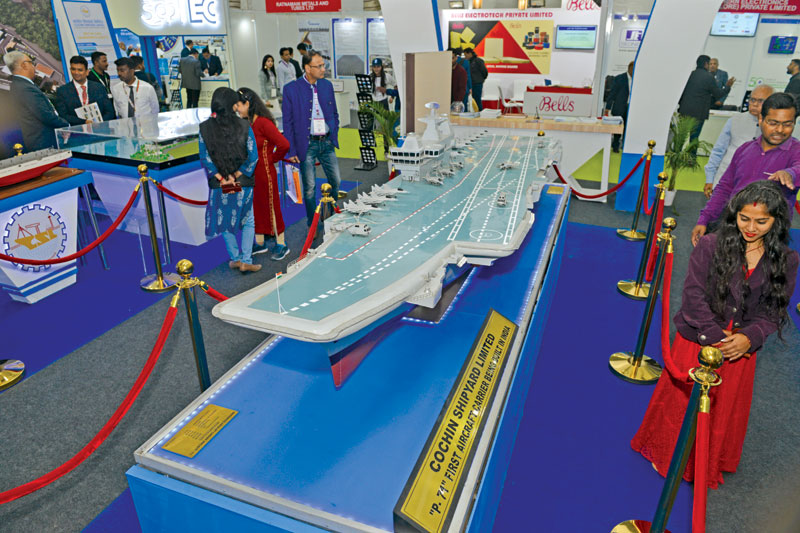
A model of Indian Aircraft Carrier (IAC) II on display at Cochin Shipyard Ltd during DefExpo 2020








 VIDEO
VIDEO