The stern-faced Chinese officer with his men in green People’s Liberation Army (PLA) uniform was the first unexpected sight the Indo-Tibetan Border Police (ITBP) party commander saw as he ascended the strategic 18,176ft Karakoram Pass. The Chinese were standing just across the border pillar that marked the boundary between India and China.
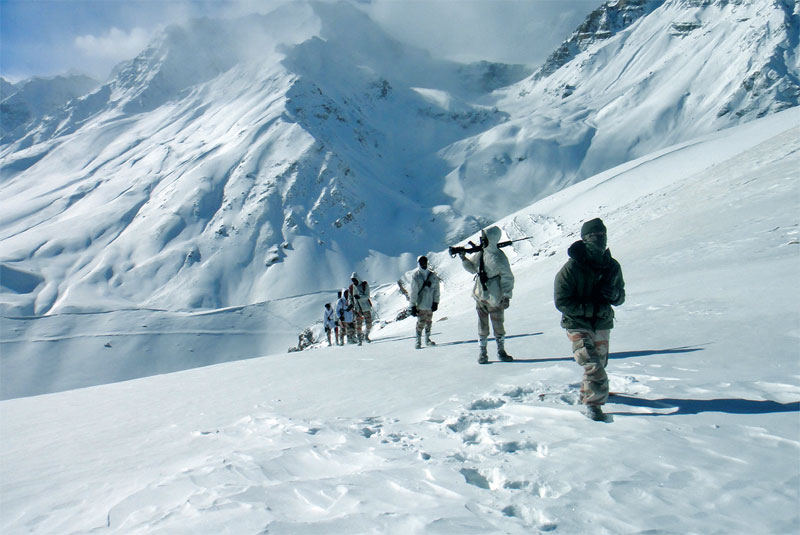
ITBP soldiers patrolling the snowy Himalayasthis
The rest of the ITBP party that was still climbing the steep slope was unaware of what awaited them, as they the full panoramic view of this situation was beyond their line of sight.
The ITBP officer slowly, without any jerky movements that could be construed as a provocation, raised his hands and said a single word, with nerves of calm steel, without displaying any emotion. Just as a matter of fact, and softly. Dushman.
ITBP soldiers, who had trained all their lives for a situation like this, were immediately deployed. A couple of them quickened their steps calmly to either side of the undulating feature. The remaining party of 14 men quickly formed an extended line on both sides of the ITBP officer. This was the part of the standard drill. The ITBP is trained for these situations. They know every rock, stone and even the grain of sand in this bone-numbing, blood-freezing high-altitude pass that can be reached after crossing the Depsang plains and moving north to this geographical feature. It is called the KK pass, that is actually a saddle between two mountains and about 148 feet wide, where icy winds slap and later numb any exposed skin of the face.
As the sky was overcast with grey clouds and the wind was howling like a banshee, the Chinese were restless. As is well known, they are unwilling conscripts, forced to serve in this harsh cold desert plateau. In contrast, it was as pleasant a weather as a routine walk in Lodi Gardens for the ITBP men, as they were hardened high-altitude troops, who served for most of their careers in these climes.







 VIDEO
VIDEO